Ovartaci: I Started as a Bird of Paradise
Ovartaci, untitled, year unknown. Gouache on canvas. Courtesy Kunstmuseum Brandts. Photo: Ole Akhøj.
Word count: 1023
Paragraphs: 12
Kunstmuseum Brandts
September 20, 2025–March 1, 2026
Odense, Denmark
Elegant women in high heels and lipstick, butterflies and dragons, life-sized dolls, and fantastical vistas all feature in the extraordinary world of Ovartaci. The self-taught artist, who spent over fifty years in a psychiatric hospital in Denmark before she died in 1985, used her art as means of transformation and escape.
Though she may not have imagined her work to be seen publicly (the doctors allowed her to make art because it kept her calm), Ovartaci’s artistic reputation has been growing lately. This is the first significant show for Ovartaci at a Danish museum, following an exhibition at Kunsthal Charlottenborg, Copenhagen, in 2017 that contextualized her in contemporary art. This March, she will even feature in Massimiliano Gioni’s New Humans: Memories of the Future exhibition at the reopened New Museum in New York.
The moniker “Ovartaci” means “chief lunatic” in Danish. Born Louis Marcussen, Ovartaci petitioned in 1958 to legally change her name. For years, Ovartaci requested to live as a woman—to wear dresses and make-up and have gender reassignment surgery—but was forced to remain in the male ward of the hospital. Her struggle is a tragic and vital part of her biography, but one complicated by the fact that later in life Ovartaci declared it to be nonsense. She wrote in a journal: “I am a man.” For this reason, there are discrepancies between male and female pronouns in Ovartaci scholarship. One might consider that Ovartaci was a schizophrenic and believed she had many past lives; she also battled the medical health care system in Denmark for so long that she was, perhaps, exhausted. At another point in her journals she noted, “I started as a bird of paradise.”

Ovartaci, untitled, year unknown. Oil on canvas, 23 × 36 ⅗ inches. Courtesy Kunstmuseum Brandts. Photo: Bent Hesby.
Crucially, Brandts does not foreground the personal story of Ovartaci—it would be easy to lean into the mythology of the tortured artist. Instead, we are immersed in Ovartaci’s wildly imaginative world. Many of the works derive from the Museum Ovartaci, which was once the Psychiatric Museum at Risskov Hospital, and the private collections of those who worked there. A cocooned gallery in the center of the exhibition conjures the modesty of Ovartaci’s room and the creative sanctuary she found there, filled with all manner of painted objects, including a collection of pipes that curator Naja Rasmussen terms “smoking phantoms.”
From the original exhibition at the Cobra Museum in Amsterdam, Rasmussen has added several works by Jean Dubuffet and Asger Jorn that situate Ovartaci within art history, aligning her with the Cobra movement and the raw style of Art Brut, coined by Dubuffet in the 1940s. Notably, Jorn met Ovartaci in person in 1952 and was dazzled by her. So much so that he offered to arrange an exhibition in Paris (which Ovartaci declined) and sent works to Dubuffet that would later become part of the Collection de l’Art Brut.
Ovartaci has also been associated with Surrealism in recent years. Cecilia Alemani included the artist in The Milk of Dreams exhibition at the 59th Venice Biennale in 2022, named for a book by Leonora Carrington, who was herself forcibly institutionalized. The curious dolls that Ovartaci made, viewed as friends and companions, and who accompanied her on bicycle rides in the local countryside, recall Hans Bellmer’s own subversive Surrealist dolls.
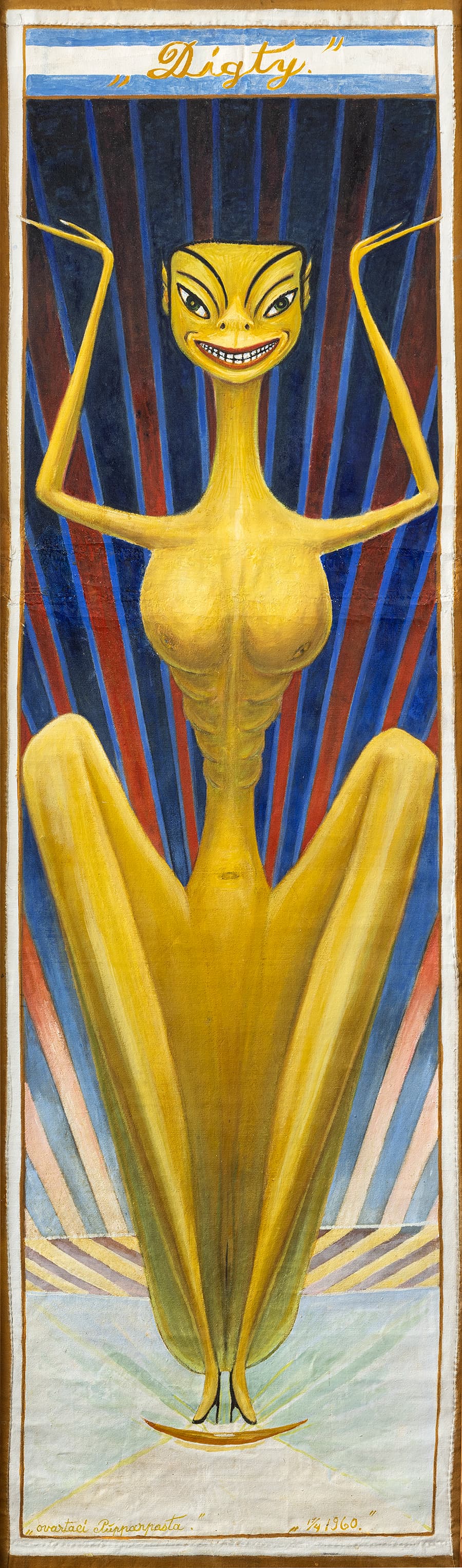
Slender women with impossibly tiny waists and legs and cat-like eyes abound. A vision of beauty, they represent Ovartaci’s idea of femininity as purity and control. One figure, though, is absent, suggested by a gouache inscribed with the phrase, “Min befrielsesdag” [my liberation day]. Significantly, Ovartaci requested gender reassignment surgery in 1951 and, after years of waiting, amputated herself in 1954. The painting, which is sadly missing from the show, commemorates this moment of self-liberation and the birth of a new identity, Miss Ovartaci. Ovartaci often played with different names in her artworks, with such signatures as Louisa Pupparpasta, Luis Gonzalez, Louis Churaberta, and more.

Ovartaci, untitled, year unknown. Oil on canvas, 65 ⅗ × 38 ⅕. Courtesy Kunstmuseum Brandts. Photo: Anders Sune Berg.
There is something timeless about Ovartaci’s world, a place in which the accessories of pharaohs, pyramids, and hieroglyphs are as natural as modern glasses and clothes. Ovartaci once said, “Yes, of course we patients have no future, only our pasts. Nevertheless, when we think ahead, we must think at least 100 years ahead in time.” As a Buddhist, Ovartaci held an ardent belief in reincarnation. Her paintings also offer a vision of life after death. In one, Ovartaci captures a past life in which she had killed a man, worked at a foundry beside other criminals, and leaps into flames to cleanse herself from sin. In another picture, painted front and back, a flurry of souls plunge through a portal. Ovartaci often painted on two sides in this way, revealing perhaps the multitude within the self as well as her desire to travel from one realm to another.
Ovartaci’s yearning for adventure and to experience other cultures manifests in the motifs of winged creatures. Birds, bats, and butterflies all represent a freedom that Ovartaci discovered through her art. In one particularly haunting painting, a winged demon hovers over the psychiatric hospital; their gossamer body is almost translucent, as if a fearsome apparition that only the artist can see. Close by, another phantom floats through the sky—a painter at their easel. Ovartaci hatched a literal plan of escape in 1973 when she made a pedal-driven helicopter. A video shows Ovartaci demonstrating the flying machine in a rare piece of footage where the artist appears in a dress and long hair.
Ovartaci’s dreamlike world and its curious inhabitants do not evolve, per say. There is no transformation from young ingénue to mature artist here. Rather, past and present lives, humans and animals, places near and far, are crystalized within her marvelous vision. Though Ovartaci expressed her disinterest in being an acclaimed artist, it seems acclaim has come knocking. It will be critical for the Museum Ovartaci to protect the legacy of this spectacular yet vulnerable artist as her reputation flourishes and her artworks journey to corners of the earth that Ovartaci herself had always dreamt of visiting.