Joy Gregory: Catching Flies with Honey
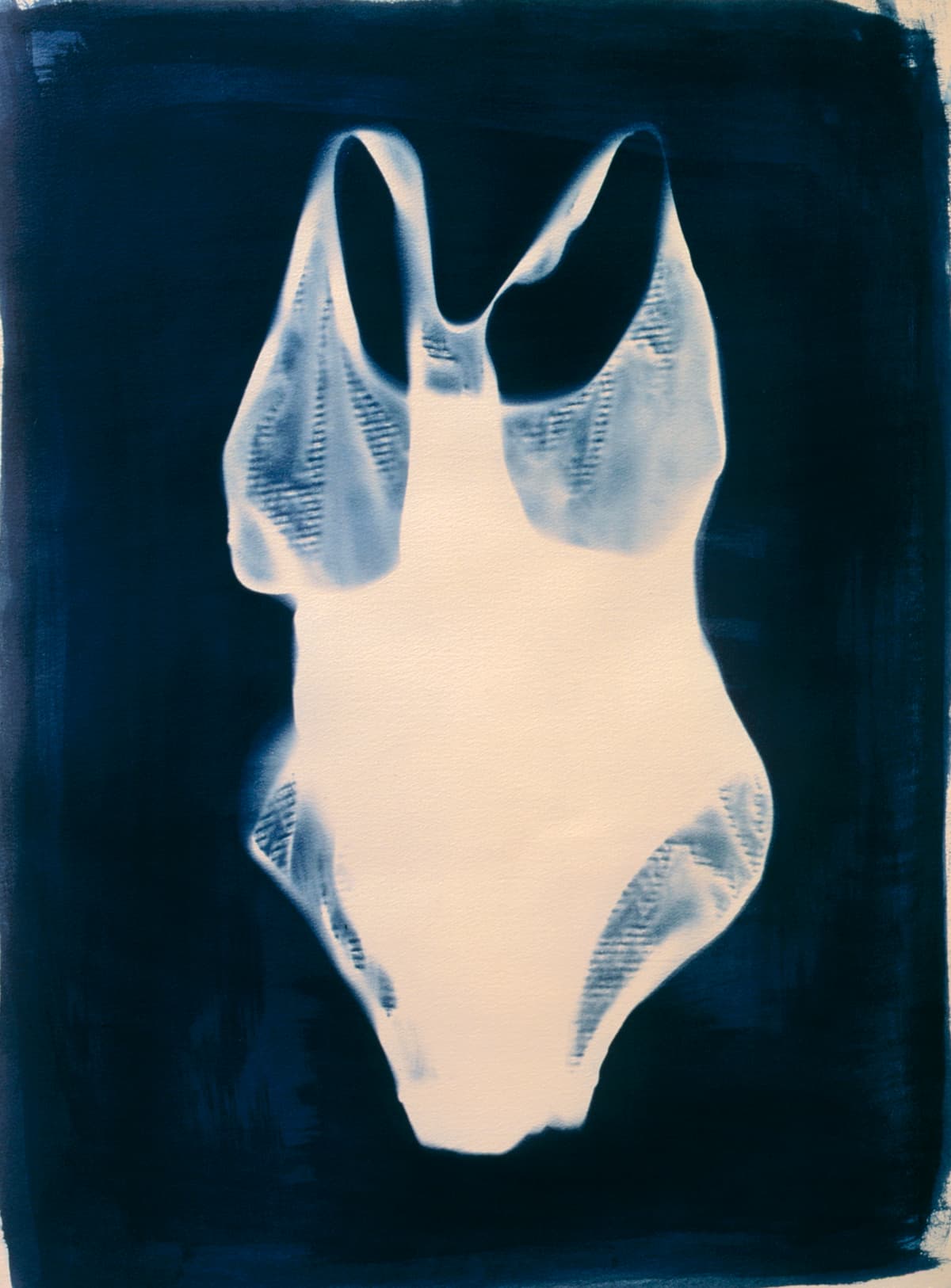
Joy Gregory, Candy Stripe Bathing Costume, from “Girl Thing,” 2002–04. Cyanotype. © Joy Gregory. Courtesy Whitechapel Gallery.
Word count: 785
Paragraphs: 9
Whitechapel Gallery
October 8, 2025–March 1, 2026
London
On entering Joy Gregory’s survey show Catching Flies with Honey, a compelling proposition awaits the viewer in the form of Salamanca (1992), a seven-foot-tall photographic portrait of the artist with her back to the camera, one hand on a metal rail, and head tilted low as if peering into a courtyard or an expanse. Simultaneously private in subject matter yet public in scale, the image reveals harmonies of geometry and monochrome that invite prolonged looking. Two qualities—seduction and authority—assert themselves, crystallizing the retrospective’s logic, intimacy, and publicity collapsed into one. That duality resonates with the exhibition’s title, a maternal maxim Gregory cites: one can act gently and still accomplish what must be done. Gregory’s own words appear top-label in the wall texts, before those of the curator’s, a reversal of the usual hierarchy privileging institution over artist.
“The Handbag Project” (1998– ) sits opposite “Girl Thing” (2002–04), one series of images mirroring the other in scale and type. Brown tones dominate “The Handbag Project” while the cyanotypes in “Girl Thing” are Prussian blue. For “The Handbag Project,” Gregory employs a salt-print process first developed by William Henry Fox Talbot in the nineteenth century, rendering the handbags spectral, x-rayed.
“Girl Thing”—eleven cyanotype swimsuits and other clothing items presented like specimens—addresses the external gaze on women, with Gregory positioning herself as one of the scrutinized. In “The Handbag Project” she assumes the role of investigator, examining luxury handbags as evidence of inequality in post-apartheid South Africa where, as she says in the accompanying wall text, women “shared the same space but were socially and politically on another planet.” The contrast of blue and brown, mineral and earthen, make a warm, pleasing display—until you realize this is part of Gregory’s gambit: the harmonious tones belie her serious politics.

Joy Gregory, Autoportrait, 1989–90. Silver gelatin lith print. © Joy Gregory. Courtesy Whitechapel Gallery.
“Objects of Beauty” (1992–95) continues the taxonomic logic: thirteen items displayed as museum specimens invite contemplation on meanings attached to tools of beautification. The tenor of the wall text leans negative (objectification) even when the series resists reductive reading. These items are instruments of self-care as well as implements of public performance, striking a distinction between looking good for oneself and for the public. Formally and conceptually, “Objects of Beauty” aligns with “Autoportrait” (1989–90) and “The Blonde” (1997–2010)—both on view elsewhere in the exhibition—in critiquing industry-set beauty standards.
Upstairs, “The Blonde” occupies its own room. On one screen plays The Fairest (1998), a video of interviews with people who are fascinated with going blonde: literally and symbolically. Gregory as interviewer is unseen; her English-accented delivery, flat, automated, clinical, uncanny as she questions her interview subject on the social labor, aspiration, and performance of appearing to be towheaded. Gregory’s clever questioning technique elicits from her interviewees idealized and personal associations that reveal why they are choosing to alter her hair color. A wall of photographs of transformed blondes, women of diverse races, are arranged in latticed grids, recalling retro film reels. Another display continues Gregory’s taxonomic proclivities: a vitrine of blond hair types, and paraphernalia, staging whiteness as labor and racialized aspiration.
Further on, Gallery III focuses on Gregory’s interest in language extinction. “Language is also a place of struggle,” insisted bell hooks in her 1989 book Talking Back: Thinking Feminist, Thinking Black, a dictum Gregory takes as a life project. In “Memory and Skin” (1998), she documents efforts to preserve Caribbean Creole and other various, Indigenous languages. In “Kalahari”(2005–10), attention turns to South Africa’s N|uu language, declared extinct in 1974 under Apartheid but later rediscovered by land‑claim activists. “Sites of Africa” (2001–06) documents London sites once resonant with African tongues. In Gomera (2009), her focus is El Silbo, the whistled language of La Gomera in Spain. If these videos are straightforward, seemingly artless, the legitimizing imperative here is to memorialize, bear witness.

Joy Gregory, Little or no breeze, 2021. Archival digital print on fine art paper. © Joy Gregory. Courtesy Whitechapel Gallery.
The final work of the show, Little or no breeze (2021), extends her acts of witnessing to historical systems of knowledge, interleaving archival texts with her own somber, performative presence. In one scene, she sits on a staircase, head in hand, suggesting lament; in another, she gazes out a window. These staged stills are subtly animated to suggest motion and are accompanied by a score reminiscent of Miles Davis’s Sketches of Spain, with expressive violin passages, tonal piano shifts, and other phrasal shifts that reinforce the work’s emotional cadence. Time and again throughout Catching Flies With Honey, Gregory wields message, material, and method to assert both seduction and authority, allure and command. She stages the private versus the public, personal versus collective. This show reaffirms Gregory as one Britain’s most inventive photographer-alchemists, a master of technique and vision.
Sabo Kpade is a critic and scholar working on Black Atlantic visual culture.