TheaterDecember/January 2025–26
NURIT CHINN & BAILEY WILLIAMS with Haruna Lee
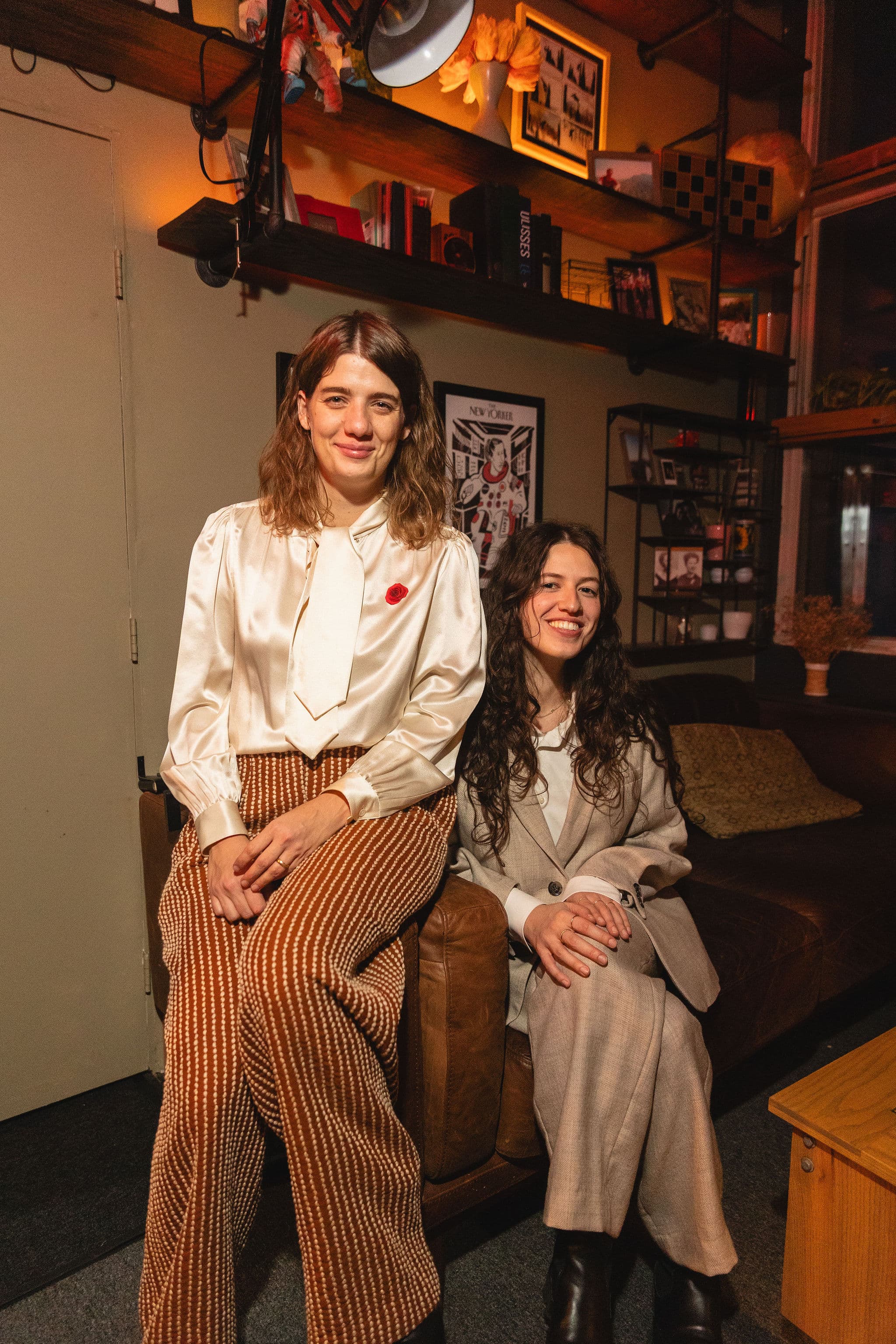
Bailey Williams and Nurit Chinn. Photo: Lee Rayment.
Word count: 1157
Paragraphs: 34
January 3–February 7, 2025
Brooklyn
On the morning of December 7, I had Nurit Chinn and Bailey Williams come to my apartment in Carroll Gardens. Over croissants and grapes, we chatted about their new leadership roles as co-directors of the Exponential Festival, now in its eleventh year and one of the few festivals remaining in New York City that showcases real experimental theater. The festival runs January 3 through February 7 at various Brooklyn venues. We had a delightfully meandering conversation about what guided these two brilliant weirdos in their curation process, the transition that this festival is going through, and what to be excited for in this year’s lineup. This talk has been shortened and edited for clarity.
Haruna Lee (Rail): I know you both separately as really incredible playwrights, and here you are coming together to run one of the premier experimental theater festivals that we have left standing. What has it been like to hold both roles of artist and producer, and how is it working with each other?
Bailey Williams: I did not know you, Nurit, prior to us being asked to come on as co-directors, which is interesting and kind of risky actually to bring on two people who do not have a preexisting relationship to lead an organization. But I think it’s been really intuitive.
Nurit Chinn: Yes. The main requirement is caring a lot. I was thinking about knowing you, Bailey, as a playwright and your work being so wild and adventurous and kind of thrilling. And something that I’ve noticed in you as a producer, which is also something that is in your work, is your meticulousness and attention.
Rail: How do you feel your artistry speaks to the festival, and what do you love about the festival?
Chinn: Something that I think works for all of us is that we’re artists.
Williams: Yeah. I really believe that artists should produce themselves at least once, if not for their whole careers, because I think it teaches you something really valuable about the way your work works. I find a lot of artistic freedom in the constraints of the stage, which I think is what it has to be about. I think Exponential really makes that an active part of the practice.
Rail: Back to the artist-led aspect. Theresa Buchheister, who founded and directed Exponential and was also Artistic Director of the Brick, and Nic Adams, who has been a part of Exponential Festival since almost the beginning—these are two knowledge bearers and history holders of this festival. So this transition here, where the four of you are together doing the baton pass, is really beautiful, but when there’s history meeting future, I think there’s gonna be an amount of chaos. I guess to that end, how do you two imagine moving the festival into the future?
Chinn: I feel like something that I’ve learned from Theresa and from Nic as we’ve been curating is that a lot of the decisions we make are practical, as opposed to aesthetic. And I think it’s really powerful to be looking at a roster of artists and be like, okay, is this show possible in the spaces we have? Is this a project that can be self-produced with the resources that we can offer and with the resources that this artist has available?
Williams: To make sure we’re not setting someone up for failure.
Chinn: And I feel like so much of the curation decision-making is unlike the theaters who are asking, what is our aesthetic? What’s the message? Who’s our audience? It’s about people who can make it work. And that’s a guiding principle.
Williams: What I also really like about this year’s lineup is that it is a real mix of “the classic Exponential artist,” which is a multidisciplinary emerging artist, and then there’s a couple of veterans that have done this for a while. And I really like having that in the same festival because I think it showcases where we are in experimental theater in Brooklyn right now.
Rail: I’m thinking about the intergenerational exchange that this creates.
Williams: There is a version of Exponential where we support fewer artists with more resources. But I don’t think that’s the point. I think the point is actually the breadth of it, because we’ve already seen what happens when seasons only support two or three playwrights. And I don’t think that’s good for the culture. I don’t think that’s good for the environment. I think our job is actually to cast a really wide net. And just see what happens.
Rail: To that end, I wonder what dreams and desires you’re seeding through this festival?
Williams: Very practical dreams. What if the stipend was larger? [Laughter]
Chinn: And getting to build a wider net of Exponential artists who continue to be part of this world, continue to feel like there’s a robust space, or infrastructure, for them to show work and grow.
Williams: When we came on in March, one of my biggest nightmares was knowing how many venues have closed in the last couple of years. And so I think one of my long-term goals is to make more venue partnerships across Brooklyn and maybe in places that felt out of reach a few years ago.
Rail: Can I ask, as an audience member, what can we be excited for with this festival?
Williams: It’s a really banger festival. I think there’s a huge breadth of people and places and performances. I don’t think there’s a theme or a coherence to the festival at all. And I’m kind of proud of that actually.
Chinn: And if themes come forward, they’re accidental.
Williams: Yeah, they’re from the subconscious of the artists.
Chinn: I’m excited about the fact that Life World begins with a one person show and ends with an eleven-person show. Or that Normandy Sherwood and Little Lord are using other parts of Target Margin Theater than the Doxsee Theater. And that Jay Stull is making his show into a potluck.
Williams: Jay’s experimenting with a different production model, which is that his play is free and you bring a dish at the end to share.
Chinn: We’re starting on January 3 and we’re going to February 7.
Williams: So we’re experimenting with the boundaries of January itself. [Laughter]
Chinn: And we’re doing a work-in-process share called SalOn! at Mercury Store.
Williams: We’re also at the Brooklyn Art Haus for the first time, with a couple of new productions: Noah Latty; Ife Olujobi and her collaborator Garrett Allen are reprising this club performance thing; and there’s this trans drag performer Aeon Andreas, who’s also doing kind of a club thing.
Chinn: So there’s chances to dance.
Rail: That is star studded!
Williams: And we have some amazing people at the Brick too, including Nurit’s play, which I’ve never seen.
Chinn: That’ll be fun.
Haruna Lee is a Taiwanese/Japanese/American theater maker, screenwriter, educator and community steward. They teach at Yale and Hunter in the MFA Playwriting Program.