A.S. Hamrah’s Algorithm of the Night and Last Week in End Times Cinema
Semiotext(e) and n+1 release two new collections of the fiery film critic’s writings.
Courtesy n+1.
Word count: 1734
Paragraphs: 14
A.S. Hamrah
n+1, 2025
A.S. Hamrah
Semiotext(e)/Active Agents, 2025
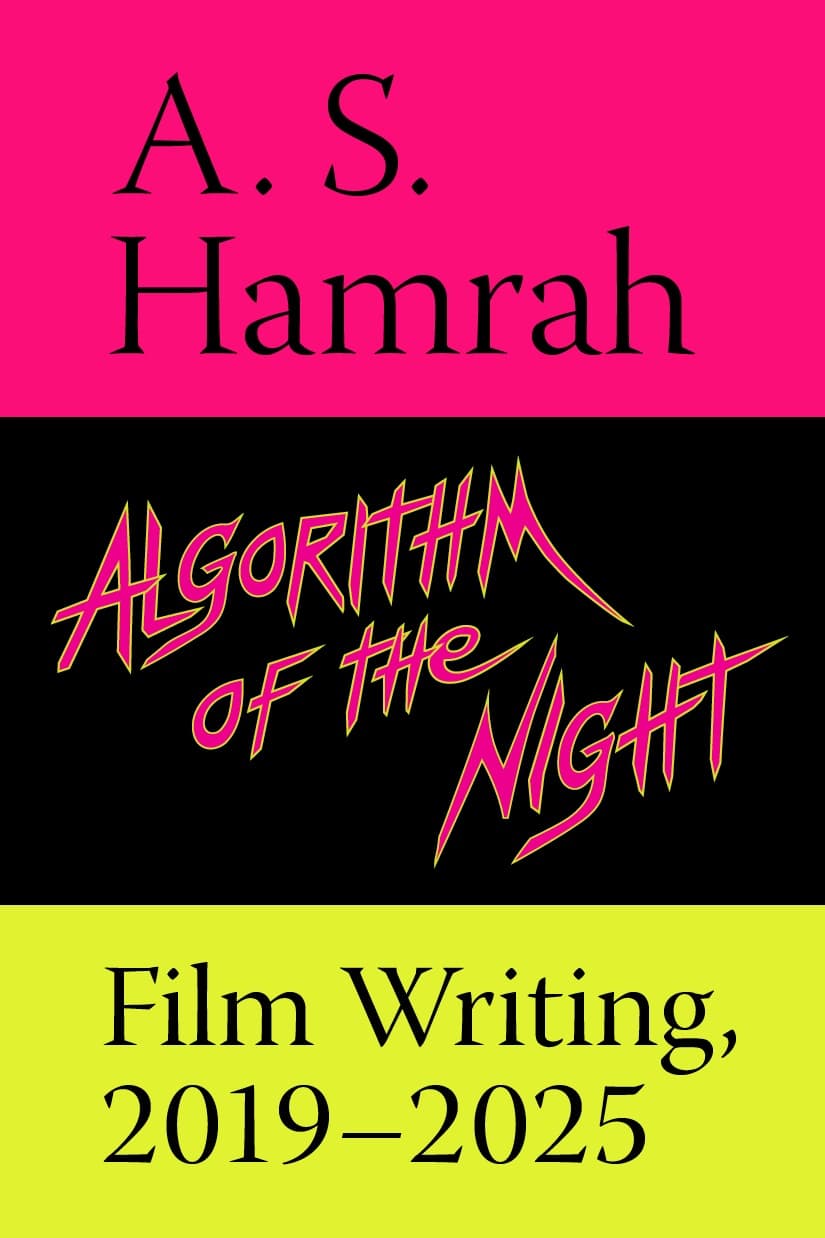
My imagination doesn’t get fired up by most professional film criticism, whether they declare the Borat sequel the best film of 2020 in the New York Times or they get chummy and smarmy to press-junket-hating directors for The Film Stage. (Letterboxd—that’s a conversation for another day.) But I’m fired up reading A.S. Hamrah. In the spirit of the great film critics Jean-Luc Godard, Manny Farber, and Jonathan Rosenbaum, he engages the reader in a real conversation, via the language-loving splay of his mind. With deadpan sobriety, he reveals just how awful the landscape of art and politics today has become. Crucially, though, Hamrah also writes without a Sontagian gloom about the decline and death of his chosen subject: film. It’s in decline whenever you read entertainment news headlines, sure, but not in Hamrah’s termite-festered, fugitive margins, which is where art and humanity will always flourish. Hamrah’s bitterness brings me hope. He knows film history, and he knows it’s being erased by multinational entertainment conglomerates hellbent on making us care for the corporate cultural detritus that they pretend is cool and original and relevant. So Hamrah does his part to resist this neocapitalist amnesia with clarity, force, and a caustic yet romantic wit worthy of Billy Wilder. As n+1’s house critic for nearly two decades, Hamrah refined a terse, unfussy voice unmistakably his own—and not, say, ChatGPT’s. Following his first collection, The Earth Dies Streaming: Film Writing, 2002–2018, Hamrah now releases two books in one month: for n+1 books, Algorithm of the Night, a collection sequel spanning the chaotic years from 2019 to 2025; and for Semiotext(e), Last Week in End Times Cinema, a tragicomic compilation of movie-related news items chronicling one year (March 2024 to March 2025) of Hollywood’s uncanny business acumen for stupidity.
One key sentence in Hamrah’s author’s bio has always struck me with its poetic eccentricity: “He has worked as a movie theater projectionist, a semiotic brand analyst in the television industry, a political pollster, a football cinematographer, and for the film director Raúl Ruiz.” I’ll read what a guy like that has to say any day of the week. He goes deeper into the semiotic brand analysis part of his life in one of the marvelously barnstorming essays in Algorithm, “Time to Face Reality.” Ostensibly a review of New Yorker TV critic Emily Nussbaum’s book on reality television, Cue the Sun!, it serves better as a declaration of principles in the context of his essential film criticism. He calls out the “Superfund site of collapsed morality” of reality TV, in far stronger and blunter terms than Pulitzer-winner Nussbaum. And he should know—after all, he worked in the whale’s belly as “a cultural analyst in an ‘omnicultural branding and insights’ consultancy where the clients were television networks,” during which time he watched “multiple episodes of nearly four hundred different reality series.” I’ll save his horror stories of that experience for you when you read Algorithm of the Night.
What haunts Hamrah, what keeps him up at night? In part, perhaps, it’s the fact that streaming services present us with lazy televisual slop and cinematic greatness as if they are on the same level. We are told that since they’re all moving images, “just harmless entertainment,” then we should stop worrying and love the balm; Hamrah always rails against such harmful ahistoric ideas. The age of streaming has encouraged the lie that what gets presented on Netflix-Amazon-Hulu is a meaningful distraction from hard times—as if distraction helps keep the harshness at bay. These content-creating factories reassure the reel-scrolling viewer that they don’t have to think too hard, that the end of a long workday earns them the right to tune out and not to feel. Hamrah’s writing denies this easy cop-out. Cinema, he argues, has force, and it finds form in the chaos of life through narratives indigestible by “monoforms.” He doesn’t treat moving images as wall décor or background noise for a risotto. COVID, he fears, deepened our acceptance of this collapse of boundaries between cinema and television—which, once you read Hamrah, is really not a trivial concern about categories, but a symbol of the larger crisis of imagination and willpower plaguing us all. A short, potent missive like “Postcard from Home” (June 2021, Algorithm) lingers on the kind of cinema that resists the relentless forward flow bred in us by 2020s capitalism. He finds, in Mike Leigh’s Peterloo, in Tsai Ming-liang’s Days, in Alice Rohrwacher’s La Chimera, in the films of Nuri Bilge Ceylan, Agnès Varda, and Abbas Kiarostami, a rebellious, scandalous pleasure, a beauty and a respect for the continuing human experiment that is “unassimilable into the regime of TV” and which “makes little narrative sense when interrupted at regular intervals.”

Courtesy Semiotext(e).
The short-form-content-complex, reified by the post-pandemic entertainment bosses who gave us The Apprentice and pulled off the advertising coup of Barbenheimer, would want us to check out of reality. Hamrah faces it squarely, as particularly evidenced in Last Week in End Times Cinema, with its impeccable cover photo of Warner Bros studio head David Zaslav as a useless and passively malevolent Hollywood stumble-bum pointing in “’Murica, fuck yeah” fashion. Per Hamrah, End Times Cinema, compiled from his weekly newsletter, is “an almanac of every bad thing that happened in the film industry” for a year: “Shrek 5 has been delayed and will now swap release dates with Minions 3.” It’s delicious and engrossing—and, in its new Gutenberg version, it shocks us to see this past year in scrolled-over phone headlines placed in such stark brutality. Here’s a particular dystopic fave: “The Miss AI beauty pageant … honors top creators of fake women with $20K worth of prizes, including $5K in cash. These male creators assert their pageant is more inclusive than problematic real beauty pageants, because they let all types of women participate, as long as they don’t exist.” Whether dealing with David Lynch’s death, or the advent of AI, or the wildfires that destroyed Altadena (where I grew up) and the Pacific Palisades, Hamrah faces the morass with a mordant gallows humor and a touching desperation: “Sing Sing is the first movie released simultaneously in theaters and prisons.” Inspired by Felix Fénéon’s Novels in Three Lines, “in which the French fin-de-siècle anarchist and art critic who ‘only aspired to silence’ wrote up violent news stories as tersely as he could,” this newsletter was a weekly highlight for anyone (like myself) who signed up for it.
Does he have blind spots? I mean, I guess. It’s funny to me that such a glorious hater of Steven Spielberg as Hamrah praised the awful West Side Story as “marvelous” and “maybe Spielberg’s second or third best movie,” though he immediately, in a move out of Manny Farber, qualifies this uncommon praise by calling it “academic” and “obvious,” likening it to “mid-century modern” and “crime jazz” à la Dave Brubeck. I think he underrates Ryusuke Hamaguchi’s Drive My Car—which he thought should’ve ended early, while I found it hypnotic all eight times I saw it at Film Forum. And he especially misreads Víctor Erice’s Close Your Eyes, criticizing it as a film that never “hums or vibrates” (it hummed for me!), that’s just about “old men whining about cinema’s decline” (by that same logic, Carl Theodor Dreyer’s Gertrud, which Close Your Eyes reminded me of, is an old woman whining about love’s decline), and that Alice Rohrwacher’s life-affirming, fresh, and devastating La Chimera is the superior film. Need we pit melancholy against exuberance? Both Erice’s and Rohrwacher’s films equally hum with life, both uncommon masterpieces released stateside in 2024.
But all this comes with the territory of being one of the sharpest and most insightful critics working today. Your tastes are yours and yours alone, and the only fidelity you have to pay is the truth you have forged out of the mass of reality before you. This, Hamrah has done for decades. And Hamrah’s reasoning, even if you don’t agree with him, is always sharp, informed, and derives from a place of profound care for the medium. I especially admire it when he takes cultural critics to task for the condescending lack of attention they pay to cinema, as in a piece near the end of the book where he extols the appearance of Cahiers du cinéma’s first issue:
When book reviewers read in Colin MacCabe’s biography of Jean-Luc Godard that Cahiers du cinéma was “the most significant cultural journal of the 20th century” they couldn’t wait to jump on him for laying it on so thick. What do they know? … Because of the tremendous impact of the Nouvelle vague, which sprang from its pages, there is visual culture (and the analysis of visual culture) before and after Cahiers du cinéma.
What do they know! I love Hamrah’s bitchy bite. He’s always contextualizing cinema, whereas others stan it as an always-and-forever given or else, especially in the literary and art worlds, ignore it at their peril.
Hamrah’s philosophy can’t be summed up in a blurb. (Though he can write a mean one-liner like no one else. He called the Reagan biopic from 2024 “the last great epic of heroic Soviet socialist realism that the movies will see.”) But a lot of his concerns coalesce in a great piece early in the book on modern consumerism and horror. Writing on John Carpenter’s They Live (1988), he writes a cultural history in miniature on the shared location of malls and movie theaters:
Cinema was already depicting the mall to eulogize mankind by mocking a form of sub-humanity that had lost itself to buying things it didn’t need. A new era of insomniac zombie shopping online is now here, and with it a new kind of consumerist horror…. This era is just as alienated, but even lonelier, having internalized consumerism through ever-smaller screens.
Good for us, then, that these two texts—which originated in the hellish world of the small screen—now reach us in book form, where they jointly tell an apocalyptic, engrossing narrative of our times. Suddenly, the chaotic present doesn’t seem so chaotic, for it has been reintegrated, thanks to critics like Hamrah, back into the unceasing sweep of an unfurling history.