Field NotesDecember/January 2025–26
The Siege of Chicago
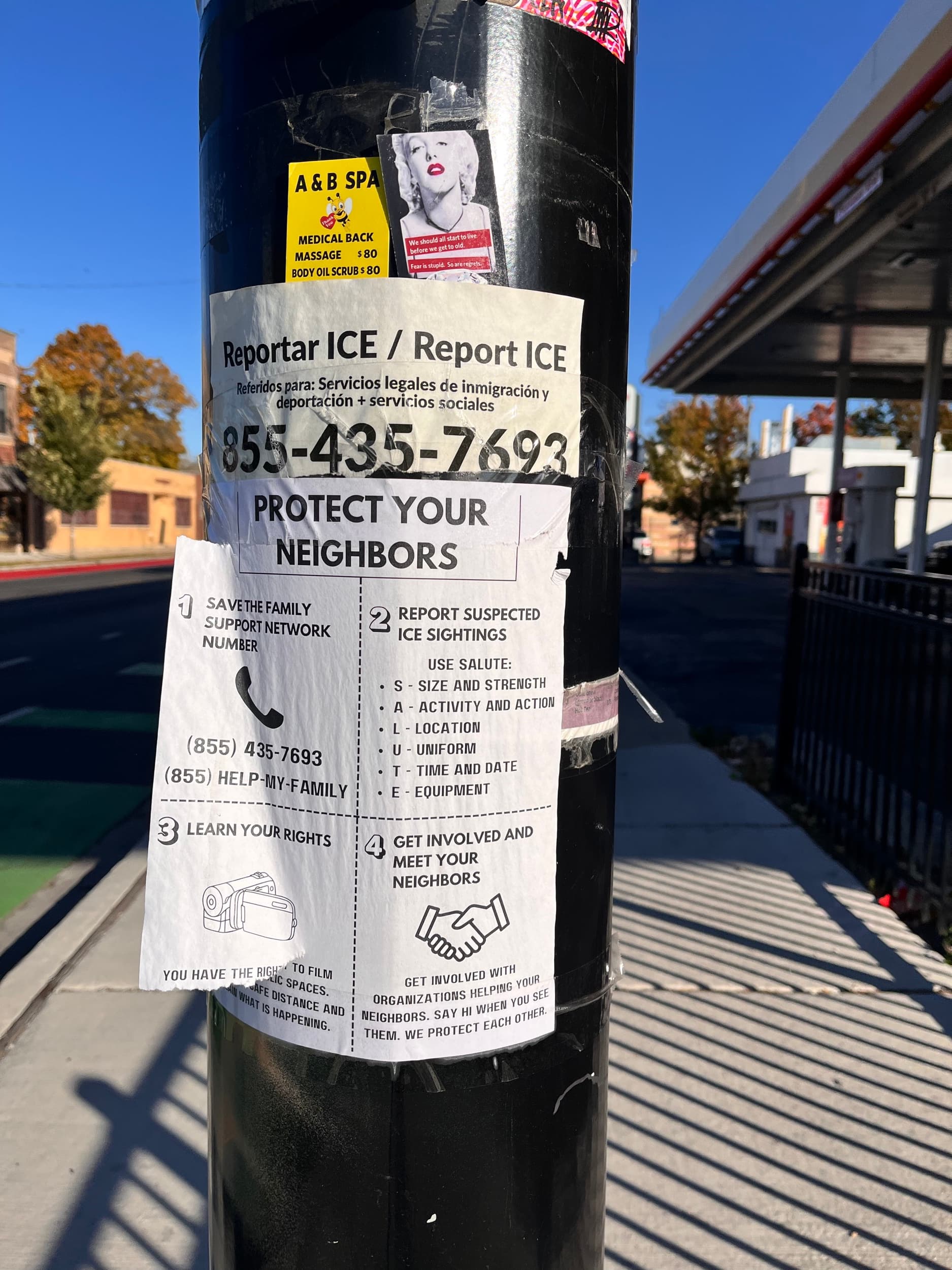
Courtesy the author.
Word count: 1711
Paragraphs: 25
I am in St. Louis for a birthday party when I watch the video about events near my home in Chicago. My hands shake. I show the clip to a relative who I thought would understand.
“Are you safe?” she asks.
“I’m not the one they’re after,” I say.
“But still,” she tells me, “maybe don’t let Bert take the city bus. Maybe think about moving.”
“MOVE WHERE?” I want to scream. I’ve lived in Chicago for twenty-five years. I want to tell her that the point isn’t whether I am safe. The point is whether safety still exists as a public good, or whether it has been privatized, fenced off, and sold as another unattainable American dream. Some lives are protected; others are controlled. I press play again and point at the screen. “Look,” I say, “LOOK. This neighborhood is predominantly white!” I want her to understand.
She nods, uneasy. “Yeah, that’s really messed up—if the video is even real.” Then she repeats, “You should think about moving.”
That is when I realize how a siege works: It isolates outrage inside of fear. It spreads misinformation. It convinces us to retreat, because if we don’t, what will we do? Rise up and start a murderous revolution?
When I return to Chicago, I have the opportunity to speak with Anna Sobor. Anna is a mutual aid worker and a sixty-four-year-old widow who has lived in the Old Irving neighborhood since 1989. “We have been fortunate here, more or less, in our last century. But this is an autocratic regime,” she tells me over the phone as she packs for a trip to Egypt. “This is different. This is the first year in thirty-six years that I didn’t hand out candy.”
This year, her new Halloween charge is ICE watch. Anna is part of a volunteer gathering organized by Alderwoman Ruth Cruz of the 30th Ward. Anna, dressed as the Great Pumpkin, with a whistle around her neck as the new style warrants, spends Halloween at one corner of a seven-block shutdown. Trick-or-treating in Old Irving is a popular event on the northwest side. This is where my daughter and her friends like to go.
“How long has it been now?” she says, and I know what she means. The measure of time has changed. It’s been two months.
On September 8, 2025, the Department of Homeland Security announced Operation Midway Blitz, a “major enforcement surge” targeting what officials described as “criminal illegal aliens.” Within days, helicopters circled above the city, and unmarked SUVs idled outside grocery stores and Home Depot locations. By week two, hundreds of our neighbors had been kidnapped and detained. A press release dated October 4, 2025, from the Illinois Governor’s Office stated: “In the coming hours, the Trump Administration intends to federalize 300 members of the Illinois National Guard.” During an interview the same week, Governor JB Pritzker noted that Texas National Guard troops were “already federalized” and arriving in Illinois. No one could explain why troops were being deployed from Texas. Is it a coincidence that many of the migrants ICE came to detain also came up from Texas three years back when Governor Greg Abbott, along with Florida Governor Ron DeSantis, freighted migrants to sanctuary cities as a political stunt? Those buses were not the end of a story but the beginning of one. What followed is a story still unfolding about a city under siege. And we don’t use that word lightly. The word has a history here.
Norman Mailer used it in his 1968 book Miami and the Siege of Chicago to describe the police crackdown during the Democratic National Convention, an earlier collision between state power and public dissent. He described the city as a battlefield for the nation’s divided conscience. Now, fifty-seven years later, that language reads less like a metaphor and more like a blueprint: how to encircle, how to stall, how to discipline civic life. What once seemed poetic or dramatic now seems predictable and template-like, because the real-world scenario maps neatly onto his literary description.
A siege doesn’t have to involve armored vehicles or walls, though Chicago is seeing those, too. It can arrive through paperwork, rumor, and fear. It can surround us before we know we are closed in. A city can be contained by fatigue more than by force. Still, neighbors share soup and wave at children they barely know. Small gestures feel defiant. Survival becomes a ritual. A ritual becomes community. Community becomes resistance.
“Kettling” usually refers to police encircling protesters and trapping them in a ring of shields. Civil liberties groups condemn it as illegal detention. In Chicago, the kettle has expanded. The city itself has become the crowd, its boundaries policed not by riot law but by migration law. In Albany Park and Irving Park, residents filmed agents pinning people to the ground, firing pepper bullets, and threatening to use tear gas. In Lincoln Square, a WGN-TV news producer was violently detained, then released without charges. At the Broadview site, a pastor was shot in the head twice with a pepper ball. A city alderwoman who tried to intervene at a hospital in Humboldt Park was violently handled, then detained, then released. In Skokie and Evanston, unmarked cars crashed into intersections, pulling over brown-skinned drivers, detaining them, then releasing them without charges—no list of names. No footage. Just fear. Detain. Release. No Charges. The effect resembles a citywide kettle: containment by intimidation. People are afraid to walk to work, to school, to the store. Parents keep children indoors. Workers are missing shifts rather than risking checkpoints. “Enforcement zones,” they’ve been called in press releases. Residents call them traps.
“I’m not backing down from this,” Anna tells me as we talk about what happened on her block. “I’m tired. I’m scared. I don’t want to live this way, but here we are.” She sighs, and I sigh. We say goodbye, and I wish her well on her trip.
Anna is part of another current moving through our city. Chicago’s mutual-aid networks, legal hotlines, and community kitchens were activated almost overnight. Churches are opening basements for families hiding from raids. Libraries host “Know Your Rights” workshops and whistle-distribution events, for parents and neighbors standing on corners before and after school, ready to blow those whistles if any ICE vehicles are seen in the area. Volunteers are filling bags with food and diapers. A sign on a wall reads: Love Is Public Safety. The phrase sounds sentimental until you see the data. In neighborhoods where aid groups deliver daily, detentions drop. People have eyes on the street, information circulates, and rumors are checked. Cooperation becomes our city’s immune response: the civic body recognizing the injury and sending care to the wound.
Power demands devotion. Devotion flows upward. But care moves laterally. That difference explains our era’s confusion: we are told safety comes from authority, when in fact it comes from solidarity.
The first Siege of Chicago ended with tear gas and televised chaos. This one prefers paperwork and plausible deniability. Yet the emotional residue is the same: distrust, exhaustion, division. In 1968, Mailer wrote that Chicago was the stage where America fought itself. In 2025, it has become the lab where federal power rehearses for the future. Policing tactics migrate outward, much like software updates: first tested on marginalized communities, then spread across a region until adopted nationally. The city that perfected redlining and predictive policing now hosts a new prototype: immigration kettling. Each iteration of these tactics teaches the state to portray fear as a means to establish a new world order.
When relatives ask if I’m safe, I no longer know how to answer. Safe from what? From whom? Safety has become private property, something you buy, move toward, fence in. Unaffordable for most. The siege turns that illusion inside out. It shows that no one is safe alone.
A friend in Albany Park texts, “We’re okay tonight. Kids asleep. Helicopter still overhead.”
Another writes, “We’re cooking for ten families tomorrow, so if you can drop something by, that would be great.”
This is what safety looks like now: fragments of care stitched together by people refusing to retreat into fear.
At night, the city hums in false calm. Miles from my home, the skyline sells its postcard beauty. But beneath it, another geography pulses: hotlines, kitchens, encrypted chats, directions on how to help, or where to go. That is Chicago’s second circulatory system, pumping blood where official arteries have failed.
By November, the morning dew is soon to be frosted. The helicopters return daily, just long enough to remind the city who owns the sky. Yet down on the ground, the numbers multiply. Volunteers drop blankets, batteries, salt, oil, and powdered milk. No one asks for papers. The moral center of Chicago has migrated into the margins. There is no press release for that. The mayor gives speeches about safety, but the people build it.
Snow will come soon. In the distance, sirens overlap with music leaking from an open window. Somewhere out there, I hear a dog bark. I listen to children laughing. The sound cuts through the hum of anxiety and hangs in the air for a moment, like a minor chord of melancholy, reminding us that the city is still alive beneath its fear.
When history records this moment, it may refer to it as another migration crisis or a law enforcement surge. From where we stand, it feels like something more enduring: the slow recognition that the public good must be rebuilt from below, again and again, by those who refuse to mistake obedience for peace. A siege is not only what power does to a city. It is what fear tries to do to our imagination. Yet our collective imagination is larger than fear’s reach. History, I realize, will not remember our rage so much as our stamina. The siege may play the music of control, but it will never find the rhythm of the ways we care for one another. Care improvises. It adapts. It refuses erasure. We will continue to show up until the kettle cools and the city remembers that safety stems from our commitment to one another.
And that, perhaps, is what keeps Chicago breathing tonight.
Amy Abeln is a Chicago-based cultural critic exploring how intimacy, power, and care shape families and cities in contemporary America.