Parable of Portals
In his self-proclaimed “obnoxious love letter to Octavia E. Butler,” d. Sabela grimes crafts a tapestry of movement that reflects themes of persistence, justice, and joy. Though disjointed, the sections of Parable of Portals are made vibrant with improvisation and immersion.
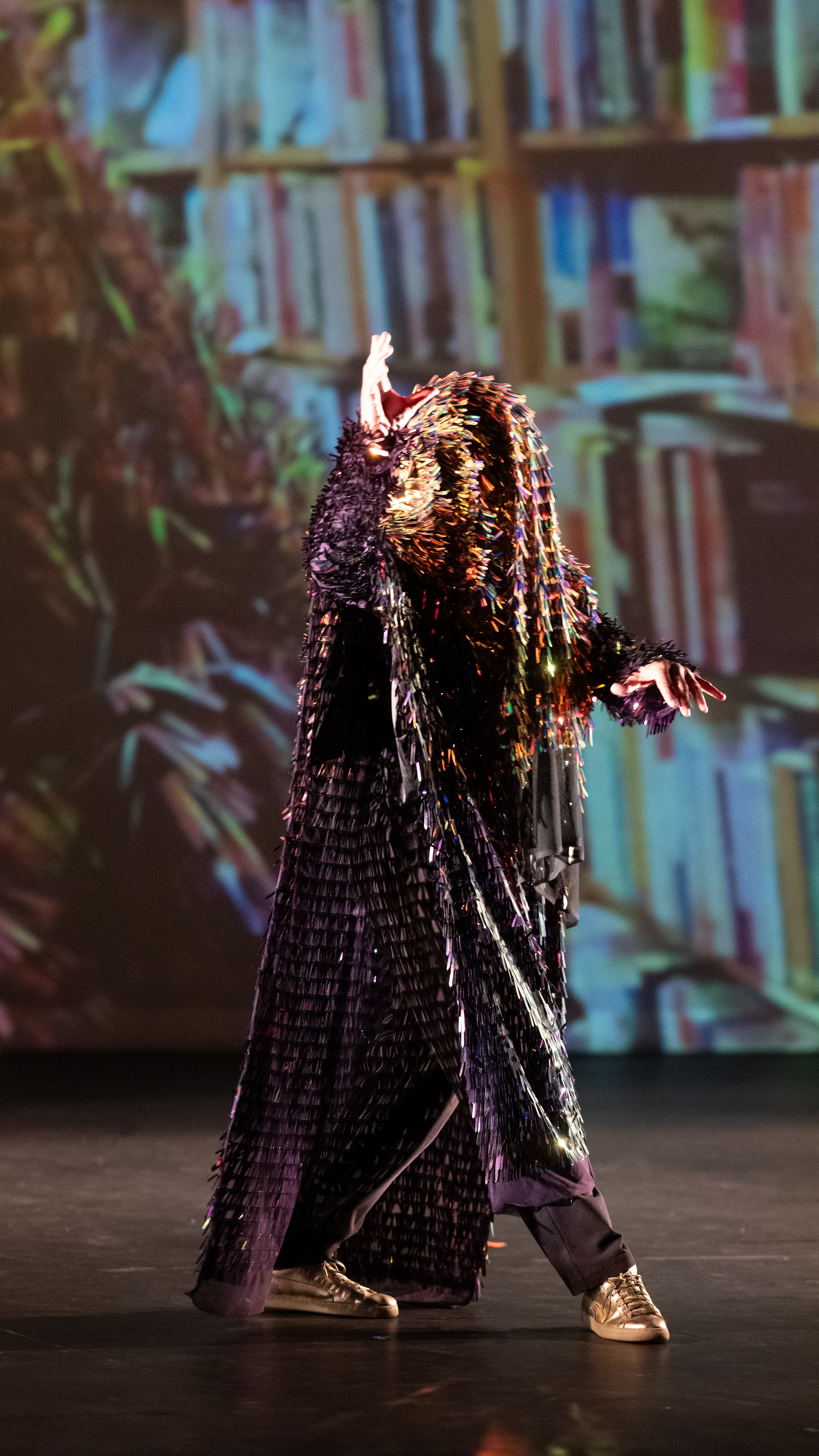
d. Sabela grimes’s Parable of Portals, CAP UCLA, 2025. Photo: Jason Williams.
Word count: 1112
Paragraphs: 11
Parable of Portals
Center for the Art of Performance UCLA
December 11, 2025
Los Angeles
In Octavia Butler’s Parable of the Sower, tragedy displaces Lauren Olamina—the protagonist—from her hometown just outside Los Angeles. Published in 1993 and set in 2024, Butler’s fictionalized world isn’t too far from today’s reality in the United States: the homeless population is growing, the community distrusts law enforcement, and an authoritarian president targets the protection of labor workers.
In Parable of the Sower, Butler writes of the struggles Olamina faces: “That’s all anybody can do right now. Live. Hold out. Survive. I don’t know whether good times are coming back again. But I know that won’t matter if we don’t survive these times.”
In d. Sabela grimes’s Parable of Portals, the LA-based choreographer transports audiences far beyond the tragedies of today. The production draws inspiration from the Parable series, which consists of Parable of the Sower and Parable of the Talents (the final installment of which Butler left unfinished before her death in 2006), as well as the author’s donated writing at the Huntington Library. Described by grimes in the program notes as “an obnoxious love letter to Octavia E. Butler,” it transforms into an expansive love letter to LA in three thematic sections: “Braiding Earthseed Invocation Portal,” “Situate Yo’Self Portal,” and “Parable of PassAge Portal.” Throughout the work, grimes nods to notable locations of Southern California through projections of cultural landmarks, including Leimert Park, and presents the body as a living oracle, with stories of Butler’s influence on the community recited live as a monologue or woven into the score. Whether the journey is smooth is debatable, but each section of the work is grounded in a palpable truth felt through the movement.

d. Sabela grimes’s Parable of Portals, CAP UCLA, 2025. Photo: Jason Williams.
Parable of Portals opens with dancers entering the space one by one from the audience, with grimes as Quantum aka Quan leading the way. The group grooves to the music with improvised house footwork, shifting weight with the beat, and expansive leg extensions and turns that naturally stitch more choreographed phrases. Leroy Olamina Butler (Brianna Mims) stumbles in with a large balloon covering her head. The imagery evokes Mims’s previous work, Jail Bed Drop, where her head is wrapped in a long fabric tethered to a jungle gym. Here, however, she is free-moving, gliding from either side of the stage while the String Theory Twins (G’bari GQ Gilliam and Shantel Urena) and the Olamina Oversouls (Janae Holster, Ambar Matos Ortiz, Andrea Rodriguez, and Leeann “GodLee” Ross) shift through energizing, rhythmic street-style phrases that oppose Mims’s slower tempo. As Mims finds her footing, the rest of the crew traverses the space in unpredictable, unified pathways that each make their way back toward Mims’s direction.
Despite the work’s hypnotizing imagery, both on stage and in the video design by Meena Murugesan, its transitions from moment to moment lack clarity. During the first section, “Braiding Earthseed Invocation Portal,” Leroy and the String Theory Twins are the primary performers on stage. They practice meditation, improvising into the next phrase with intentional steps, discovering the complexities and textures of each lift and leg extension in real-time. At times, this allows the throughline of Leroy’s journey of survival to present itself through the development of Earthseed (a religion Olamina created in Parable of the Sower with the core belief that “God is Change” to encourage conscious change), especially when the dancers work as one unit, rising together like a deep breath. Her struggle and direct action with the community takes form in the growing union of movements and characters on stage. Other times, the dancers’ dynamic and trajectory remain opaque. They oppose levels and movement qualities, creating a distraction from the story they already established with Leroy.

d. Sabela grimes’s Parable of Portals, CAP UCLA, 2025. Photo: Jason Williams.
“Situate Yo’Self Portal” is the strongest of the three sections. The main character on stage and in videos is played by grimes. In the visual projections, we see him in a tinsel from head to toe, which shimmers under the sunlight with the tiniest movement. He begins with more pedestrian steps, walking, allowing the tinsel to slowly morph with his body. Then he bounces, making the tinsel flow like water down his body, doing so around significant locations of Southern California, including Octavia’s Bookshelf in Pasadena. Meanwhile, he does the same on stage, creating a mirroring effect. At times, he matches the live swaying with that on screen. Other times, he deviates to discover something new with the tinsel underneath the stage lighting.
It’s exciting to travel through these portal sections. It’s a sink-or-swim happening through dance that reminds us we must keep going in times of struggle to find the joy that’ll sustain us. As grimes dances, he harnesses this sentiment. On the surface, the act is silly, but as the projections flip through current events, a stronger statement forms: grimes wants to continue Butler’s mission to create change. A video of him dancing with kids in Leimert Park juxtaposes scenes of protest on the news.
Traveling through the last portal, “Parable of PassAge Portal,” the show centers on the Olamina Oversouls. The crew of dancers primarily improvise with a sensual flow that combines street styles with fluid contemporary movement. Often, they isolate a limb within the newly discovered texture to guide them into a new phrase. As the dancers move, the projections behind them evolve from female figures, bordering on deities, to nature. The latter third of this work is about the ensemble, rooted in the tradition of the cypher in Black vernacular dance. There is a give and take between performers that helps create a conversation within the movement. One person’s step forward could inspire another dancer’s leap. As Orion Sun plays, the quartet ebbs across the stage before the members each flow in their own directions, sustaining the same energy despite their diverging styles that range from house to wacking.
Parable of Portals is less a performance with a concrete story and more a tapestry. Pulling from his multidisciplinary and multisensory approach to movement, grimes reflects on Butler’s impact on his work and across disciplines in the Afrofuturist genre. The work, hopping between improvisation and set steps, is playful without projecting a desire to be taken as a finished product. Change doesn’t happen overnight, as depicted in the sociopolitical parallels between Parable of the Sower and America today. There are little glimpses into the varied patches on grimes’s tapestry—each hold a different energy, construction, and texture—but all aim to pay homage to Butler’s work and message. Afterall, it is an obnoxious love letter—lined-out mistakes and creases included—that earns new marks and bends with each read.
Steven Vargas is an actor, dancer, and journalist whose work focuses on the intersections of media, social justice, and performance. He has written for the Los Angeles Times, Flaunt Magazine, USA Today, Dance Magazine, ARTnews, and other publications.