ArtSeenDecember/January 2025–26
Pegan Brooke: Into absence, MIST
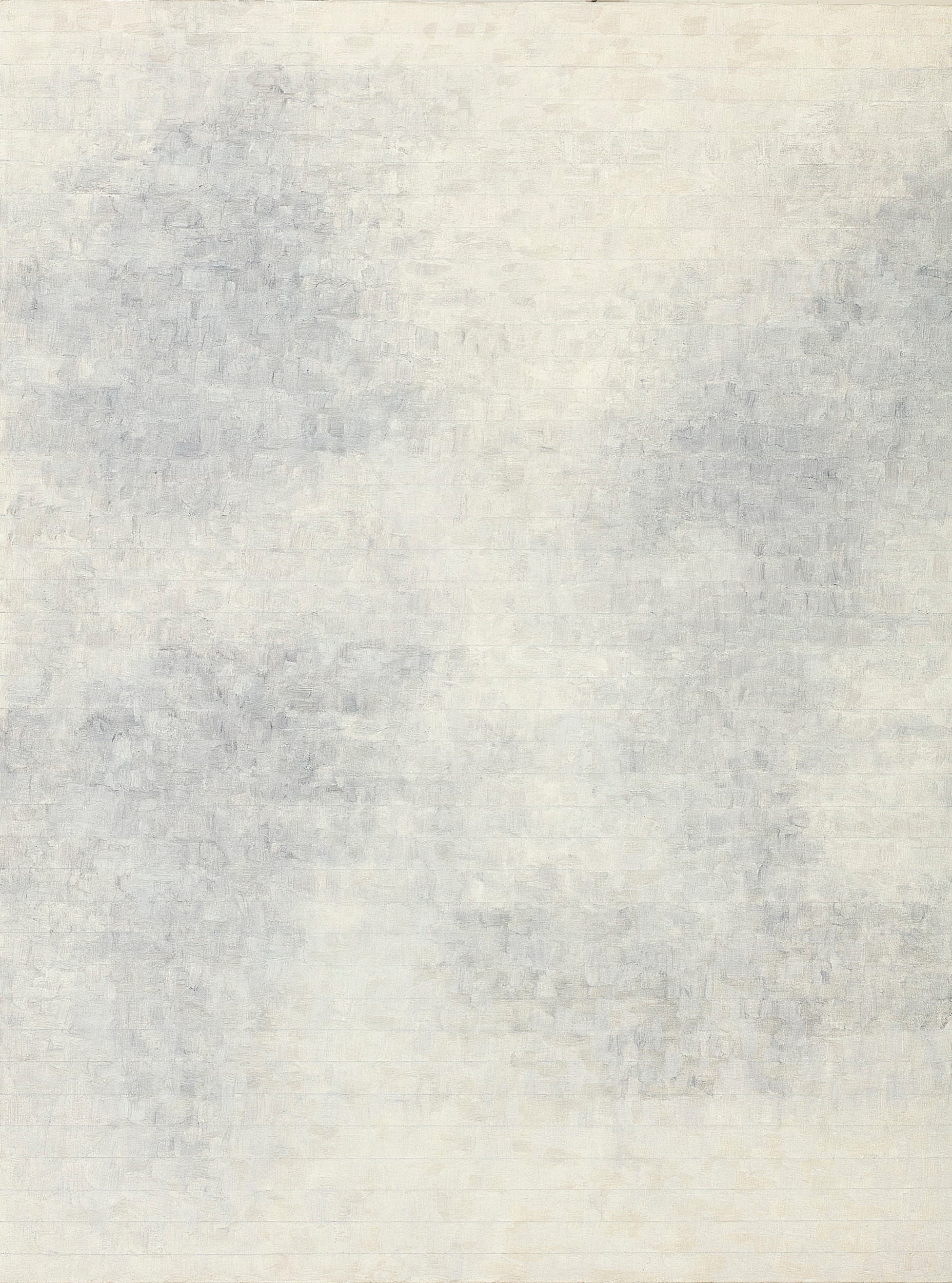
Pegan Brooke, S-378, 2024. Oil on Canvas, 40 × 30 inches. Courtesy the artist and re.riddle.
Word count: 650
Paragraphs: 6
re:riddle
October 4–December 20, 2025
San Francisco
Pegan Brooke’s new oil paintings are masterpieces of delicate evanescence, simultaneously allusive and omnipresent. That quality may not fully translate into print or screen representation, but it is inescapable when the works are viewed in person. These untitled works from 2024–25 are at once forthrightly present and mysteriously evocative, invoking moments of twilit transition with confident aplomb as they capture the complex interplay of several different kinds of light. One of these is the external kind that bathes and refracts from within cloud-like dimensional forms hovering in space, while the other is that which emanates from behind the paintings’ picture planes.
These works call to mind many things, ranging from J.M.W. Turner’s misty watercolors of the Venetian lagoon to the recent idea in theoretical physics holding that the entire universe is made up of a kind of quantum foam where virtual particles constantly fluctuate in and out of existence. Even though half of the ten paintings in this exhibition are small (three more are mid-sized), they all feel much larger and more expansive than their measurements might suggest. This has to do with the way that Brooke modulates visual distinction, which makes the forms in her paintings feel precise even though they are far from being specific. It explains how the works invite a kind of slow looking, seducing their viewers with a chorus of visual whispers that slowly bloom in the mind’s eye.

Installation view: Pegan Brooke: Into absence, MIST, re.riddle, San Francisco, 2025. Courtesy re.riddle.
Brooke’s palette is always subdued, mixing violet-tinged soft gray with greenish umber to evoke both a wintery calm and the slow fade of memory. Other areas are formed of delicately tinted pink and/or ochre to achieve a pearlescent effect, completing a range of subtly tonalized color that evokes Giorgio Morandi’s still lifes from the 1950s or Philip Guston’s abstractions from the same decade. These paintings are neither color fields nor are they any kind of traditional landscape, even though the wispy cloud forms sometimes look like a succession of fog banks moving toward the viewer. That they are something entirely other is to their credit.
All of this is conveyed via overlapping organizations of perpendicular brush strokes of differing widths and similar lengths, conjuring video track lines or dissolving pixelizations. Everything about these paintings seems to exist in a simultaneous state of dissolution and reformation, slowly respirating between those polarities. It is worth noting that Brooke uses reflective elements such as mica in her paints. She does this with a light touch that avoids ostentation, but it does exert an energizing effect that brings the wandering eye back to the surfaces. In so doing, it also underscores the most interesting aspect of Brooke’s paintings, which is the way that they transmute, subsume, and synthesize the conventional distinction that can be made between beauty and the sublime. According to Edmund Burke’s famous 1757 essay on that topic, the distinction rests on understanding beauty as being a pleasing, well-formed configuration that quintessentializes everyday experience, whereas the sublime is found in those unforgiving aspects of nature that threatens to overwhelm and destroy the viewer who confronts it. This may be too antique a distinction to be of much use to contemporary discourse but at our moment of political upheaval and dystopian technological transformation, it may also have renewed relevance. Too often, contemporary “beauty” is routinized and made mechanically formulaic, while the sublime now needs qualifiers to be properly understood. Either way, ebullience is sacrificed for theatrical flamboyance. None of this would make much sense to anyone familiar with the aesthetics of traditional Asian painting, because Burke’s brittle dichotomy does not provide any account of how those two factors can and should coexist in a single work of art. Brooke’s new paintings remind us of that possibility by acting on it, doing so with a dignified generosity that points to a better tomorrow.
Mark Van Proyen is Associate Professor of Art and Critical Thinking at the San Francisco Art Institute.