ArtSeenDecember/January 2025–26
In Practice: Coco Klockner
Word count: 860
Paragraphs: 13
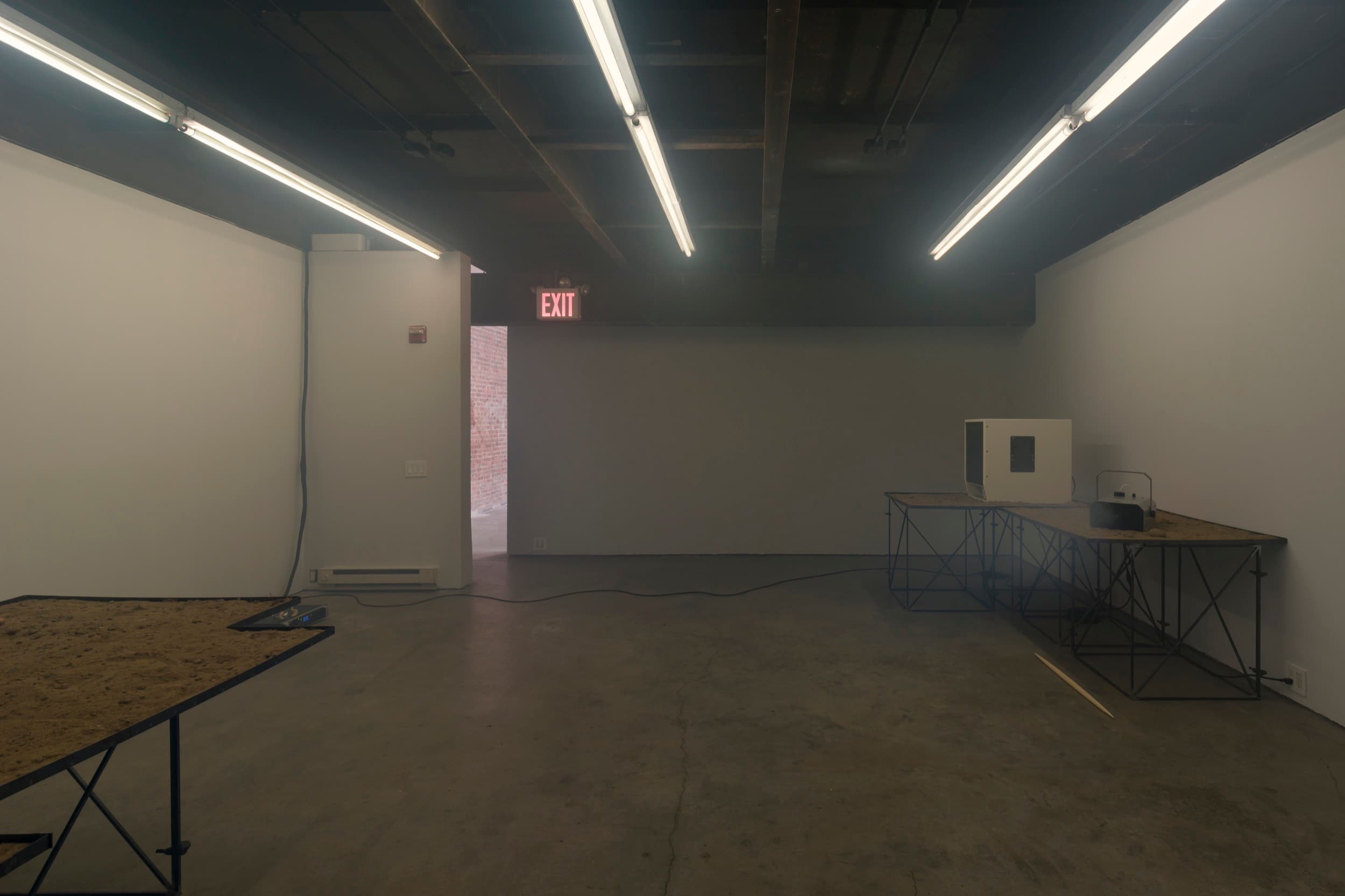
Installation view: Coco Klockner: In Practice, SculptureCenter, New York, 2025. Courtesy the artist and SculptureCenter. Photo: Charles Benton.
SculptureCenter
October 18–December 22, 2025
Long Island City, NY
A faint click overhead cues the beginning. A motion sensor has tripped, and two speakers on opposite sides of the gallery begin to murmur. Their sounds are at once thudding and difficult to place: not quite language, not quite music. The bass rolls across the room and hangs in the fog—dense enough to see, thin enough to breathe. You are inside the work, rather than before it. The speakers converse across you, their alternating hums and layered reverberations carving an invisible space between them in which you are momentarily suspended.
This is Coco Klockner’s installation at SculptureCenter, a work that uses sound not as a medium in or of itself, but as an extension of sculpture. The piece is composed of a looping dialogue played on two large speakers pushed to opposite ends of a small room. Klockner treats the speakers as sculptural bodies—objects with agency, voice, and presence. Each speaker rests in a constructed shallow vitrine filled with a kind of apocalyptic dirtscape. Electrical cords snake across the floor to a shared receiver, veins connecting these two figures in their private yet public exchange.
If at first the thudding tonalities and jolted hissing of fog evoke the disorientation of a night club, that atmosphere quickly dissolves into something more complicated. The muffled dialogue, though indecipherable, is an unmistakable rhythm of call and response, interruption and overlap. It is not music, but it has measure; not speech, but it has voice. A flashing green light signals when each speaker “speaks,” confirming the illusion of dialogue. The effect is uncanny, as though two machines are confiding in each other.
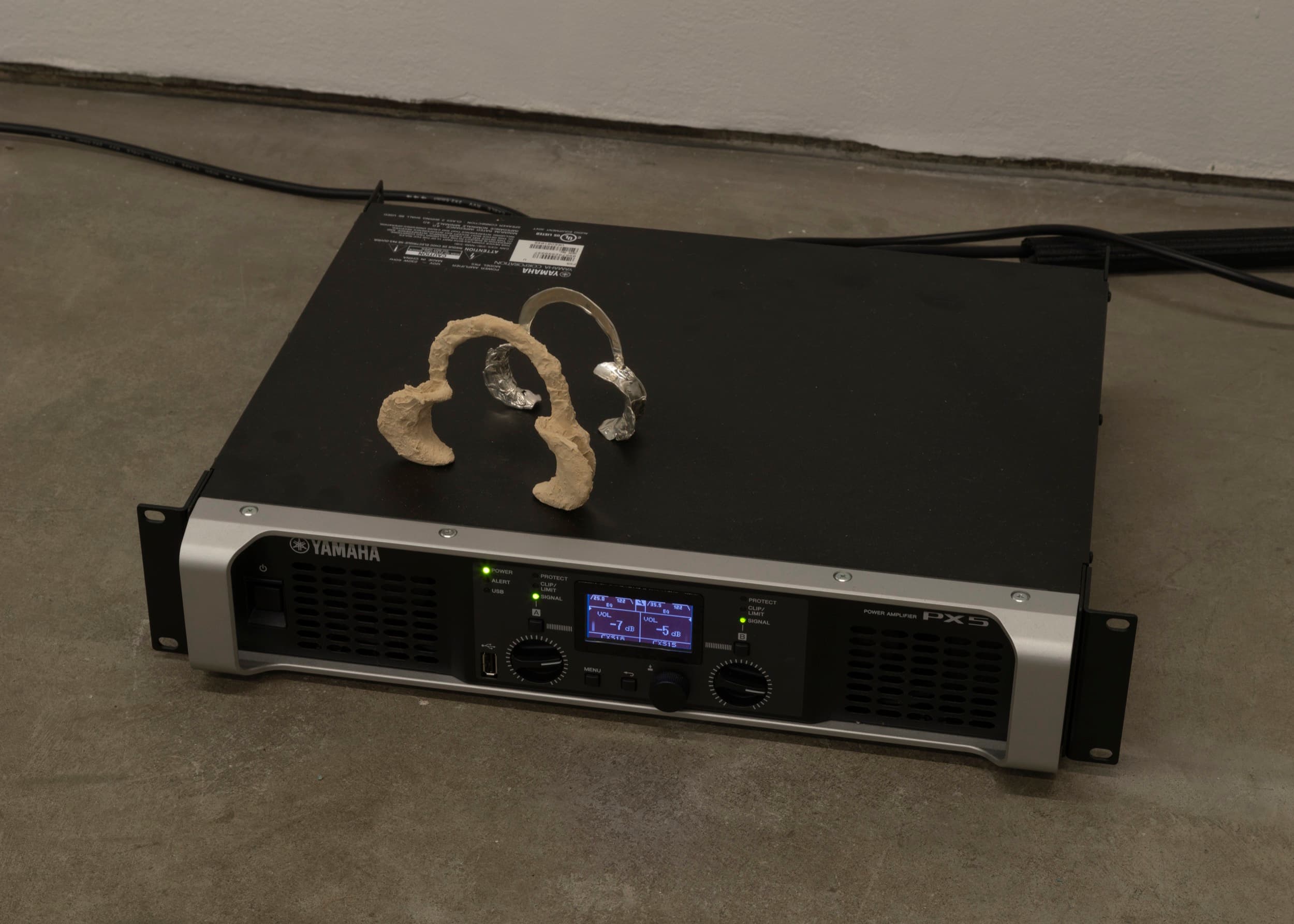
Coco Klockner, untitled, 2025. Plastic mouth retractor, wood filler, 935 silver. Dimensions variable. Courtesy the artist and SculptureCenter. Photo: Charles Benton.
In this, Klockner’s installation participates in a lineage of artworks that have sought to humanize or anthropomorphize the inanimate. Louise Bourgeois’s “Personages” from 1946–55 come to mind—totemic, freestanding forms that evoke absence through presence, bodies replaced by verticality. Felix Gonzalez-Torres’s “Untitled” (Perfect Lovers) paired clocks, or “Untitled” (March 5th) #2 (both 1991) twin light bulbs, extend the metaphor of conversation into time and illumination. Klockner’s speakers join this lineage, but with a twenty-first-century inflection: their dialogue is extracted from a real phone call, manipulated and abstracted until language gives way to vibration. The intimacy remains, stripped of comprehension.
Sculpture here is neither abstract nor representational; it is formal without being about materiality. What gives the work its tension is its in-betweenness—between object and organism, form and event, sound and structure. The experience is sculptural because it organizes space: the fog’s density, the sound waves’ reach (audible throughout other exhibitions on view at SculptureCenter), the motion-triggered temporality of activation. And yet it is performative, dependent on the viewer’s movement and the architecture’s responsiveness. The body of the spectator completes the circuit.
Klockner’s preoccupation with corporate and commodified aesthetics—familiar from earlier works—persists here, though more obliquely. The speakers could almost belong to a flagship store or a tech demo, the art object repurposing the visual codes of commercial desire. The vitrines pushed to the room’s edges, their surfaces coated with dust and rocks, read as relics of institutional display—ready-made ghosts of the biennial circuit. The effect is one of reversal: a critique of spectacle disguised as its continuation.
In this sense, Klockner’s installation is not only about sound or sculpture, but also about the contemporary condition of art’s infrastructure. The absence of seating—despite the eight-minute auditory loop—feels deliberate, mirroring the contemporary condition of an airport or corporate plaza, where even rest is monetized or prohibited. Visitors hover, listen, move on. The work enacts that tension between access, participation, and exclusion.
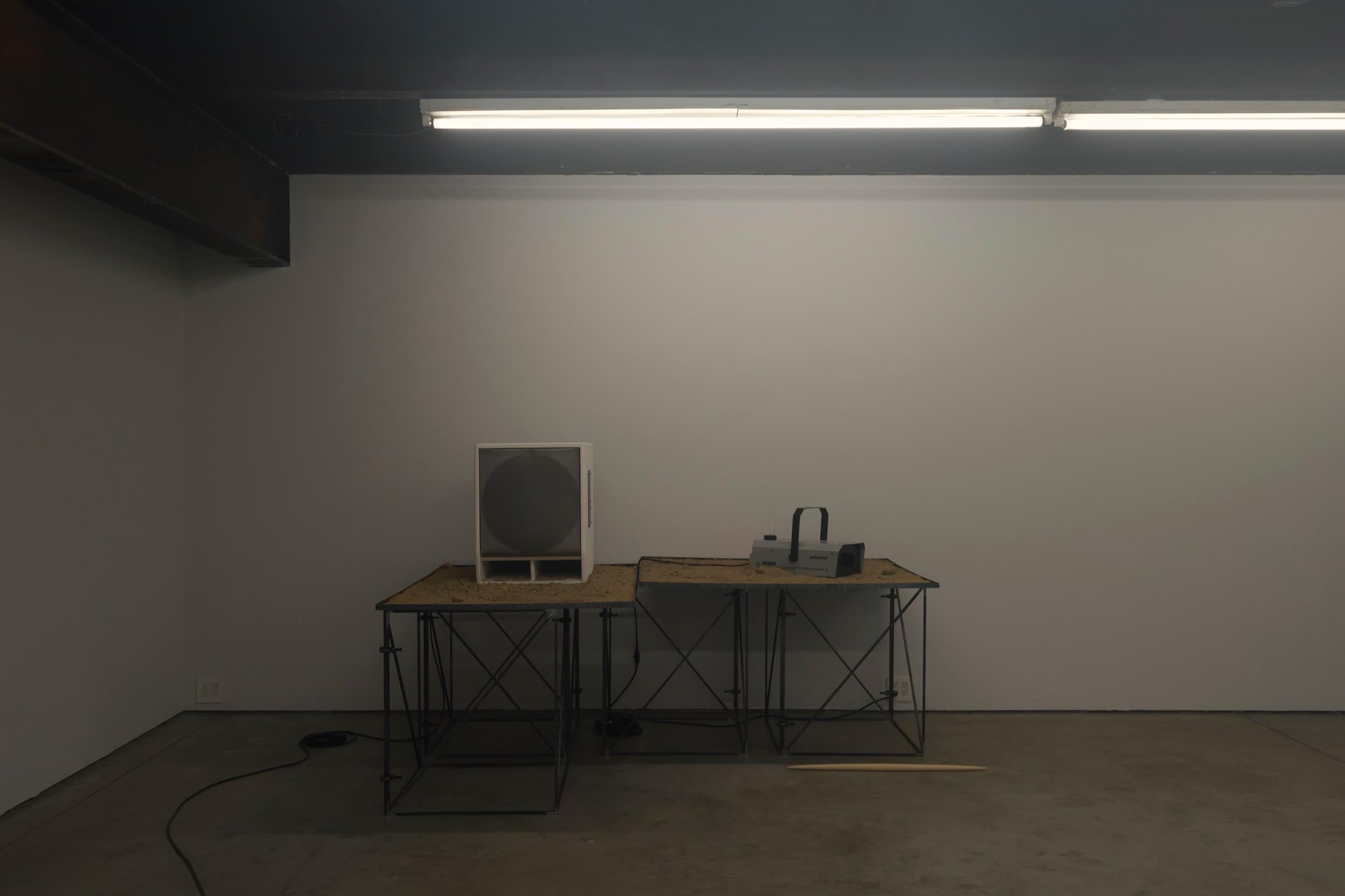
Installation view: Coco Klockner: In Practice, SculptureCenter, New York, 2025. Courtesy the artist and SculptureCenter. Photo: Charles Benton.
A parallel might be drawn to Kevin Beasley’s 2018 installation at the Whitney Museum of American Art, where a plexiglass chamber containing cotton-gin motors transformed historical violence into vibrating sound. Like Beasley, Klockner manipulates sonic force to make social structures perceptible in the body. But where Beasley’s sound carried the weight of history, Klockner’s embodies the contemporary state of structural alienation—a conversation we can feel but not understand, a dialogue without resolution.
The show’s restraint is part of its power. Klockner resists the temptation toward immersive excess that dominates much recent installation art. There is no narrative, no score—just a pair of interlocutors in the dark. The work’s materials—speaker, fog, dirt—form a vocabulary of obsolescence, suggesting a post-industrial landscape where communication has replaced contact. (Two purely sculptural interventions at floor-level contribute to the muted visual mystique.)
Standing between the two speakers, one is both inside and outside the exchange: implicated but unaddressed. The conversation seems to fold around the viewer, to use space the way language uses silence. The room hums, and the body hums back.
Klockner’s installation refuses clarity, but in that refusal it articulates something about how sculpture speaks today. No longer a monument, nor a mere object, it becomes a site of encounter—between bodies, technologies, and systems of display. The work asks what kind of conversation remains possible between art and audience when both are mediated by machinery. It is not an answer but an atmosphere, and it lingers after the speakers fall silent.