ArchitectureDecember/January 2025–26
Almost Something
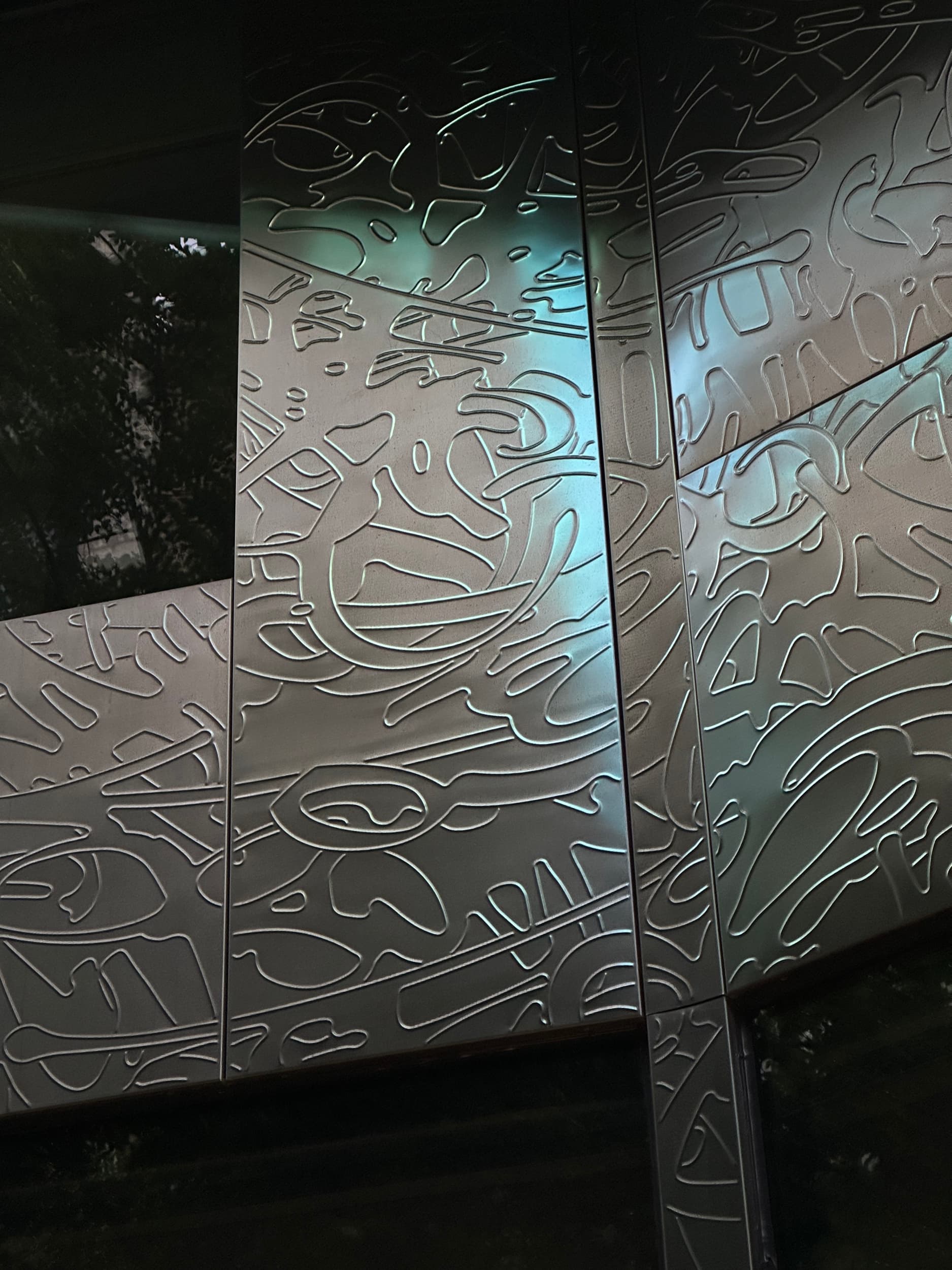
235 40 Bond Street, Herzog & de Meuron. Photo: Edgar Rodriguez.
Word count: 1274
Paragraphs: 8
I was recently walking around NoHo and stopped by Herzog & de Meuron’s apartment building on Bond Street—an undisputed icon of the early 2000s that gleams with the enthusiasm and excess proper of the architecture of its time. Today, these qualities for a new building would raise more than a few eyebrows—still, I like this building; it is eccentric, bold, and, unsurprisingly, precise. This time around, I looked very closely at the façade and noticed that the iridescent-green stainless-steel panels covering the first two floors of the building are not only embossed with the famous graffiti motif but also printed with an almost microscopic dot pattern covering the entire surface. The person I was walking with asked what I found so interesting about this building, to which I responded without much thought that the image of a building that someone has so thoroughly thought through from beginning to end gives me a unique kind of satisfaction.
On our way down to Bleecker Street station to take a train back home, we stumbled upon another building that caught our attention. This building, in contrast to the Swiss firm’s example above, is not a destination, it is the type of building one simply walks past by. An inconspicuous construction squeezed between Lafayette and Mulberry. The structure—in a few words—is an imprecise, redundant, and pragmatic aggregation of elements, materials, and graphics on a razor-sharp triangular lot. Currently, the building is occupied by a small sandwich shop called Bite in a two-story Concrete Masonry Unit (CMU) at the south end of the lot and a vacant steel and glass storefront covered in vinyl prints located towards the north. Two massive billboards overlooking Lafayette Street face the second floor of the assemblage, overshadowing and camouflaging the small building behind luxury brand advertising. This structure is not a deliberate act of architectural genius, but rather the accidental byproduct of a seemingly untraceable string of urban and economic forces continuously shaping a site, temporarily frozen in a fragile balancing act.

Bleecker St, between Lafayette and Mulberry St. Photo: Edgar Rodriguez.
My curiosity was piqued. Back at home, I dug deeper into the intriguing building and started to uncover one by one the consecutive historical events and actions that gave this tiny plot its current character. I found several blog entries on the history of the neighborhood and its transformations over time, as well as a surprising mention of the structure in a New York Times article by Christopher Gray.1 Gray offers an overview of the history of the street grid in NoHo and how, at the beginning of the 1900s, the extension of the then-called Lafayette Place southbound and the construction of the subway line underneath resulted in a series of unconventional leftover spaces along its edges, including this peculiar lot. It is also noteworthy that in maps prior to these modifications, when Lafayette Place did not cut through the blocks between Great Jones and Houston, the block which our lot was a part of was already an anomaly by New York City standards.2 Within that historical street grid, the converging alignments of Bowery and Broadway were absorbed by this block, resulting in an irregular trapezoidal shape.
On an architectural scale, the current state of the building is an aggregation of multiple programmatic apparatuses over time. In 1960, the lot was used as a four-pump gas station and repair shop, with three telephone booths shoehorned in the tip of the triangle.3 Towards the end of the twentieth century, as NoHo began to transform from the city’s Gasoline Alley into the case-study gentrified neighborhood it is today, the multiple gasoline stations and repair shops in the neighborhood were replaced with retail storefronts. In 1994, a single-story steel and glass retail space was built on the site.4 Bite opened its first restaurant there in 2002, joined by Sparky’s All-American Food in November of 2005, which was superseded by Pinche Taqueria just three years later.5 With these businesses, awnings were attached to the structure, and the two billboards were installed at some point between 1998 and 2007.6 The resulting assembly is absurd, redundant, and disordered—but also strangely captivating.
This anonymous building provides a sound background against which to read Entramados Materiales.7 Like our case study, the installation produced by the architecture practice salazarsequeromedina for this year’s Architectural League Prize exhibition resists an easy description.8 Both structures evade the formal clarity or symbolic content necessary to convey specificity—they comfortably retreat one step short, inhabiting a state of almost somethingness. If the wedge building in NoHo is a causal object formed by the city’s infrastructural, economic, and regulatory forces, then Entramados Materiales is its speculative twin: an idiosyncratic simulacrum portraying contingency, redundancy, and misalignment as a formal language. Installed across three identical, white-walled cubicles at Pratt Institute’s MFA studios in Brooklyn, the piece consists of three structures built from a combination of off-the-shelf materials and bespoke elements arranged in three—intentionally ambiguously labeled—archetypes: Shelf/Tower, Table/Canopy, and Bench/Bridge. These assemblages combine drywall steel studs, clamps, aluminum profiles, live-edge wood slabs, and galvanized HVAC fittings, along with small elements designed and built by the architects, in three uneasy compositions that lack a singular dominant form, logic, or identifiable gesture. Yet, some of these elements and the relationships between them suggest familiar architectural elements, such as ramps, awnings, columns, slabs, roofs, or guardrails—but never quite stabilize into recognition. As such, the installation can be considered a study on insufficiency—a refusal to resolve into legibility.

235 40 Bond Street, Herzog & de Meuron. Photo: Edgar Rodriguez.
My goal here is to offer the notion of Almost Something as a lens through which to reconsider both Entramados Materiales and buildings like the one at the corner of Lafayette and Mulberry. Fundamentally, these structures resist completion, occupying a space between being and not being. They recall Giorgio Agamben’s ideas on potentiality—by not only having the ability to become something but also the capacity to remain unactualized. In that suspension, architectural form is held open, refusing finality and, from a Heideggerian perspective, existing in time through its entanglements with the world around it. This understanding shifts architecture away from the static, autonomous object and toward being-in-the-world, where meaning and definition emerge through context and perception, thus challenging the conventional authorial relationship between the architect and their work. On a more prosaic level, Almost Something allows us to reevaluate what might otherwise appear as automatic, unintentional, or banal. It invites us to see makeshift or mundane structures—those often overlooked by the discipline—as conceptually rich, not as resolved forms, but as lingering possibilities.
For a young practice whose previous work is characterized by formal rigor, legibility, and precision, Entramados Materiales signals an exciting and meaningful shift. Where salazarsequeromedina usually works through clear and definitive formal strategies, this installation embraces indeterminacy and hesitation. It relinquishes control in favor of something less ordered, more open, more poetic. In doing so, it quietly resists architecture’s long-standing tradition to be read—whether through classical form, a modernist diagram, or even graffiti—and instead offers a phenomenon that is content with being noticed, potentially misread, and hopefully revisited. Just like the odd wedge in NoHo, Entramados Materiales stands as a record of accumulated decisions, constraints, and improvisations. However, unlike the wedge, it does so knowingly, performing its ontological ambiguity as a proposition for reconsidering architecture. To disregard structures that are almost something as simply “unfinished” would be to miss the point entirely. Almost Something is not awaiting completion but intentionally remains in progress, occupying the moment just before resolution. Structures built and evaluated from this vantage point stand in opposition to architectures of total clarity—where every millimeter has been considered, and every detail asserts control—affirming instead their architectural value by remaining fragile, strange, and full of possibility.
- When Gray’s article was published, Bite was on the opposite end of the structure to where it is now, occupying the glass storefront that is currently vacant. See Christopher Gray, “Along Lafayette Street, Some Very Odd Lots,” New York Times, June 17, 2010.
- “Part of Wards 8, 10, 14, 15 & 17, New York City” G.W. Bromley and Co., Philadelphia, 1891.
- R1S2_3027C135, 1960. “Subway Construction Photograph Collection,” New York Transit Museum, https://nytransitmuseum.catalogaccess.com/photos/177154?search=lafayette+and+bleecker&includedFields=Objects%2CPhotos%2CLibrary%2CArchives%2CPeople&page=2&size=50&withImages=false.
- A photo from 1998 shows the glass addition without any awnings or billboards. Looking South on Lafayette Street from Great Jones Street, incl. the Puck Building, 1998. “Carole Teller's Changing New York, Part 5,” Village Preservation.
- Peter Meehan, “A Late-Night Reveler’s Best Friend,” New York Times, December 28, 2005.
- Jennifer Bleyer, “Billboard Blues,” New York Times, March 25, 2007.
- Entramados Materiales translates imperfectly to English as “Material Frameworks.”
- “Salazarsequeromedina: Entramados Materiales,” the Architectural League of New York, June 11, 2025, archleague.org/article/salazarsequeromedina-entramados-materiales-league-prize/.
Edgar Rodriguez is a contributor to the Brooklyn Rail and runs the office operadora in Syracuse and Mexico City.