Horror Arias
Word count: 1450
Paragraphs: 18
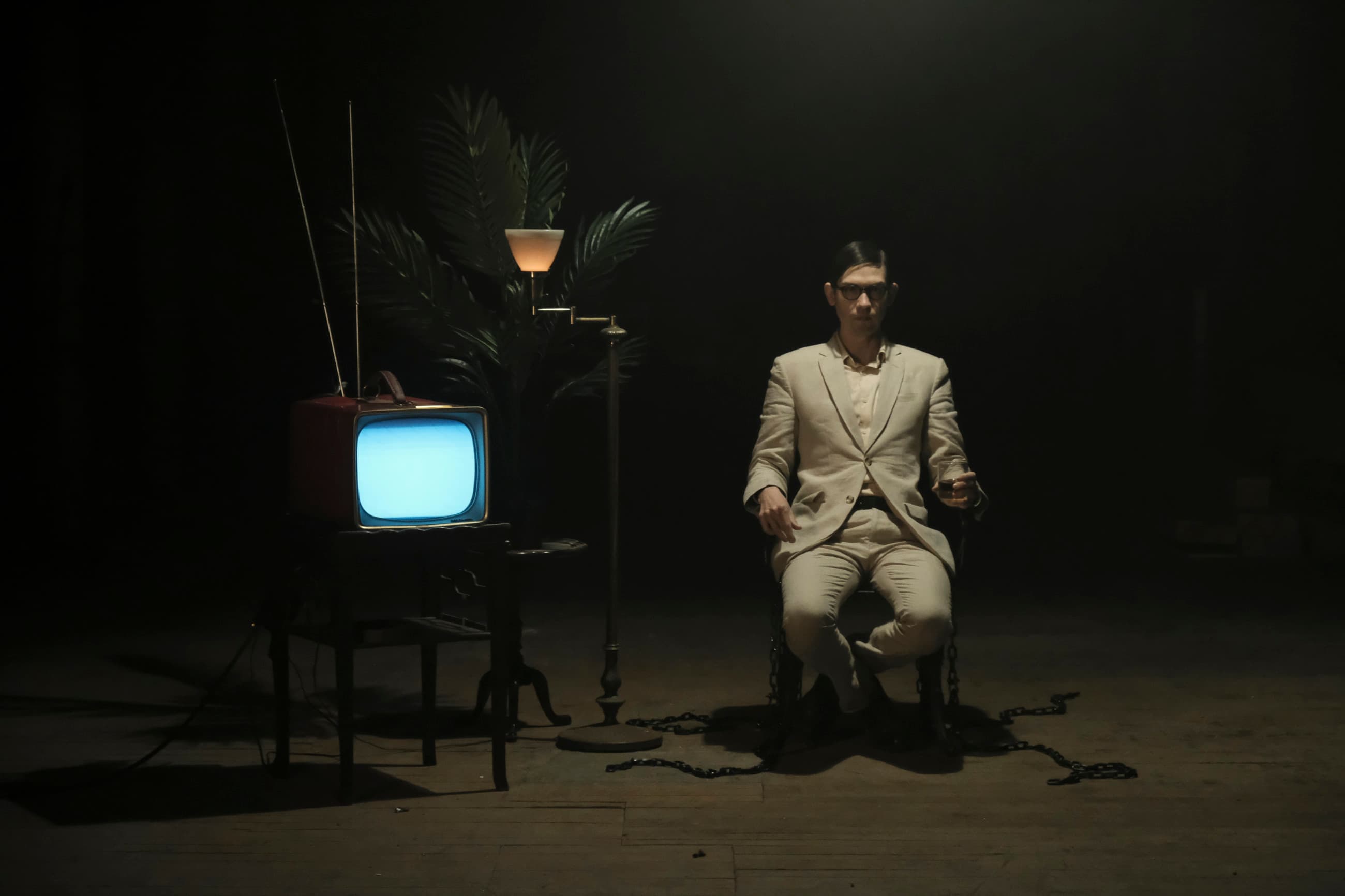
Timur in Black Lodge. Photo: Matt Soltesz.
Opera and horror thrive on excess. Both often take contemporary topics and process them through a theatrical lens, producing works that are exaggerated, sometimes even to the point of camp. As someone with a strange devotion to both, I’m fascinated by the ways in which they overlap. Whether it’s an opera or a horror film, audiences go in expecting catharsis (or at least that’s what the psychoanalysts tell us). The same impulse that drives someone to see Nightmare on Elm Street for its purgative scares and gore also draws someone to sit through four hours of Tristan und Isolde just for the emotional release of its final harmonic resolution. As both genres evolve, they increasingly borrow from one another, blurring the boundaries of form.
This overlap traces back to the very birth of modern horror: World War I. The conflict that permanently altered how society imagines war, death, and the human body naturally left its mark across the arts. T. S. Eliot wrote The Waste Land; Otto Dix painted his searing series “Der Krieg”; and in the world of opera, Alban Berg composed the shocking Wozzeck.
Horror is embedded in the material of Wozzeck, making it uniquely stageable as a horror opera. The story itself is one of insanity, trauma, and death, and the music compliments this with its atonal romantic lyricism. William Kentridge’s 2019 Met Opera production embraced this fully, presenting a desolate, fractured world that mirrors the inner breakdown of the main character, Wozzek. Kentridge filled the backdrop with his signature grainy charcoal drawings, layered with stop-motion projections that evoke nightmares of shelling, crashing planes, spectral children, and fragmented memories.
In addition to the backdrop, Kentridge had silent stage actors add to this horrifying atmosphere. During the orchestral interludes, performers dragged themselves across the stage on crutches, faces obscured by gas masks, moving in an unnatural way, heightening the sense of grotesquerie. One of the most disturbing choices in Kentridge’s staging is the replacement of Wozzeck’s child with a puppet. After Wozzeck kills his wife and then himself, the stage is left with only a wooden puppet, bouncing eerily as a boy’s voice sings “hop hop, hop hop” offstage.
The opera’s ending is already devastating, but in this version it becomes eerier. Dolls—or puppets—meanwhile have become symbols of horror in pop culture. Think of Anabelle or Chucky; those animated killer dolls that have inspired nightmares. But the puppet in Wozzeck does the opposite. It underscores the absence of human life, amplifying the horror. As Mark Fisher explains in The Weird and the Eerie, something becomes eerie when it is defined by absence. In Kentridge’s Wozzeck, that absence of human presence makes the production uncanny, unsettling, and undeniably horrific.
While this approach works particularly well for Wozzeck, given that it is already a horror opera, the same cannot be said for other works. The Royal Opera House has, at times, marketed standard pre-World War I repertoire as “horror” or at least “spooky” in an effort to sell more tickets. Verdi’s Macbeth was a natural candidate: Banquo’s ghost and Lady Macbeth’s visions of blood certainly lend themselves to the grotesque. Phyllida Lloyd’s 2002 production leaned into this, using effects one might expect in a horror film. The Witches’ Chorus, for example, is staged with fog, dramatic lighting, and women dressed in black and red while chanting. Blood is also a common motif throughout the production.
Yet despite these choices, the production never truly feels like horror. The effects are striking, but the story itself does not sustain the genre, nor does Verdi’s music. Horror in opera cannot be manufactured solely through staging; it needs to be embedded in the score. Twentieth-century music is often more successful in this respect, as its often fractured harmonic language and dissonance naturally unsettles the listener. It’s no coincidence, after all, that Kubrick turned to Ligeti’s Lontano and Bartok’s Music for Strings, Percussion, and Celesta for The Shining. Verdi’s music, by contrast, with its lyrical and direct nature, rarely inspires fear in the listener.
There are also cases where the story and music are horrific, but the production does not embrace this, causing the work to fall short. The dark fairytale of Bluebeard, when paired with Bartók’s evocative music, is rife for horror, but when a production sidesteps these aspects, it collapses. This can be seen in the filmed version of Bluebeard’s Castle from 1981. Directed by Miklós Szinetár, and featuring big names like conductor Georg Solti and the London Philharmonic Orchestra, the production feels more like a B-movie.
The staging seems to draw inspiration from early German Expressionist films such as The Cabinet of Dr. Caligari and Nosferatu, but lacks the overt horror elements that would make it a true successor. As Bluebeard shows his wife, Judith, each room, she encounters images of blood and torture. There is so much potential in this scene to use horrifying images—that are in fact only possible through the medium of film—but here they are represented only by a weak red light and some red paint. When Bluebeard’s past wives are revealed, they are shown in metallic headdresses and gowns with long trails. The backdrop looks like a sci-fi movie with neon lights and large grey blocks all around. The moment feels more like a scene from Star Wars than a descent into horror.
Many staged productions used similar elements, like lighting to represent the character of each room; Judith will open a door and a stream of light will come through. This is effective, but only when used on stage. One of the benefits of filming an opera is the director can play with the unique medium to showcase the work in a different light. Szinetár could have easily filmed the opera as a horror film, but instead chose to recreate a staged production for film.
The film was clearly low-budget, but that does not mean it was doomed to fail. In fact, many classic horror films were made on shoestring budgets, like Carnival of Souls, Night of the Living Dead, Eraserhead and The Blair Witch Project. The reason it failed is the lack of genre direction. Had Szinetár leaned more fully into the horror elements of the opera, the production may have worked much better.
This is not to say that opera has not embraced the horror film. While the story and score of canonical works cannot be rewritten, new operas can—and many already do—draw directly from the genre. Much of David T. Little’s work, for example, is steeped in horror-film aesthetics to the point of merging the two forms. His opera-film Black Lodge—a filmed industrial rock-opera—employs both “active” horror (jump scares, flashing lights, unsettling costumes) and “passive” horror (atmospheric choices such as camera angles and surreal backdrops).
The opera follows an unnamed man who moves through the Bardo, reckoning with his past and the guilt bound to it. Drawing inspiration from figures like David Lynch and William S. Burroughs, Black Lodge resists logic and instead rewards surrender to its dreamlike, nightmarish progression. It synthesizes every element discussed above; horror is present in the plot, the design, the music, and even the medium itself. It even begins, quite literally, with a jump scare.
The music evokes horror as it oscillates between heavy metal, abrasive textures, and quiet, spectral passages. The unnamed protagonist—the sole singer—has a vocal range to match this sound world. At times he sings in a high falsetto; at others, he drops into a low metallic tone reminiscent of sprechgesang.
After the initial jump scare, the camera pans slowly through an abandoned warehouse until it reveals the unnamed man on a swing, gliding back and forth. Next to him is a static TV, which becomes a recurring motif throughout the film (evoking memories of Poltergeist and Oculus). This scene establishes the atmosphere with its eerie mise-en-scène accompanied by a string quartet playing loud, dissonant chords.
Other horror elements can be found throughout the film: body horror, as a double of the unnamed man cuts off his fingers one by one with shears; grotesque costuming, as instrumentalists appear in the desert with black gaping mouths and eyes rolled back, reminiscent of Art the Clown in Terrifier; and camerawork, with multiple slow pans that build a creeping sense of dread.
Ultimately, horror in opera is most effective when it runs through every level of the piece, its story, music, and staging. Production design can nod to horror, but for it to truly work, horror has to be in the opera’s DNA. In a world increasingly desensitized, horror offers a solution to consistently purge and provoke audiences. This honors the original opera, while also modernizing the genre, pushing it forward in a necessary way.
Sydney Minor is a New York-born, UK-based arts writer and musician. She is currently an MPhil candidate in Musicology at the University of Cambridge.