Keeping Time
Emma Fiona Jones reports from ms. z tye’s multimedia performance at OCDChinatown and delves into themes of time, viewership, and queer possibility.
Word count: 1085
Paragraphs: 22
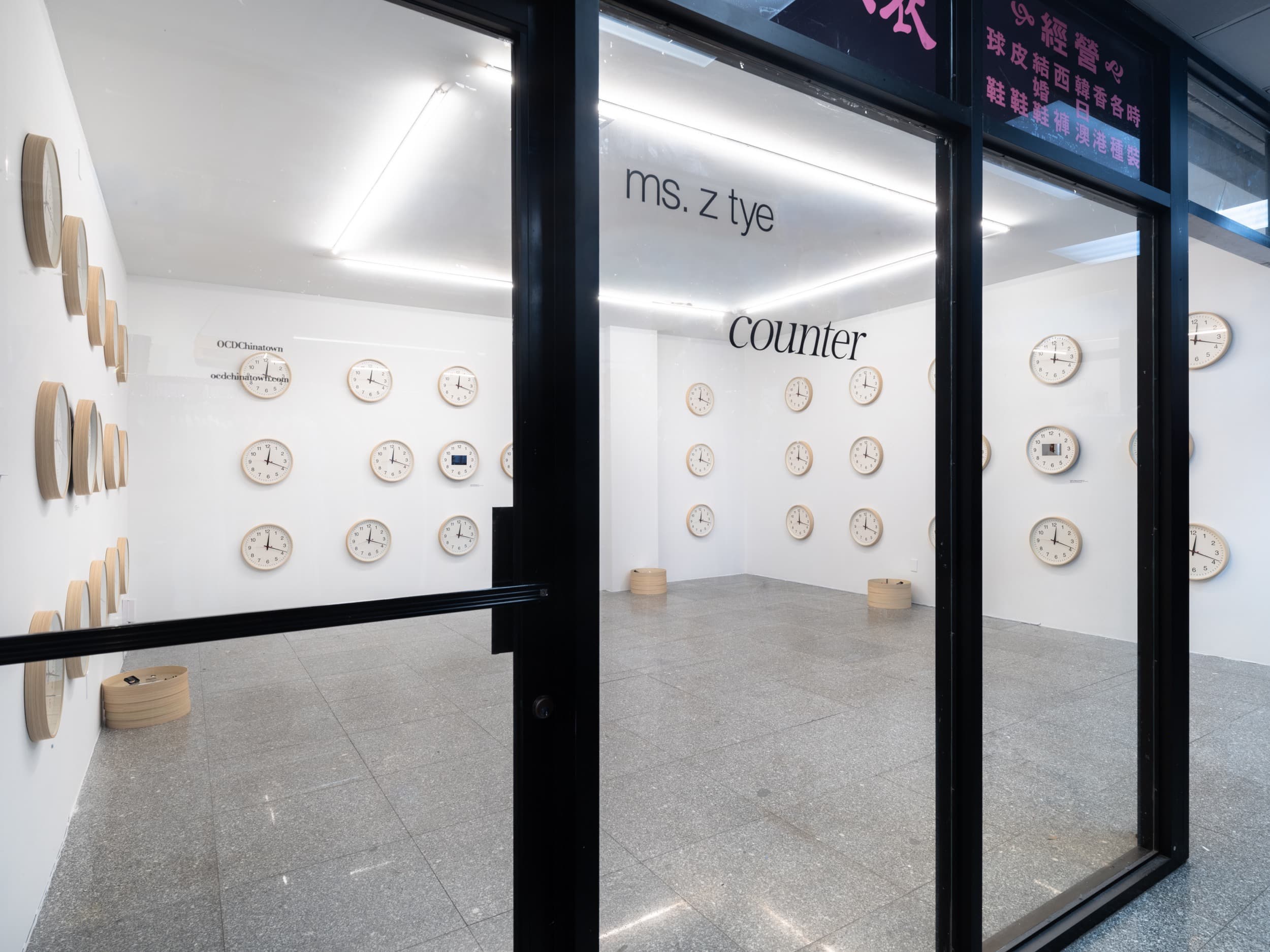
ms. z tye’s Counter, OCDChinatown, New York, 2025. Photo: courtesy OCDChinatown.
Counter
OCDChinatown
September 19–November 2, 2025
New York
It is rare that an audience experiences an exhibition at the same time. Even at an opening, how many people are looking at the art—and how many are huddled in a cluster clutching scantily-filled plastic cups, or wooing the curator, or engaged in a (dare I say performative) smoke break in the street outside?
It is rarer still that viewers are made aware of their own gaze. The art exhibition often requires its audience to leave their bodies at the door, to be reduced to a lens through which the work is captured.
In ms. z tye’s newest body of work, Counter, presence is mandatory and the act of looking is turned back on the viewers. Playing on the word “clockable”—meaning to be perceived as a trans woman—she breaks from the linear understanding of transition, instead implying an endless becoming guided by spectres of the past.
In a performance on the opening night at OCDChinatown, a crowd gathered in the center of the gallery as tye wound around the room methodically like the hands of a clock, counterclockwise, then clockwise.
Allowing the audience’s gaze to first fall on the artist herself, she then led us into her line of sight: initially toward a film inlaid in a clock; then to rows of ticking clocks on the wall; next to a disassembled clock; then to the artist’s body once again, which now became a clock itself, silver slippers twisting elliptically on the speckled linoleum floor and elongated red nails soundlessly counting the seconds. As she regressed through time, tye had slowly rolled up the hem of her dress, which she now rolled back down.
Her way of working draws on Merce Cunningham’s “choreography by chance,” in which isolated movements are assigned sequence by, for instance, flipping a coin. At intervals, tye suddenly looked out at the audience, breaking the collective trance, before locking eyes with a viewer and asking them to count to sixty. This is a technique she refers to as “returning the gaze”—a means of taking back control of her body and the eyes that lay upon it.
“I enjoy diluting the gaze by asking people to play an active role in the performance,” she explained to me the next day. “Escapism is not a goal of mine during performance, but labor is, and I don’t desire to be alone in that feat.”

ms. z tye’s Counter, OCDChinatown, New York, 2025. Photo: courtesy OCDChinatown.
Sixty clocks ticking in near-unison line the walls of the gallery, three of which hold a video monitor at their center, which play in turn at twenty-minute intervals. The media within the clocks represents a time warp: as viewers stand in the installation, time moves forward around them, and yet the video triptych invites them into the past.
Three dissected clocks lay on the ground, batteries and springs strewn across their faces. If the ticking clocks on the walls reflect a reverence for ritual and its relation to timekeeping, the deconstructed clocks dislodge the mythos of progress that permeates Western thought in general and narratives of transition in particular. Topographical in form, the sculptures suggest nonlinear means of navigating the material realm.
“Currently, it feels like the trans body is a governed body, or in many ways a discarded body,” tye says. “Many folks are constantly questioning the validity of transness, and these sculptures are an ode to that feeling.”
Taken together, the installation(s), films, and performance compose, as Jack Halberstam writes in In a Queer Time and Place: Transgender Bodies, Subcultural Lives, “a mode of seeing and being seen that is not simply at odds with binary gender but that is a reorientation of the body in space and time.” This way of looking takes as its focal point the trans body, a lived refusal of the childhood-adolescence-marriage-reproduction progression.
The first film, Tasking, distills a lifelong reverence for Black femininity and the labor entwined in its enactment. Domesticity weaves through tye’s practice—often in deference to her late grandmother, Deloris Bell, born and raised in McDonough, Georgia, whom she describes as her kindred spirit, a stern southern matriarch set in her ways.
“There is a connection between the divine feminine and divine timing in those recollections,” she reflected. “Tasking is my way of honoring her labor that went unrecognized.”
Returning to the work later, I was transported to my own grandmother’s bedroom in her house in Georgia, watching her hang up her clothes in her closet with painstaking care, as my six-year-old mind tried to deduce the logic of the process: Was it by color? Fabric? Season of wear? I thought of a line that I recently found scribbled in the back of a notebook from David Wojnarowicz’s “Doing Time in a Disposable Body” in Memories That Smell Like Gasoline: “I associate with certain gestures or body language or scars or other physical characteristics an entire flood of memories and fictions and mythologies.”

ms. z tye’s Counter, OCDChinatown, New York, 2025. Photo: courtesy OCDChinatown.
Relationships dwells in queer feminine entanglements with the living—human and otherwise. Two reclining figures place their foreheads together, as one reaches for the other’s hand; a silhouette in a doorway bows her head as if in prayer; an outstretched palm reaches toward the sky, a strand of beads draping from unfurled fingers, trees whispering in the background.
Reaping the Benefits conjures to my mind Toni Cade Bambara’s concept of “in-difference”—conscious detachment from tyrannies of daily life, speaking and dancing the terms of existence we wish to see into being. As the camera zooms out on a figure in profile, words appear at the foot of the monitor—
the desire to be punctured in a place you don’t yet possess
We have elaborate aesthetic codes for what we don’t like, but we are missing a rich language for what we
want; Reaping the Benefits elegantly resists this downward pull. As I make my way toward the exit, my gaze catches on a serpentine figure in the center of the clock, lithely swaying between two neat rows of trees.
For all its calculated candor, the trans gaze that presides over Counter, ultimately, becomes impossible to track, precisely because—to return to Halberstam—“it depends on complex relations in time and space, between seeing and not seeing, appearing and disappearing, knowing and not knowing.” In tye’s hands, time recedes into the body, becoming the bone structure beneath its organic transmutations. Both reverential and playful, fluid yet still, Counter dissolves logic into longing, spinning spectral traces into chance becomings.
Emma Fiona Jones is an artist and writer based in New York. Her work has appeared in Whitehot Magazine, IMPULSE Magazine, Momus, Femme Art Review, and beyond.