Eiko Otake & Wen Hui: What Is War
Word count: 853
Paragraphs: 10
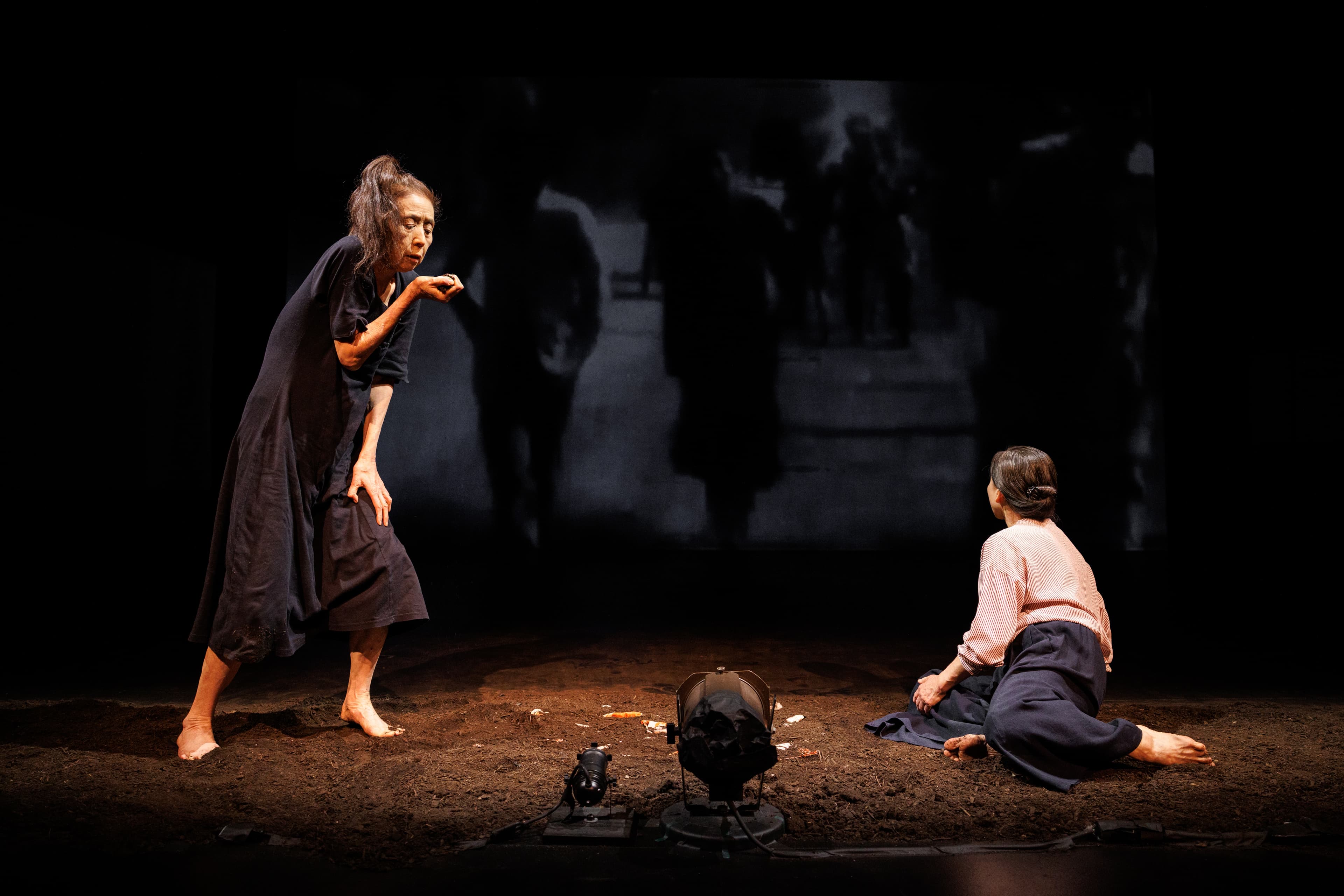
Eiko Otake and Wen Hui, What is War, Brooklyn Academy of Music, Next Wave, 2025. Photo: Maria Baranova.
What Is War
Brooklyn Academy of Music
October 21–25, 2025
Brooklyn
Look first at the hands: searching, clenched, or placed over the heart. The face: withdrawn, anguished, lost in thought. The body: contorted, depleted, exhausted. Near the beginning of Eiko Otake and Wen Hui’s chilling new performance, What Is War, the duo walks toward and past each other, ever so slowly, on a long stretch of dirt that spans the width of the stage. Over the course of several silent minutes, they seem to move through all the stages of grief.
Indeed, their gestures throughout this hour-long tone poem on death, patriarchy, and madness strongly reminded me of Käthe Kollwitz’s famed 1921–22 “War” series. For those large-format, stark black-and-white woodcuts, the German visual artist radically simplified her compositions. The women depicted are left to face their shock, heartache, and fears alone—much like Otake and Wen in What Is War.
Otake and Wen first met in 1995 at the Guangdong International Experimental Theater Festival. A few years later, they shared time together when Wen spent a year in the US on a fellowship. It wasn’t until 2020 (and another fellowship that brought Otake to China) that they began collaborating, spending some days together talking about the effects of the Second Sino-Japanese War (1937–45) on their families. When the COVID pandemic hit, they turned to Zoom, meeting weekly to look at footage they had shot together in China. Out of this, they made a documentary, No Rule Is Our Rule (2022), and they began planning What Is War. Originally commissioned by the Walker Art Center (and a number of co-commissioners) the minimal, unhurried, yet well-paced work debuted at the Walker and UCLA’s Center for the Art of Performance this past April and made its way to BAM in late October.
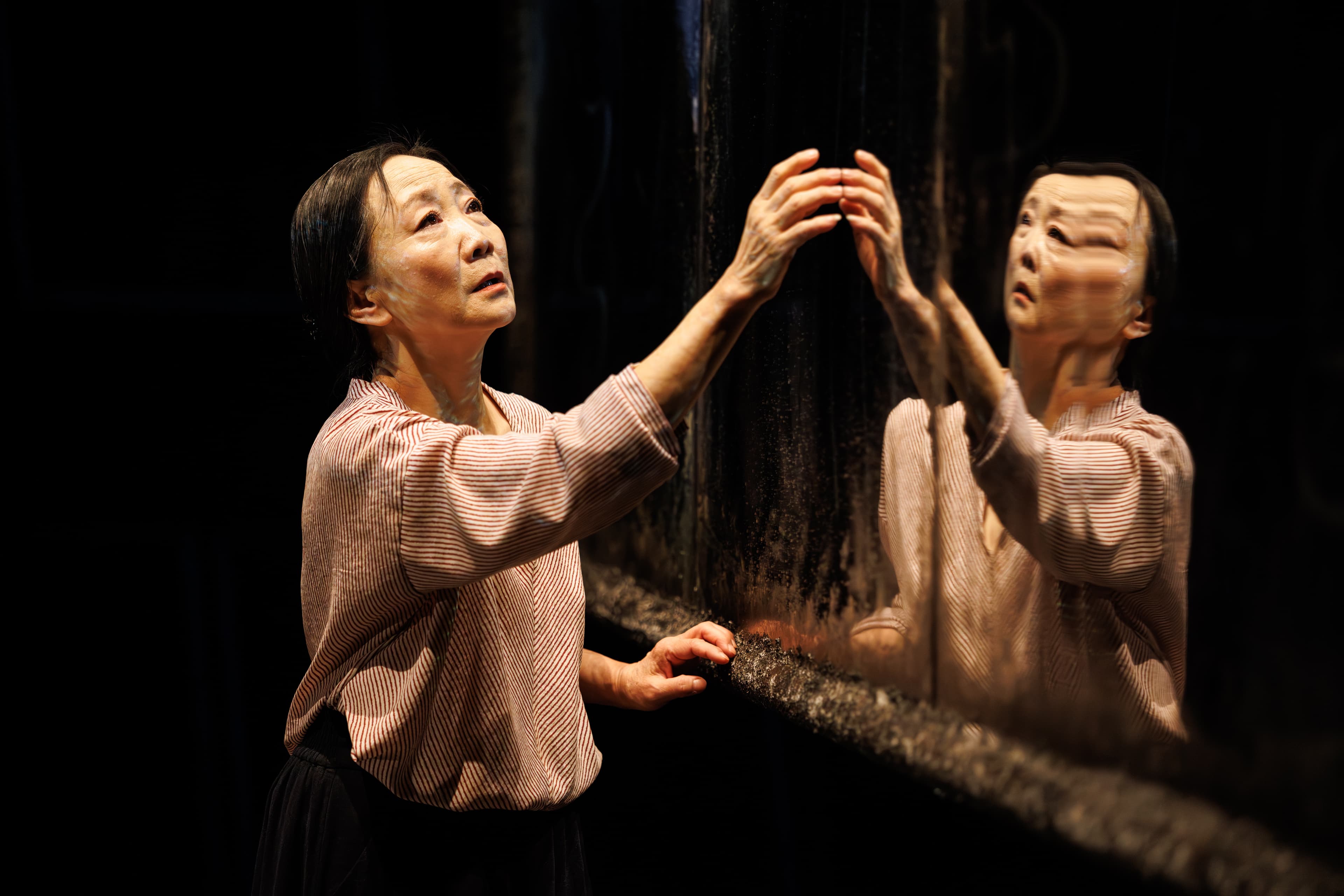
Wen Hui, What is War, Brooklyn Academy of Music, Next Wave, 2025. Photo: Maria Baranova.
Among the scenes from China that appear in the performance: exterior shots of the Lijixiang “Comfort Station” in Nanjing. Here we see the faces of numerous Chinese women who were driven into sexual slavery by the Imperial Japanese Army during World War II. The number of women involved in these horrors is unknown but estimated to be between at least 20,000 and possibly 200,000. While leaning against a projection of one of the “Comfort Station” buildings, Otake feels her way along this remembered image of its exterior, and, as she passes by its windows, her hands appear to enter through the glass. Not long after, she removes her black dress and walks her thin, naked body toward the audience. Landing downstage center, she stares forward, making eye contact with her viewers. She could have been one of the women depicted on the wall, full of rage.
Another poignant sequence surely referenced the blast shadows found throughout Hiroshima and Nagasaki, after the mornings of August 6 and 9, 1945. These occurred when an intervening body or object shielded part of a surface that was otherwise scorched by direct heat radiation from the US-dropped atomic bombs. During one of Otake’s monologues, she conveys a conversation with her friend, the Japanese writer Kyoko Hayashi, who had been exposed to the bomb in Nagasaki. “Bodies I saw on August 9 had no outlines,” she relays. With their backs to the audience, Otake and Wen are lit from behind by a bright light, making their large shadows appear against a white curtain. As they walk upstage, their physical bodies slowly merge with their dark shapes. Their outlines disappear.

Eiko Otake and Wen Hui, What is War, Brooklyn Academy of Music, Next Wave, 2025. Photo: Maria Baranova.
What is war? Endless. Every war creates more war, violence, and expropriation. War is a technology, a virus, and a deadly metaphor. A short video plays at the very beginning of the performance where the duo sits in conversation and agrees that war touches everyone. When I saw the performance with my mother, I thought about how she lost her brother to a war, and how silencing that can be for generations. Even after the piece, we didn’t talk about it. It is still too painful.
Thankfully, Otake and Wen refuse to be quiet. The program’s transcript in the playbill sings out sharply. By speaking up as artists, as genocides unfold around the globe, they resist the endless cycle of war. Yet, this wasn’t a spotless piece—it was sometimes hard to hear what they were saying and the script could have been sharper. It was also very different from Otake’s solo public outings wherein she appears almost saintlike, whether roaming through Battery Park City for Slow Turn in 2021 to recall her memories of 9/11 on its twentieth anniversary or inching wormlike across the floor of Fulton Center for A Body in a Station in 2015.
It was different and less concise, but in that way, it also succeeded in conveying the traumatizing impacts of war. The very subject of this new work entails a chaotic disarray. It is not so much about the experience of war firsthand, but rather what it means to grapple with intergenerational trauma through memory. Inevitably, this requires a verbal and visual language of confusion, of anger, and of bodies without outlines.
Lauren O’Neill-Butler
Lauren O’Neill-Butler is a New York–based writer and editor. Her books include The War of Art: A History of Artists’ Protest in America (Verso, 2025) and Let’s Have a Talk: Conversations with Women on Art and Culture (Karma, 2021).