Lafleur & Bogaert in New York
Word count: 825
Paragraphs: 11
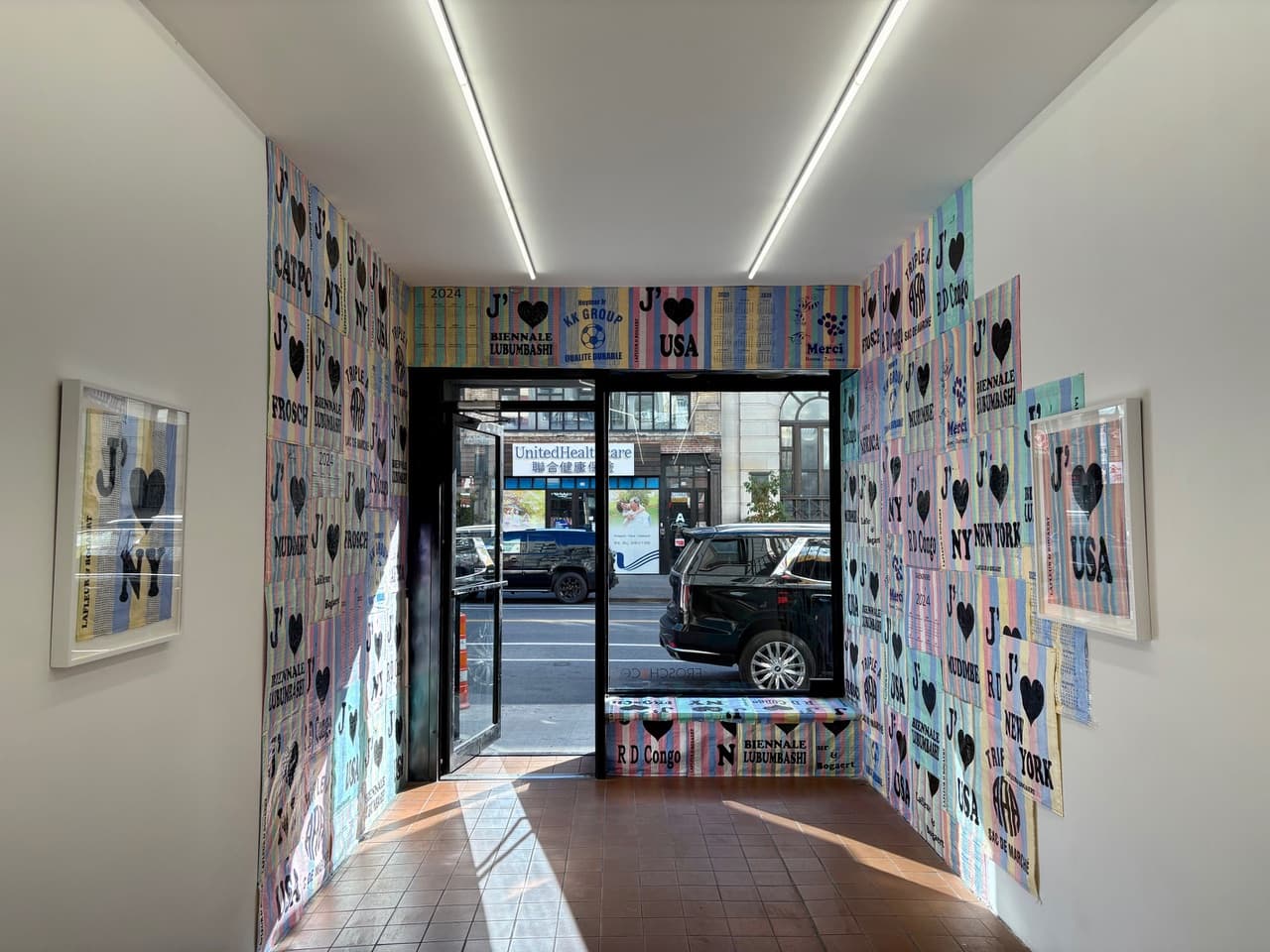
Installation view: Lafleur & Bogaert in New York, FROSCH&CO, New York, 2025. Courtesy FROSCH&CO.
FROSCH&CO
October 23–November 30, 2025
New York
Lafleur & Bogaert in New York, at FROSCH&CO, marks years of trans-Atlantic association. Michel Lafleur (Haiti) and Tom Bogaert (Belgium) have been friends and collaborators since they met in 2013 at the Ghetto Biennale in Port-au-Prince. The exhibition presents three evolving bodies of work that suggest establishment art gaining in the long term as it cedes ground—slowly, voluntarily and involuntarily—to under-represented art made in isolated, precarious conditions. Despite limited in-person meetings due to the logistical problems caused by Haiti’s chronic political unrest, Lafleur & Bogaert in New York introduces Lafleur, who descends from enslaved ancestors from the Belgian Congo, and Bogaert, a Belgian national who worked as an immigration and refugee lawyer, taking turns as leader, opening psychological space where business sense intersects rich, previously untapped content.
Spearheaded by Bogaert, the selfie-ready installation series “J’aime RD Congo” loosely collages ubiquitous colorful, polypropylene, African shopping bags, installing them like wallpaper floor-to-ceiling and over a built-in bench. Hand-stenciled with titles such as “J’aime Frosch,” “J’aime Mudimbe,” “J’aime NY,” “J’aime USA,” and “Triple A Sac de Marche,” the bags highlight Lafleur and Bogaert’s soft-focus, dandelion-like dissemination of affectionate value. J’aime RD Congo: Le Grande Tour began in 2023 while Michel Lafleur could travel, and since 2024, after opening week of the Lubumbashi Biennale, the tote bags have appeared in Kolwezi and Lusanga, near diamond mining territories, heading for the tour’s final stop in Kinshasa where the totes will be made into kites and flown over the sea. As humble souvenirs the bright carryalls bearing Lafleur & Bogaert’s slogan “J’aime (place any proper name here),” adapt to multiple locales and are affordable on sliding scale to all income levels. They evoke the allure of Birkin bags and the legend of actress Jane Birkin meeting Jean-Louis Dumas of Hermès on a plane between London and Paris, if you replace one European city with an African or Caribbean one.
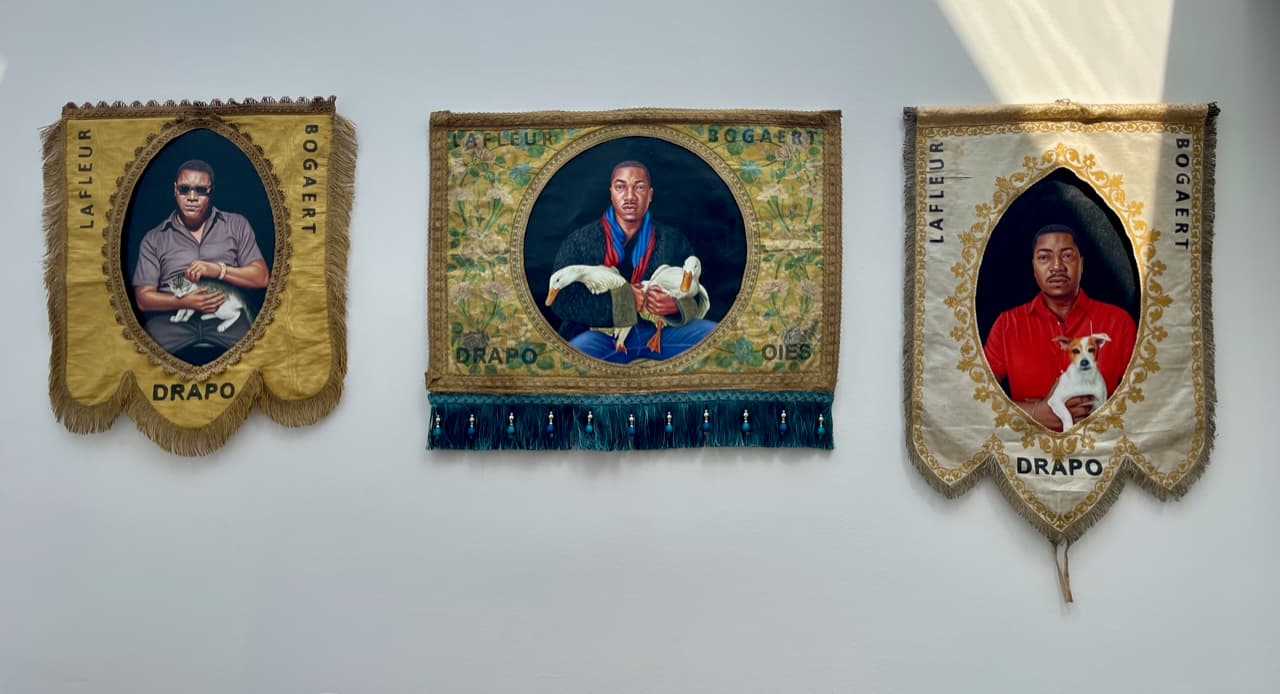
Two related series require many steps. “Twa Drapo” showcases Lafleur’s self-portrait painting, and “Primitif,” his Black Madonnas; in both, the paint is so thinly and delicately applied that canvas texture is visible. Lafleur paints as a modern in the Flemish-Renaissance manner, achieving fluidly rendered hands and facial expressions that leverage rare, small imperfections. For instance, in Drapo Chat (2025), Lafleur’s lower hand almost seems to fade away. The pieces blend the clarity of Flemish painting with a Haitian painter’s steady self-regard.
Installation view: Lafleur & Bogaert in New York, FROSCH&CO, New York, 2025. Courtesy FROSCH&CO.
Lafleur ships his canvases from Port-au-Prince to Budapest, where Bogaert sources antique church banners and tapestries, excising the Virgin Marys and child Christs and inserting Lafleur’s self-portraits and Black Madonnas. Primitif 2.5 (2024) stands out: Bogaert allowed fruit, furniture, and part of a Madonna’s hand to remain “in the picture.” Replacing hallowed European religious figures with contemporary African and Haitian personages seems to recover psychic territory and time from slave-economy history, not in combative terms but inch by meticulous inch.
Bogaert travels with the art to his native town of Bruges to outfit and finish framing Lafleur’s images with the help of Inge De Zutter and Paula Devriendt. They collaborate on color choice and subtle transitions between lace, sequin, silk, bead, rug-hooking, tassel, fringe, gimping, and machine stitching. The surrounding textile’s interplay of textures and range of faded antique to modern colors spotlight Lafleur’s restrained, flat painting. The “Primitif” series recalls Margaret van Eyck, picturing her ceremoniously replaced by an anonymous Black woman similarly posed.
The “Twa Drapo” series, three self-portraits by Lafleur comfortably seated with his cat, two geese, and a dog, respond to Donald Trump’s lies about the Haitian community of Springfield, Ohio stealing and eating people’s pets. Lafleur paints himself as if honorably responding to Trump’s aggression: Drapo Chat presents Lafleur protected behind sunglasses, Drapo Oies (2025) depicts absolute neutrality, and Drapo Chien (2025) conveys glints of pain within strong resolve.
Installation view: Lafleur & Bogaert in New York, FROSCH&CO, New York, 2025. Courtesy FROSCH&CO.
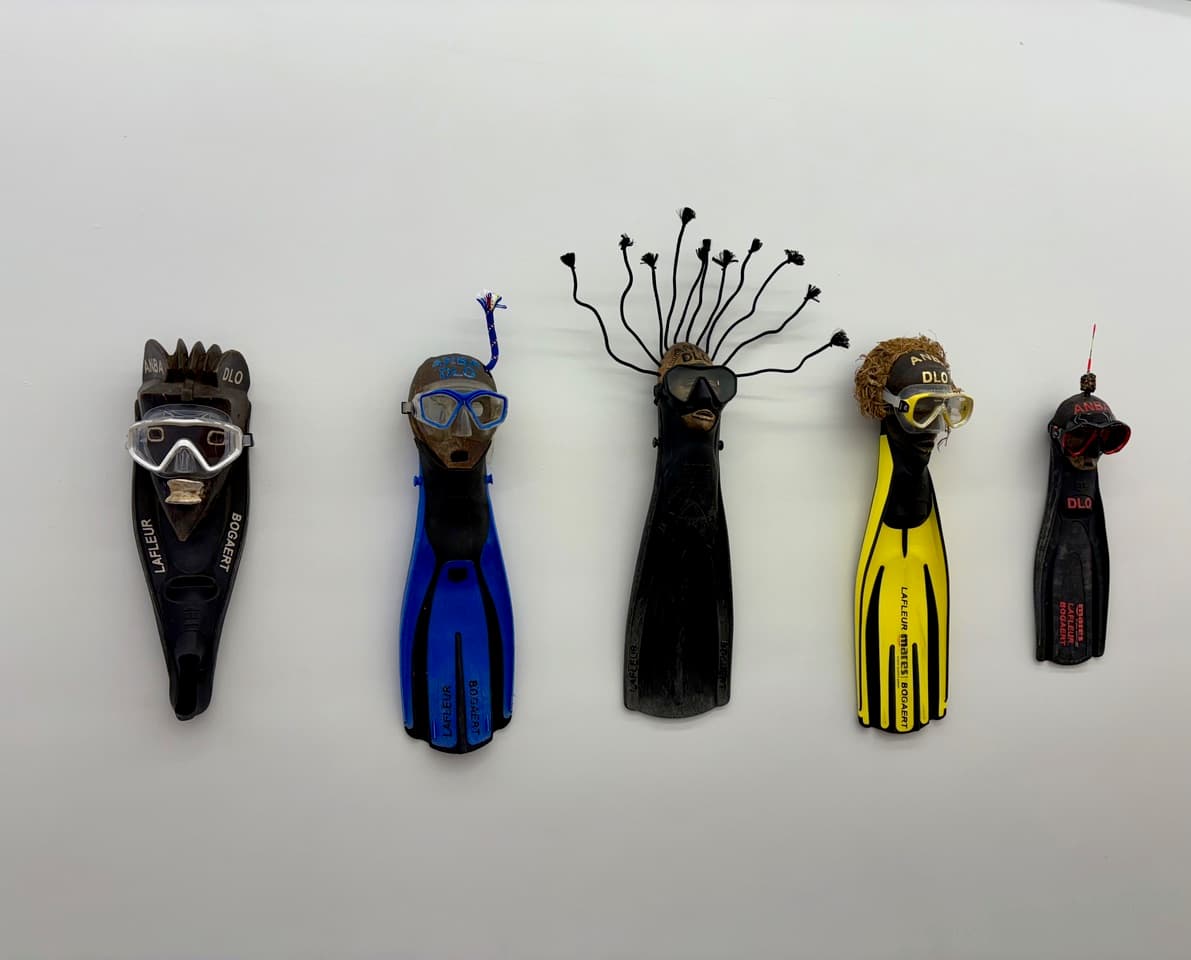
Showcasing Lafleur’s hand at sculpture, The “Anba Dlo” series combines wooden faces Bogaert sends to Lafleur from his collection of Congolese tourist masks, which are considered historic remnants from disappearing villages. Lafleur combines these open-mouthed and empty or closed-eyed heads with fragments of diving gear left behind from former Haitian aquatourism. The streamlined, single-flippered sea spirits or personal gods lack torsos and limbs and are protectively dressed in rubber masks, snake-like wire or rope hair, fishing lures, all wittily christened with the Lafleur and Bogaert logo.
In an email Lafleur said:
Most people, even in the city, still have some connection to the countryside, which we call a ’bitasyon.’ It has layered meanings—it’s the literal place your family has lived, especially if they’ve been there a long time, like the actual land. But it’s also seen as the repository of your family spirits and ancestors—where a lot of your spiritual power resides.
Practical, improvisational, and portable Lafleur & Bogaert in New York is light in temperament and heavy with history.
Elizabeth Johnson is an oil painter, art writer, and guest curator, based in Easton, Pennsylvania. Her landscape paintings fuse realism and abstraction by interlocking distorted photographic images and lush surfaces.