Jameson Magrogan: During an Eternity
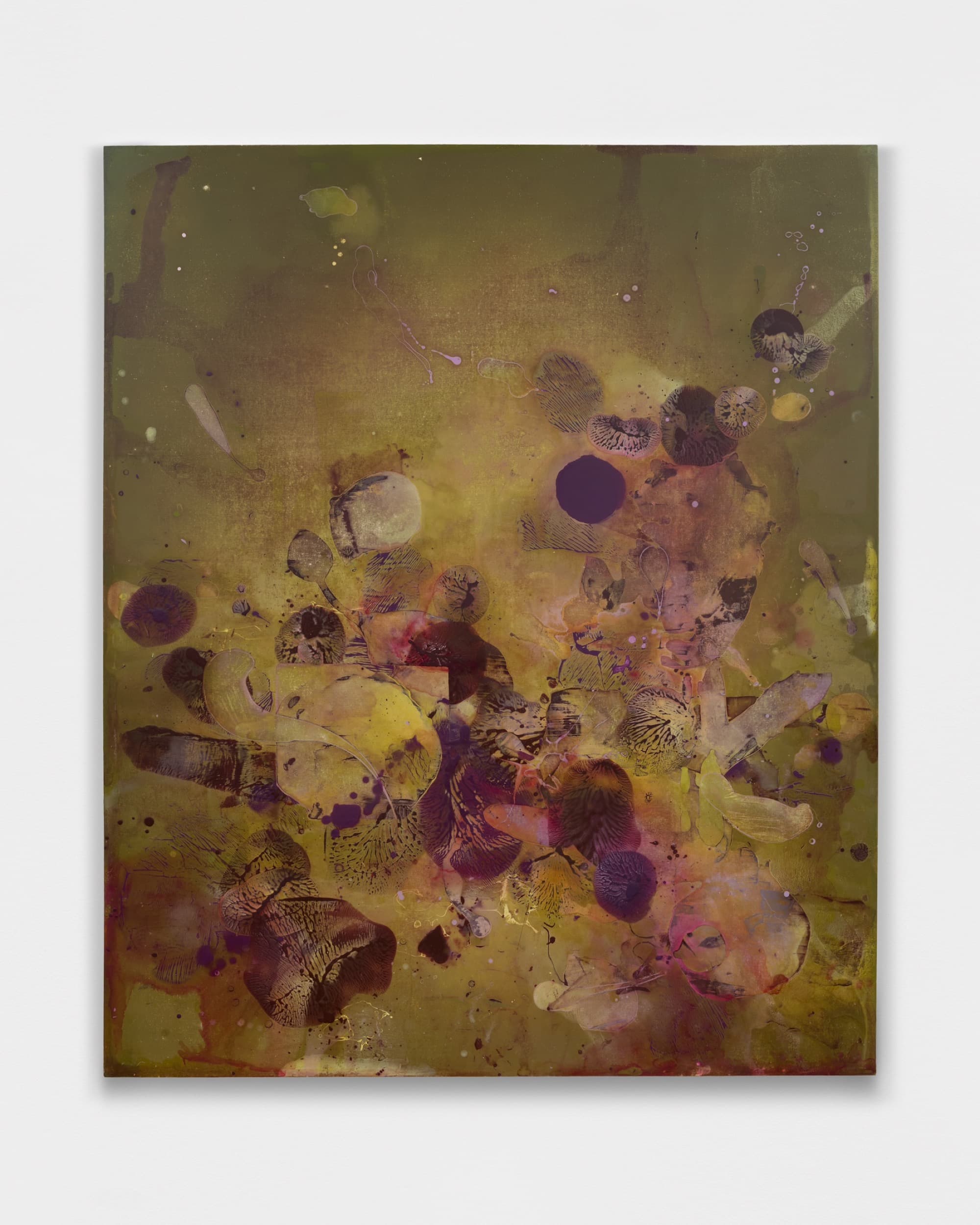
Jameson Magrogan, During an Eternity, 2025. Acrylic on canvas, 70 × 58 inches. Courtesy RAINRAIN, New York. Photo: Olivia Divecchia.
Word count: 621
Paragraphs: 9
RAINRAIN
October 24–November 22, 2025
New York
For his first solo exhibition—presented at RAINRAIN—Jameson Magrogan, a 2021 MFA graduate of Hunter College, presents During an Eternity. The exhibition consists of six large-scale paintings in which Magrogan employs color—both opaque and transparent—to explore his relationship with the surface he is working on, as well as the history of abstraction writ large.
Approaching an empty canvas is always a daunting task, especially in our contemporary moment. The medium of painting carries a weight, one accumulated by the practices of thousands of artists over hundreds of years. Historically, the art school model teaches about artists who have come before—their palettes, their subjects or lack thereof—in reference to practice. Must artists erase all or most prior knowledge, allowing their instinctual mind-body to take over, for the work to be successful?
The title of Magrogan’s exhibition functions as an oxymoron, since during suggests a stretch of time set in motion with a possible beginning and end, while eternity is infinite and outside of time. One might imagine the phase as referring to a discrete phenomenon that occurs or is segmented within an ongoing or unending sequence. An individual painting has a beginning and end, borders, limitations. Yet, as a whole, one might argue that painting as a practice falls within the realm of sempiternity, the endless duration through time.

Jameson Magrogan, Still Yet, 2025. Acrylic on canvas, 59 × 49 inches. Courtesy RAINRAIN, New York. Photo: Olivia Divecchia.
The work that shares the name of the exhibition, During an Eternity (all works 2025), is an acrylic painting, 70 by 58 inches, painted in royal tones of golden yellows and deep plums, with lightness at the top and denseness towards the lower part of the canvas. Magrogan uses varied techniques in application: pouring, scraping, wiping away, and using metal plates and perforated vinyl as a means to press the medium onto the surface. Devoid of traditional application and any purposeful moments of representation, color-scapes like During an Eternity give the viewer permission to explore the space of the canvas as a map without a destination.
“The eternal present is the space within which your whole life unfolds, the one factor that remains constant. Life is now. There was never a time when your life was not now, nor will there ever be,” writes Eckhart Tolle in his 1997 book The Power of Now: A Guide to Spiritual Enlightenment. Exploring time and timelessness in painting—or art and even pop culture in general—is not an individual pursuit, fixed in one place, time, or person, but rather an eternal obligation of human existence.

Jameson Magrogan, Untitled_Gray4, 2025. Acrylic on canvas, 59 × 49 in. Courtesy RAINRAIN, New York. Photo: Olivia Divecchia.
Magrogan faces this challenge head on. Many of his canvases are built using swaths of warm reds, golds, lush purples, peach, fuchsia, and hints of deep or turquoise blues. The shapes are biomorphic, at times resembling tree branches or the bisected silhouette of a brain, squishy folds or channels for neurons in darker colors sitting atop faded lilacs and dusty pinks. In Still Yet, the canvas dances between layers of color and undefined shapes that look pixelated over scrubbed-away pigment. In our heightened digital era, hands-on materiality and tactile processes are greatly appreciated. Even if the marks leave no trace of brushstrokes or fingerprints, the personhood of the artist—their identity—shines through.
Another work, Untitled_Gray4, uses the same “language” employed in Magrogan’s other paintings but has a centrally located line vertically dividing the space of the canvas. Meditating on the possible within the impossible, or stasis within an eternal flux, painters are tasked with using a malleable medium and an ancient visual language to communicate in new ways, day after day. Born in 1992, Jameson Magrogan is staking his place in art history, offering a compelling, conceptual argument for the continued, in-depth exploration of abstraction.
Katy Diamond Hamer is a New York based arts writer with a focus on contemporary art and culture and has been actively engaged in the arts community on a global level for over ten years. Beyond writing she lectures at universities including NYU and Sotheby's Institute and has been a panelist on several occasions both as a participant and moderator at the New York Academy of Art and Art Basel Miami amongst others. A graduate of New York University, Hamer has written for magazines including Cultured Mag, Galerie Magazine, Flash Art International, New York Magazine, The Creative Independent, BOMB, and many others, including the Brooklyn Rail. Interview subjects of note include Robert Storr, Courtney Love, Helmut Lang, Cecilia Alemani, and Takashi Murakami.