Man Ray: When Objects Dream

Man Ray, Le violon d’Ingres, 1924. Gelatin silver print, 19 ⅛ × 14 ¾ inches. © Man Ray 2015 Trust; Artists Rights Society (ARS), New York; ADAGP, Paris, 2025. Courtesy the Metropolitan Museum of Art, New York, Bluff Collection. Promised Gift of John A. Pritzker. Photo: Ian Reeves.
Word count: 834
Paragraphs: 9
Metropolitan Museum of Art
September 14, 2025–February 1, 2026
New York
As a boy, Man Ray recalled in his 1963 autobiography, he would place fern leaves on proof paper within a printing frame, expose the frame to sunlight, and produce a white negative of the leaves. Decades later in 1921, Ray accidentally discovered the technique of rayographs, a way of producing photographs without a camera by placing objects on light-sensitive paper in a darkroom and then shining a light on it. Perhaps his 1921 invention was not so much a “discovery” as a revisiting or a return to a technique he always carried within him. As children, we try things for no particular reason other than to pursue our wonder with few inhibitions.
As it happens, one of the rayographs currently on display at the massive exhibition Man Ray: When Objects Dream at the Metropolitan Museum of Art captures fern leaves, interspersed with what look like fluffy dandelions. It is one of the exhibition’s sixty-one rayographs (all simply titled Rayograph), displayed with around a hundred other works, including some of his most iconic films, paintings, and sculptures, such as Cadeau (1921)—for which he glued a row of tacks on the bottom surface of a flatiron—and the alluring photograph of his lover Kiki de Montparnasse, Le violon d’Ingres (1924). The vast majority of the works date from the late 1910s to the 1920s, the transitional period when Dadaism was giving way to Surrealism. This exhibition is the first to situate the artist’s rayographs within his larger body of work from this period.
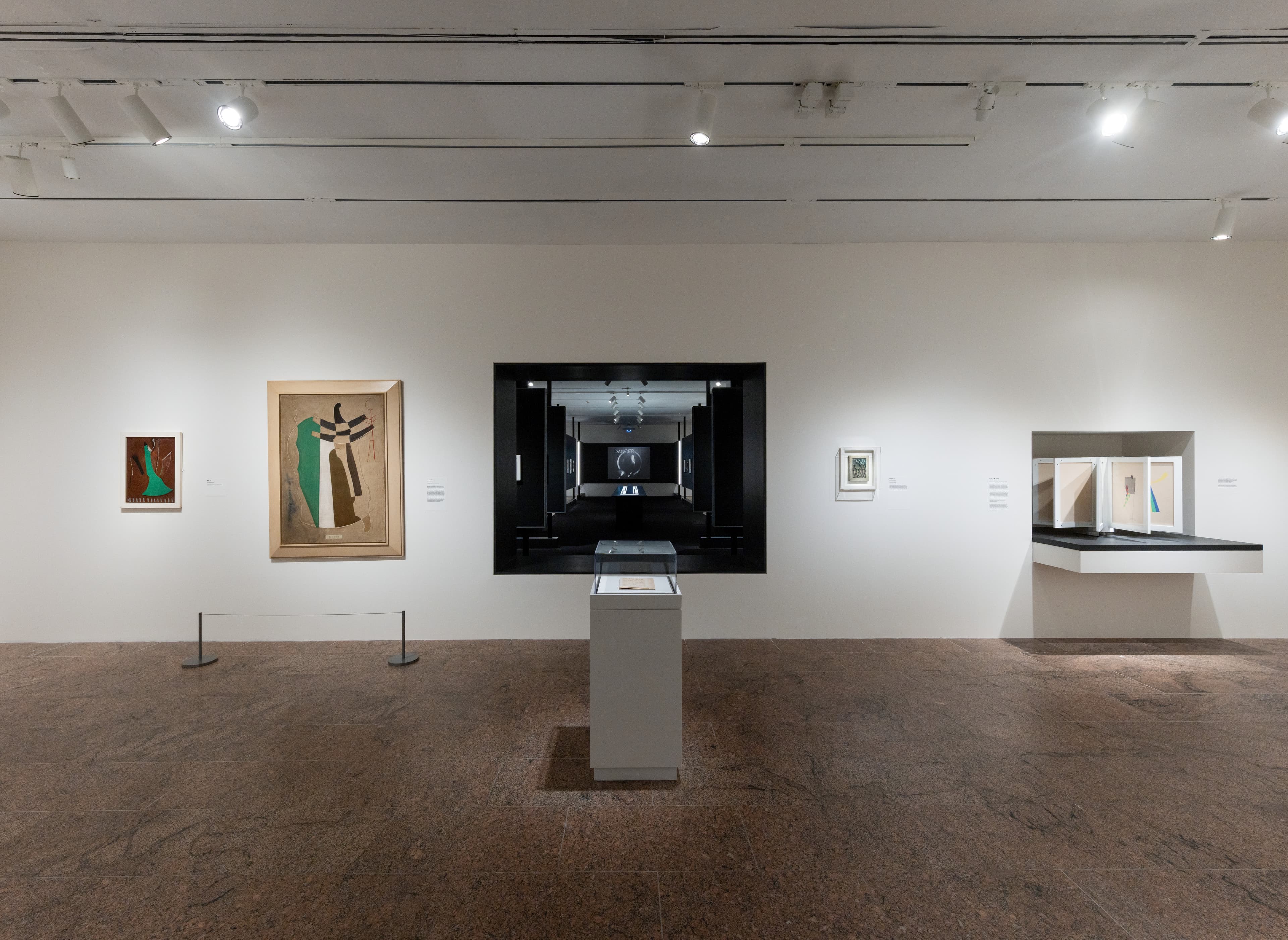
Installation view: Man Ray: When Objects Dream, the Metropolitan Museum of Art, New York, 2025–26. Courtesy the Metropolitan Museum of Art. Photo: Anna-Marie Kellen.
Rayographs were not the first camera-less photographs. Photograms—photographic images made without a camera—had been around at least since the 1830s in the experiments of William Henry Fox Talbot and Anna Atkins, but the rayographs are shot through with Ray’s distinct Surrealist sensibility (he was included in the first Surrealist exhibition in 1925). When Objects Dream shows the range of knickknacks and objects Ray used to make his images. In his autobiography, he described his elation upon stumbling on the technique: “[I took] whatever objects came to hand: my hotel-room key, a handkerchief, some pencils, a brush, a candle, a piece of twine … I made a few more prints, excitedly, enjoying myself immensely.”
The day after Ray made his first rayographs, the Dadaist poet Tristan Tzara came over to take a look, calling them “pure Dada creations.” This sort of unconscious free-associating via the hand—taking whatever is around—is akin to a haptic, externalized form of rambling internal monologue: digesting whatever incoming, unprocessed data is available. Rayographs are essentially shadow images of objects, and like x-rays, are marked by various gradations and levels of transparency. Everyday objects acquire an eerie beauty. The rayographs are brightly lit, mirage-like images glowing like ghosts (the exhibition is very dim, as if designed to mimic a darkroom), but it’s hard to make out what exactly the individual objects are, as they are often overlapping on the photo paper.
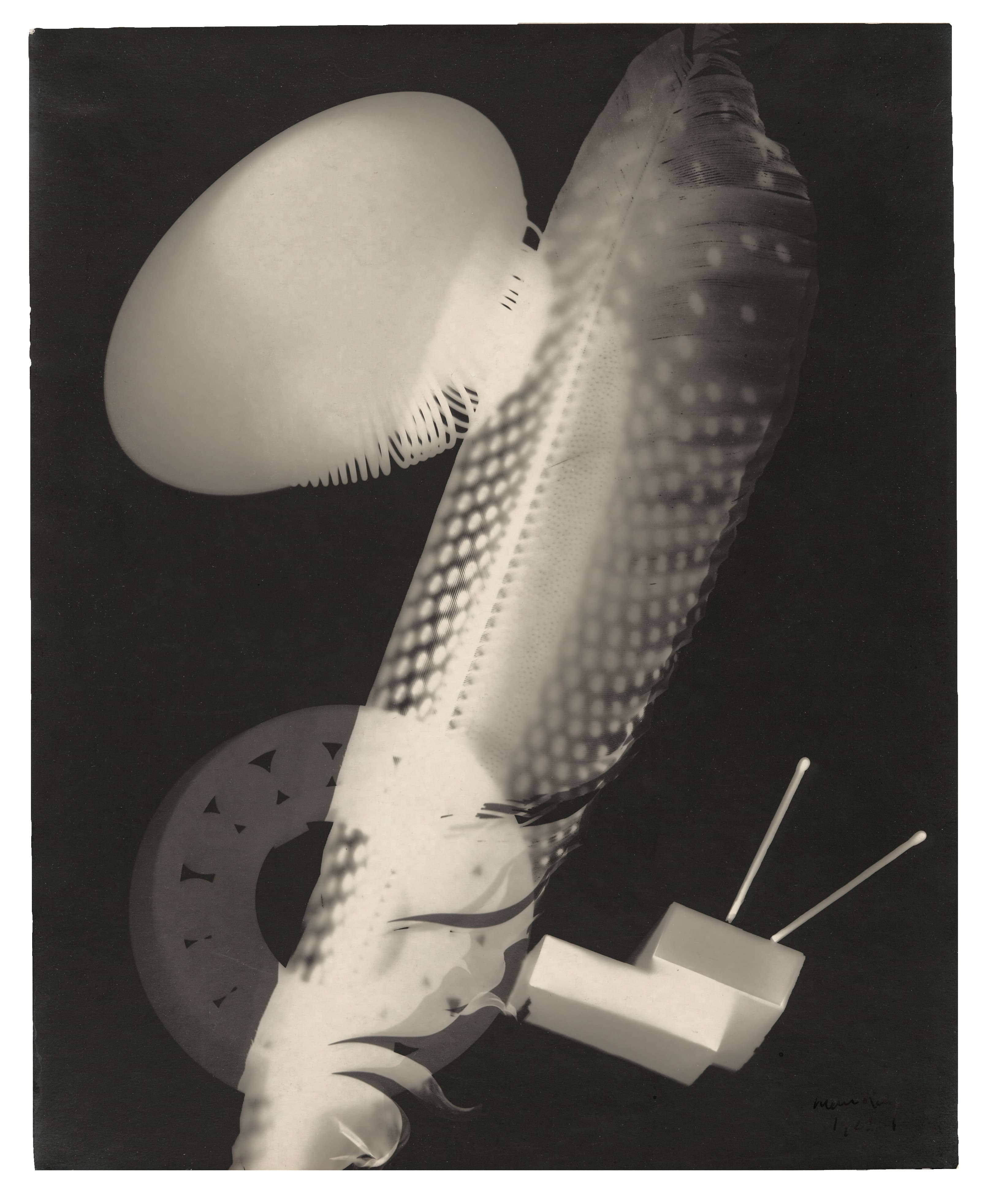
Man Ray, Rayograph, 1923. Gelatin silver print, 11 ½ × 9 ¼ inches. © Man Ray 2015 Trust; Artists Rights Society (ARS), New York; ADAGP, Paris, 2025. Courtesy Yale University Art Gallery, New Haven, Gift of the Estate of Katherine S. Dreier. Photo: Yale University Art Gallery, Gift of Collection Société Anonyme.
In a 1999 essay, Rosalind E. Krauss noted that such photographic practices were seen as “doubly disprivileged within the modernist canon,” as photography’s ontology from its very beginnings was understood to be documentary. The result, Krauss contends, “was that all those trick effects with which Surrealist practice was identified in the popular imagination—double exposure, sandwich printing, montage, brûlage, solarization—were seen by straight photography as an act of impurity with regard to the medium.” Krauss’s point is that Surrealist photography, by virtue of its various “trick effects” (of which Ray was a master; he thought this was the entire point of photography, as this exhibition deftly shows), denies the viewer the traditional sources of photography’s authority: clarity of meaning, transparency of method, decisiveness of representational truth. Indeed, the first audience reaction to Ray’s rayographs was utter confusion: viewers did not know what they were looking at, not least how they were made.
Some of the paintings and prints in the show seem to strike a different note from the rayographs, but they contain the same obsession with light and shadows. In what is one of his best-known paintings, The Rope Dancer Accompanies Herself with Her Shadows (1916), Ray took inspiration from a rope dancer he saw at a vaudeville show. On the canvas he choreographs colored forms that suggest movement, as well as the shadows of the dancer, against a light grey background that gives the impression of transparent glass. Similarly, in his solarized photographs, which he began making at the end of the 1920s with Lee Miller, Ray re-exposed film negatives, resulting in eerily lit photographs that visually resemble bas-relief sculpture.
Somewhere in Ray’s photography is the proposition that, in the words of the poet Jack Gilbert, “We must risk delight. We can do without pleasure, / but not delight.” Ray’s works—both cognitively uninhibited and sensually gratifying—restore us to previously undreamt mysteries and remind us that we create our own methods for wonder through constant investigation.
Emily Chun is a writer and a Ph.D. candidate in art history at Stanford University.