Rebecca Allan: Groundcovered (A Survey)
Word count: 790
Paragraphs: 10
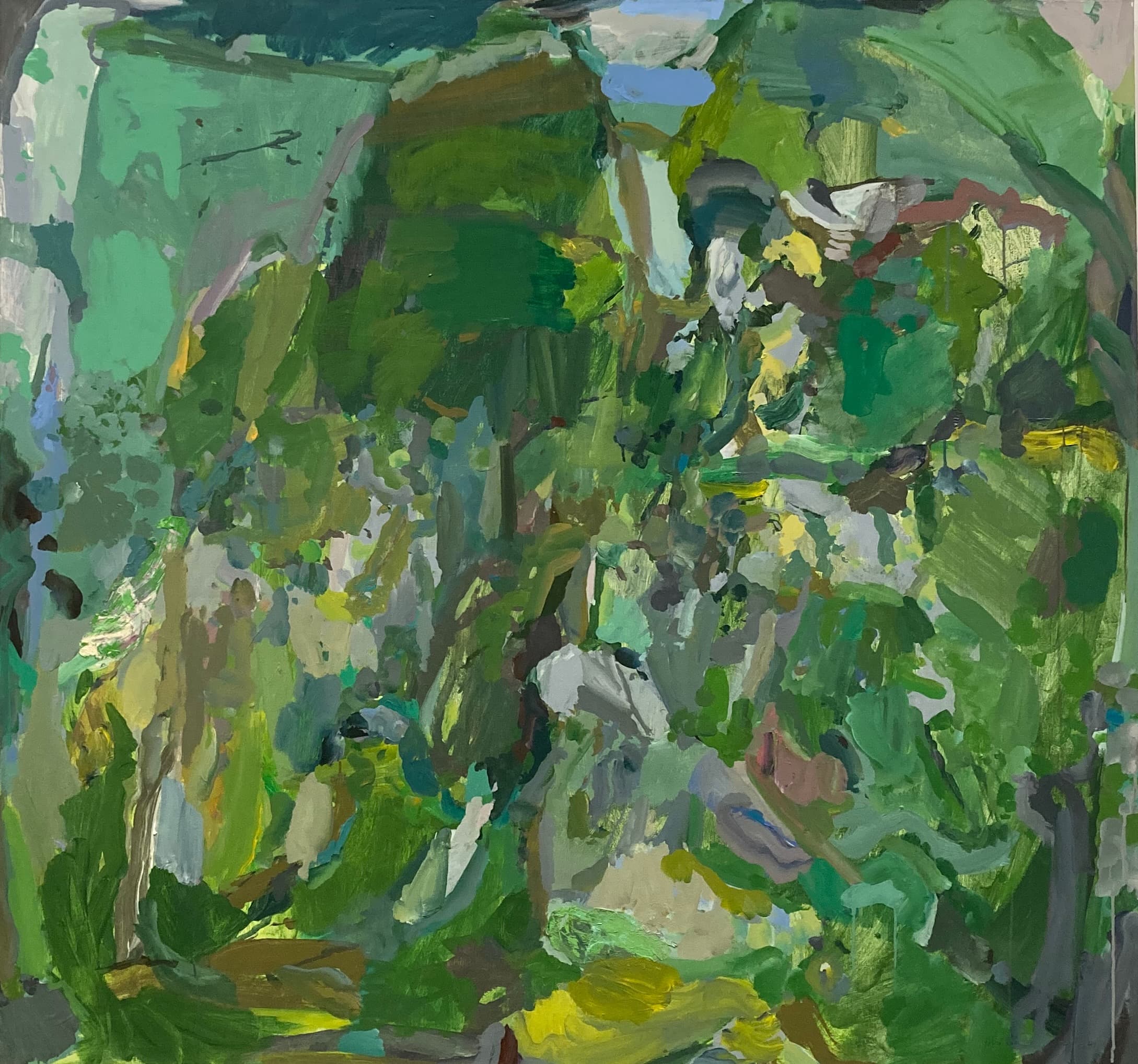
Rebecca Allan, From Gierangerfjord (Norway) to Pine Mountain (Kentucky), 2014–17. Acrylic on canvas, 60 × 64 inches. Courtesy the artist and 447 Space.
447 Space
September 12–October 24, 2025
New York
Imagine standing in a forest, eyes closed, looking up. Light filters through the overstory and flickers across your eyelids. Your mind’s eye activates, associating patterns and shapes. That quiet moment of reflection and sensory overlap is what it feels like to stand in the middle of Rebecca Allan: Groundcovered (A Survey) at 447 Space. Allan’s works are meditative and tranquil, capturing the transportive beauty of the natural world. She distills this energy into abstract forms that capture the fluttering warmth and serenity of nature. It is less about the landscape itself, and more about how it feels to be within it.
Stepping into 447 Space, the noise of Manhattan fades almost instantly. The quiet, windowless interior with its exposed wood beams and soft, diffuse lighting creates a profound sense of stillness. This atmosphere complements the work's transportive quality, inviting slow looking and reflection as one moves through the show, which features thirty-six paintings and works on paper.
A salon-style arrangement of smaller works on paper introduces the exhibition, offering visual vignettes of natural landscapes titled after specific locations. In the main gallery, large-scale paintings line the walls with chromatic yet serene compositions that the artist refers to as “cosmological landscapes.” Standing in the center of the room each work captivates, realizing a perspective of a natural landscape whose abstraction draws in the eye and one finds themselves able to imagine the full figurative landscape of the forest. Allan’s color choices recall the vividity of the Fauves, but with more subdued hues.
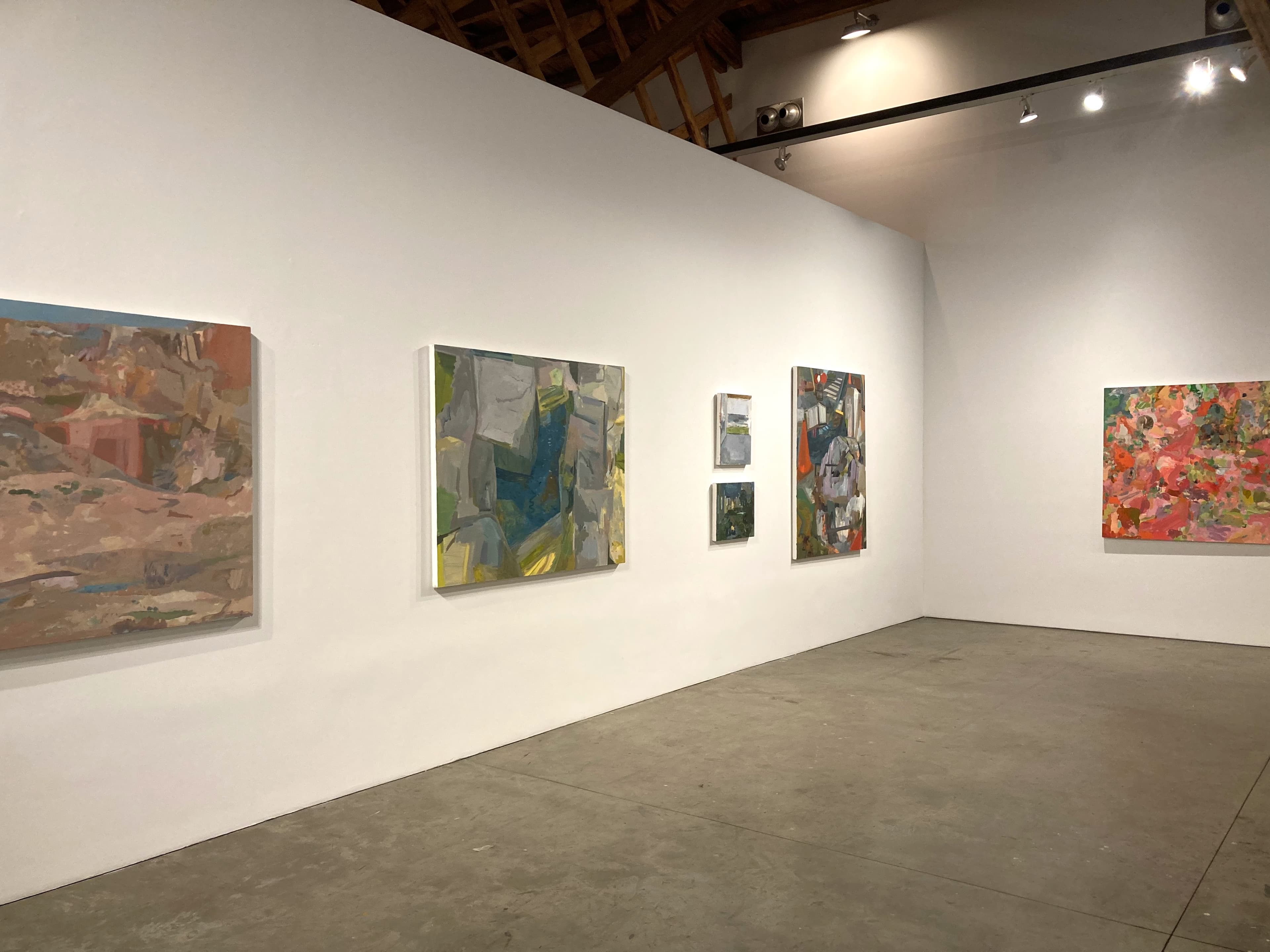
Installation view: Rebecca Allan: Groundcovered (A Survey), 447 Space, New York, 2025. Courtesy the artist and 447 Space.
The exhibition reads as a kind of natural history of all the places Allan has lived, from Western New York and the Atlantic Northeast to the Pacific Northwest, Kentucky, and across the Atlantic to Lebanon and Norway. Despite the geographic breadth, these environments are brought together through Allan’s assured brushwork and her warmly nostalgic palette. No place feels too far removed; instead, her abstractions leave space for familiarity, welcoming personal resonance in the viewer’s own memory. In From Gierangerfjord (Norway) to Pine Mountain (Kentucky) (2014–17), the lush composition bridges the fjords of Norway with the Appalachian landscape of Kentucky. It’s not just a visual link between disparate geographies, but a reflection on how nature, despite regional distinctions, can evoke similar emotional responses. Allan’s work is less about representing exact locations and more about capturing the essence of being in nature. Would a viewer know this was Kentucky from looking at one of her fully abstract pieces? Perhaps not. Other works such as Thunderstorm at the Museum (Watermill) (2025) are more representational, but they do not dictate interpretation: they act as quiet suggestions rather than definitive statements, allowing for the viewer’s own memories and associations to take root.
Allan’s art historical references surface subtly in works such as Absinthe (after Degas) (1996), a nod to the famed Impressionist’s painting of the same name. While Degas’s version centers on a solitary woman drinking, Allan reimagines the scene as a landscape with its surface interrupted by a delicately rendered face in the rightmost corner. Here, the figure is not the subject but a ghostly memory embedded within the terrain. This interplay between landscape and portrait, past and present, reflects Allan’s interest in how memory constructs place. Her work goes much beyond depicting a place; it layers it with history, emotion, and psychological depth.
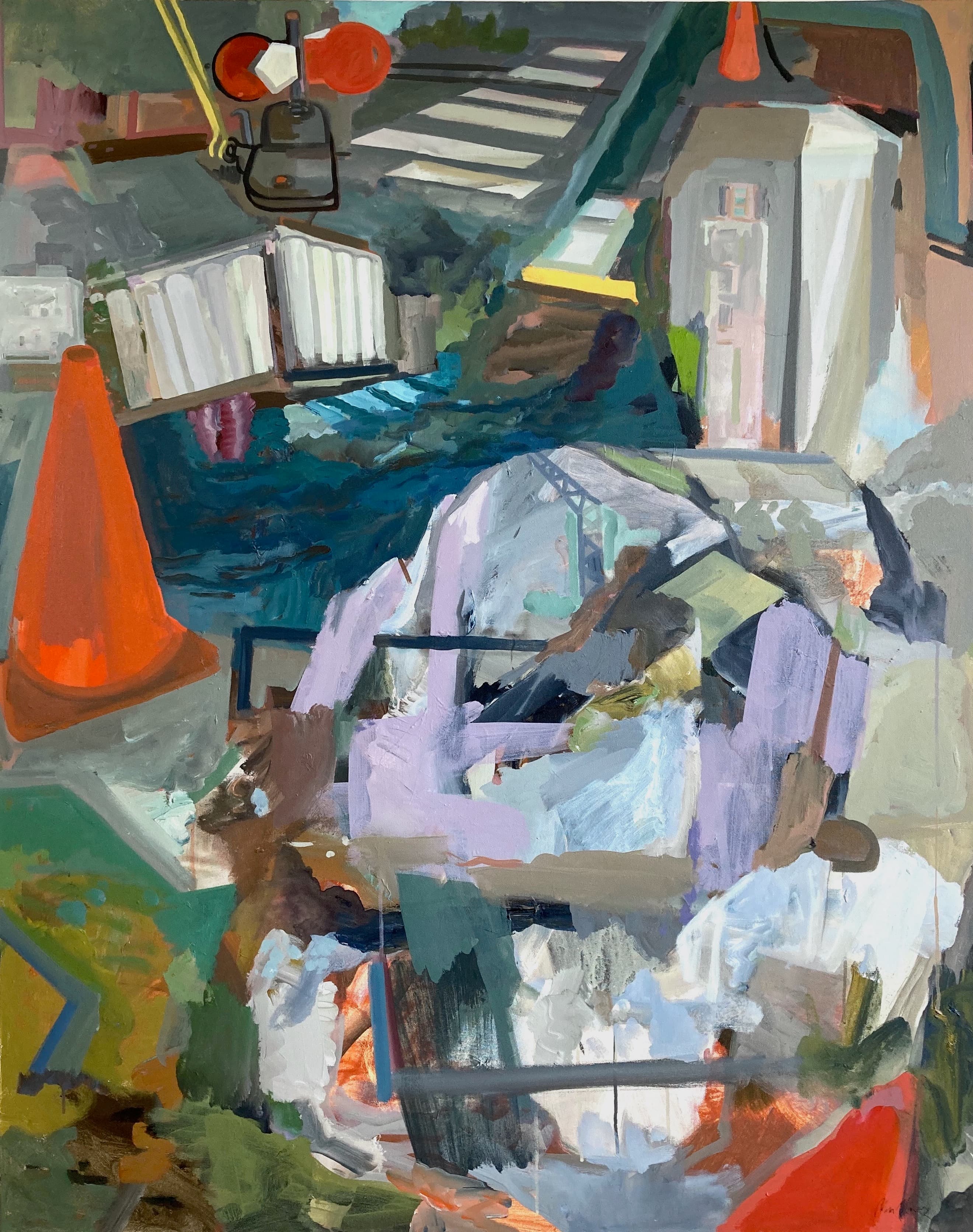
Rebecca Allan, Construction Site with Manual Switch and River (Bronx to Buffalo), 2018. Acrylic on canvas, 60 × 48 inches. Courtesy the artist and 447 Space.
The artist’s deep engagement with land conservation, environmental awareness, and the history of painting comes together in compositions that reframe classical motifs through her own abstract language. This is especially evident in works like Constellation in a Grass Garden (2023), whose circular format and vibrant palette recall the Rococo style, similar to contemporary Flora Yukhnovich who also reinterprets historical styles through an abstract lens. In Allan’s case, however, these references are grounded in the natural world, creating a dialogue between past and present, observation and imagination.
In Construction Site with Manual Switch and River (Bronx to Buffalo) (2018), Allan continues to blur the line between abstraction and figuration, evoking the fragmented nature of memory. She recalls elements of a construction site, but what remains most vividly is a single bright orange traffic cone. In this way, Allan’s works function as mementos, shaped not by literal representation but by the emotional and sensory traces that linger in the mind.
As I moved through the exhibition, I was struck by how Allan’s paintings mirror the way memory operates and how the mind recalls seemingly random, small details. They prompt quiet reflection on timeless questions: How does the mind layer impressions to construct the landscapes of experience? And most simple and salient: how do we remember?
Madeline Pittel is a contributor to the Brooklyn Rail.