Postures

Jean Rhys, ca. 1929. © ARCHIVIO GBB. Courtesy Michael Werner Gallery.
Word count: 1045
Paragraphs: 12
Michael Werner Gallery
September 12–November 22, 2025
London
Antoinette Cosway’s life begins to unravel when her childhood home falls to fire. Her mother breaks in its aftermath, slipping into a darkness from which she never returns. Years later, the circle closes. Antoinette burns, as if the fire had been waiting, patient and hungry. It is this path—marriage, madness, fire—that Jean Rhys traces in Wide Sargasso Sea, her postcolonial prequel to Jane Eyre. By 1966, when the white Creole writer published the novel at seventy-five, her life had endured its own fires: ruinous marriages, years lost to drink and despair, arrests for assault and public disruption, psychiatric confinement, and the derision of social exile.
At Michael Werner Gallery, Postures: Jean Rhys in the Modern World sees Pulitzer Prize-winning writer and curator Hilton Als continue his exploration of literary lives through art, following exhibitions on James Baldwin and Joan Didion. Postures brings together paintings, sculptures, photographs, and memorabilia, some from nearly a century before Rhys was born in 1890. They add up to a collage that, by evoking her memories and grievances in metaphorical images, heightens their fidelity to feelings rather than facts.

Installation view: Postures: Jean Rhys in the Modern World, Michael Werner Gallery, London, 2025. Courtesy Michael Werner Gallery.
The show begins and ends with Dominica, the Caribbean island of Rhys’s birth, which she later recast as the charged landscape of Wide Sargasso Sea. A Kara Walker drawing, Stages of Sugar Production: Planting (2014), depicts a Black woman shoving a stalk of sugarcane up a white man’s ass. With images like this, Als doesn’t shy away from the uneasy paradox at the heart of Rhys’s childhood: that her internalized oppression took shape within a freedom that displaced her own class. Her ancestors were slave owners, and their fortune crumbled after emancipation. “Old time white people nothing but white nigger now, and black nigger better than white nigger,” a friend reminds Antoinette, Rhys’s unmistakable stand-in.
Postures is attuned to the tension between Rhys’s racial essentialism and her struggle for self-definition. But the show also extends those inner conflicts into a broader history of power, privilege, and unstable hierarchies. An 1810 print by Agostino Brunias portrays free Black people in Georgian fashion—refined, dignified, and, most importantly, distinct from the enslaved. Next to it is a Hurvin Anderson untitled painting (2025) that conjures the fire at Antoinette’s family estate, which was ignited by a mob of ex-slaves. What lingers is the terrain glowing absinthe green beyond the smoke—the “green menace” that later haunts Antoinette’s English husband. He feels alienated by the land and so did Rhys.
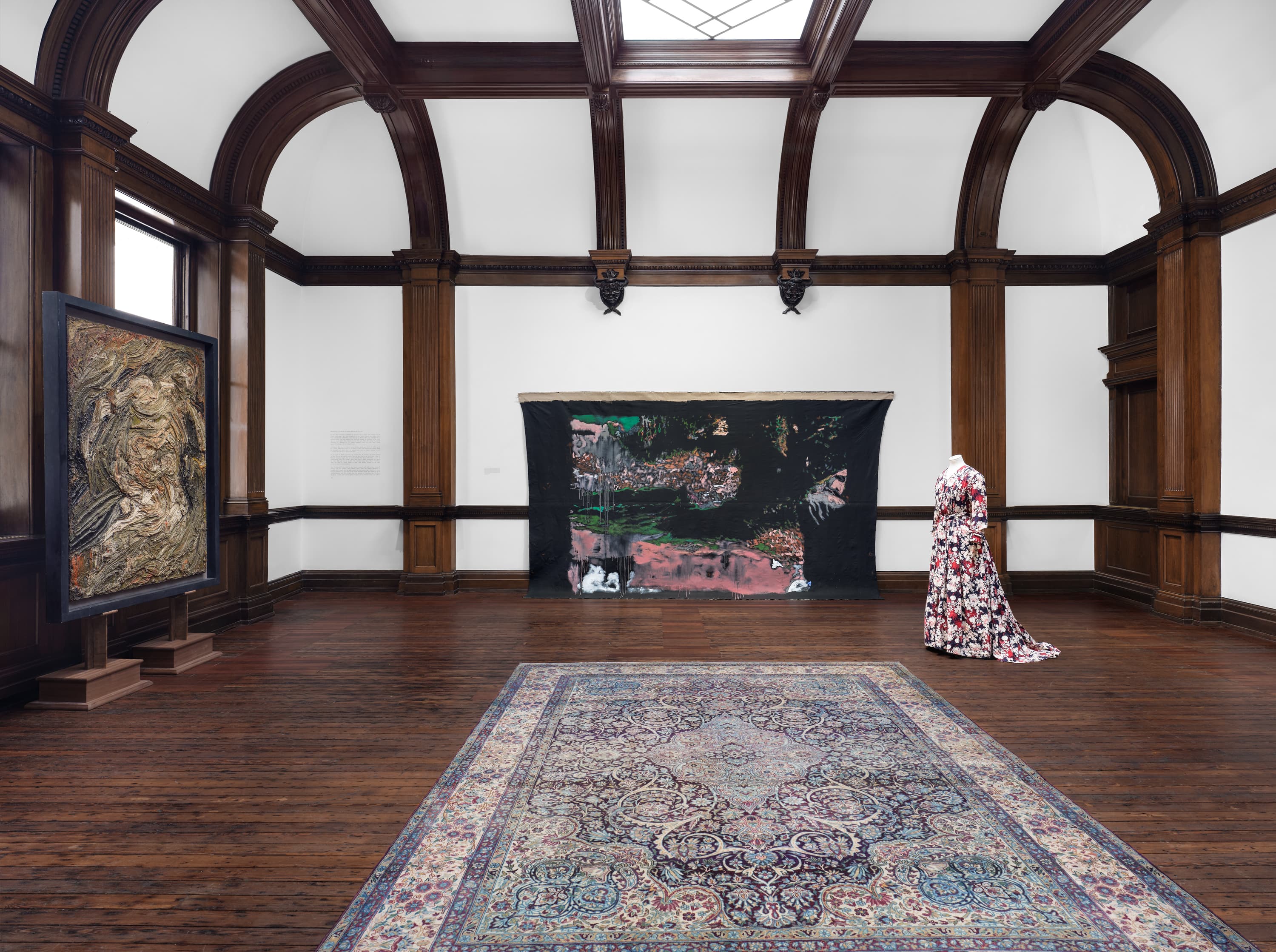
Installation view: Postures: Jean Rhys in the Modern World, Michael Werner Gallery, London, 2025. Courtesy Michael Werner Gallery.
From there, the show follows her as she left Dominica at sixteen and drifted from London to Paris to Vienna to Brussels, from chorus girl to mannequin to governess to prostitute, from lover to lover. Francis Picabia’s Tête de femme (ca. 1941–42), like a Hollywood studio portrait, evokes a woman staring out as if she hates and pities you at once. The same brew erupts in Rhys’s 1939 novel Good Morning, Midnight, when her proxy Sasha Jansen is suddenly seized by the impulse to strike an indiscriminate “you” with a hammer: “Crack it will go, the egg-shell; out they will stream, the blood, the brains.”
Als’s most obvious yet striking pairing is Hans Bellmer and Sarah Lucas. We know Bellmer’s perversely deformed doll, but here you’re drawn to her eyes, dazed and unfazed, while Lucas’s twisted legs curiously perch on a plinth of breeze blocks and fiberboard. Together, they challenge you to confront women’s suffering as an industry that exacts numbness from its victims. To that, an ink-on-paper work, Invitation to the Dance (2025), by Somaya Critchlow portrays a woman sitting cross-legged in her lingerie, a ghostly shadow looming behind her, but her expression suggests she has faced whatever comes next many times before.

Francis Picabia, Tête de femme, ca. 1941–42. Pencil, gouache on paper, 10 ¼ × 7 ¾ inches. © The Estate of Francis Picabia. Courtesy Michael Werner Gallery.
Then those ideas of repression take frightening form in Leon Kossoff’s painting of a figure gutted from within, Seated Nude No. 1 (1963), and Florian Krewer’s untitled painting (2021) of bodies flailing on fire. The intensely inward quality of these works echoes how a Rhys heroine, chronically broke and brokenhearted, doesn’t confront her grief—because she can “abstract” herself from her body, to borrow Rhys’s word from her autobiography Smile Please. Her point, I think, is that she learned to live with pain, but also to accept that, if she was doomed for disaster, prudence no longer mattered. So she and her characters drank until they forgot.
I find this to be the engine of Rhys’s writing: the ownership of her emotional volatility, inability to course-correct, and persistent sense of inadequacy. She lived a messy life, to which the novel came to serve as a means of hygiene. Prose imposes cause and reason, however arbitrary and solipsistic. It builds hidden patterns, premonitions, and thus fate. It always sides with this author because, unlike society, it sees good judgment as a seed of life’s banality, which the novel must upend. Postures fulfills that logic; it finds Rhys most compelling when she was groping for a great novel about mess and the threads of how she ended up there.

Hans Bellmer, Untitled, 1949, printed ca. 1949. Aniline-coloured gelatin silver print, 5 ½ × 5 ½ inches. © The Estate of Hans Bellmer. Courtesy Michael Werner Gallery.
Between Rebecca Warren and Kai Althoff emerges the first flicker of Rhys’s subversion. Warren sculpts clay into a form that seems to be recording its own physical journey into womanhood. Responding to that loss of innocence, Althoff paints four figures sprawled across a bed, a scene Als links to the moment when young Antoinette first wonders if happiness is a virtuous goal. One figure smiles as another aims a wand at them—the gesture verging on a stab. Antoinette discovers later in Wide Sargasso Sea that there’s only one entryway into heaven: “I could hardly wait for all this ecstasy and once I prayed for a long time to be dead,” she pleads.
In Victor Man’s Memorable Equinox (Girl with Goya’s Skull) (2024), the mystery of her mercurial desires is laid bare. A naked woman cradles a skull against her head, as if it were a plush pillow. Rhys confided in her diary that only by writing could she earn death—the one inevitability life cruelly withholds. But that’s precisely what she gave Antoinette. And so the madwoman in the attic burns in the fire she sets herself.
Minh Le is a London-based writer and journalist.