Ashley Garrett: Psyche

Ashley Garrett, Persephone, 2024. Oil on canvas, 94 × 57 inches. Courtesy the artist and SEPTEMBER. Photo: Pierre LeHors.
Word count: 775
Paragraphs: 7
SEPTEMBER
August 16–October 12, 2025
Kinderhook, NY
“If we opened people up, we’d find landscapes,” said auteur Agnès Varda, who knew as well as any artist that places have it in them to inhabit us, remaining vital in our hearts and minds after we’ve departed. The Hudson Valley has long since lured artists hoping to find sublimity in nature—or, at least, an enthusiastic muse—famously beginning with the Hudson River School and their formally resplendent vistas of titanic mountains, sparkling waterways, plantlife, and drama in the firmament. In Psyche, her third solo show at SEPTEMBER, Ashley Garrett taps into this rich tradition of observational painting, but with seventeen works that might be rightly dubbed abstract impressionism. They are not the landscapes as she initially saw them, but motes of a place transfigured by time and memory that are manifested in a maelstrom of varicolored paint.
The show opens with Gnossienne (2025), a large horizontal abstraction named after a suite for piano by Erik Satie. The French composer was known to line his sheet music with lyrical fragments of paratext; in his Gnossiennes, for example, Satie implored musicians to play “avec une légère intimité” (with lightweight intimacy) and in a manner that is “très luisant” (very luminous). These phrases may well describe the undercurrent of Garrett’s version, which erupts from its center as if a stone were just dropped into a pool of kaleidoscopic light. The left and bottom edges hold most of the picture’s chromatic intensity—fiery reds, oranges, and yellows intermix with aqueous blues and radioactive greens—whereas its middle is a splash of softer hues advancing toward all four corners of the canvas. One must stand back to admire the synergy of the brushstrokes in concert, but it’s worth getting up close to trace the path and pressure of each individual vector.
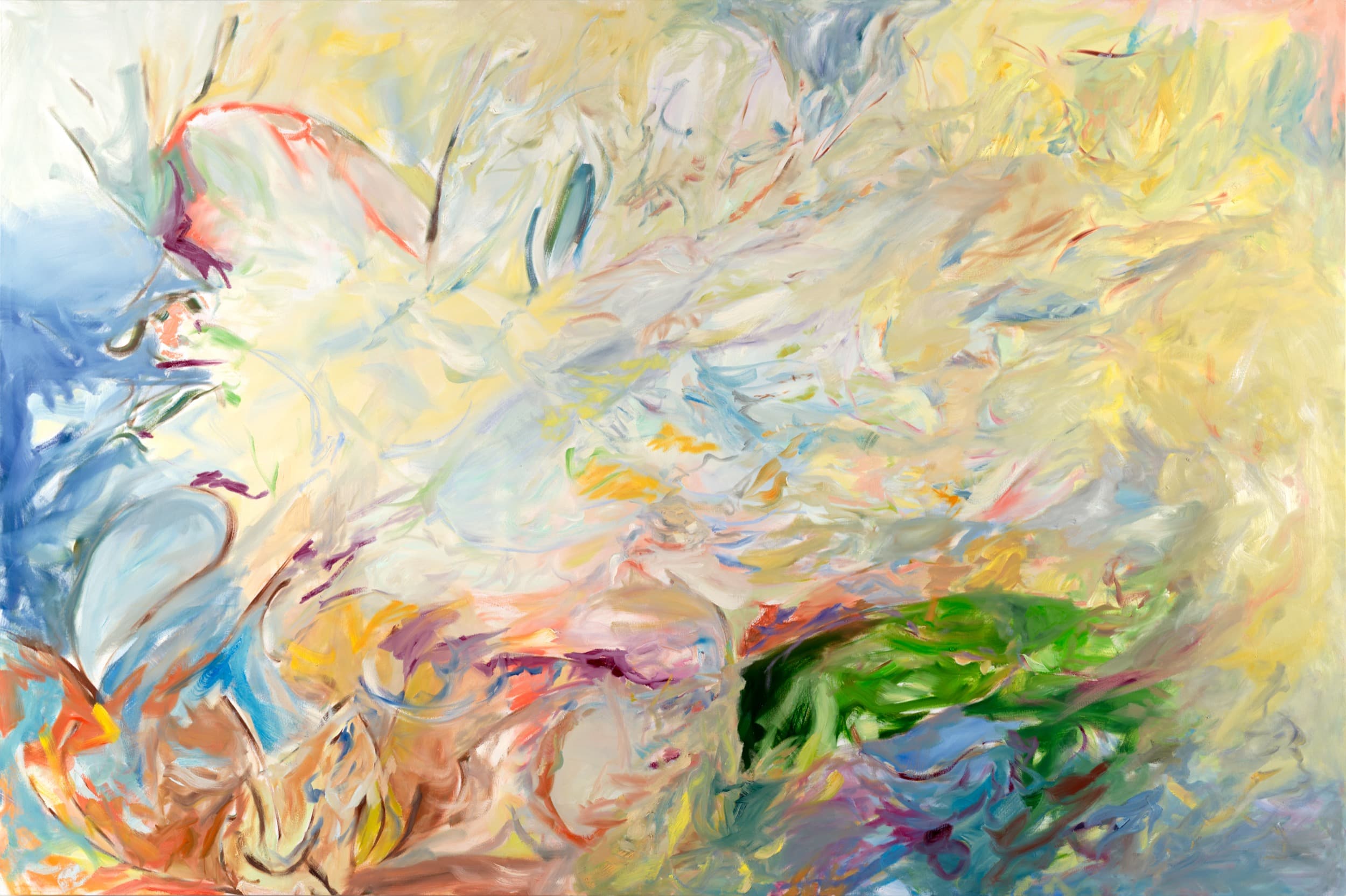
Ashley Garrett, Gnossienne, 2025. Oil on canvas, 70 × 105 inches. Courtesy the artist and SEPTEMBER. Photo: Pierre LeHors.
Garrett creates space by relating marks of various weight and scale, convincingly implying depth without explicitly describing objects. This strategy is prominently applied in Persephone (2024) and Vocare (2025). Looming large at nearly eight feet tall, Persephone ambiguously suggests a figure ethereal enough to be the goddess of springtime herself. The painting’s finest lines of purple, blue, and yellow waver around her ankles like flowers excited by the return of their mother. Just beyond them, she is modeled in wider, paler swaths of paint that do not so much define her features as they convey her radiant aura. Vocare is the closest thing to a conventional landscape in the show, and is similar to Persephone in that the contents of its foreground are starkly rendered in focus. Tall stalks coalesce in vibrant thickets on either side of a path, which leads to a vaguer horizon of swirling blue and gold gestures.
But generally, Garrett is less concerned with the portrayal of recognizable personages and places than she is with giving form to the intangible spirit that courses through nature. She paints intuitively, drawing as much from within as from without. The interwoven licks of color in Alighten (2024) conjure peripheral darkness and distant levity—a light at the end of the tunnel, so to speak, promising emergence from a treacherous position. The painting Anthousai (2024), titled after an archaic name for a flower nymph, emanates nascent joy. Fluid commas of bold pink and dry smears of azure waft across the canvas like petals carried by an aromatic breeze. And then there are the totally non-representational pieces like Breathwave (2025), Echoalia (2024), and several small works on paper, wherein the corporeality of Garrett’s referents is dissolved into filaments of unfettered energy.
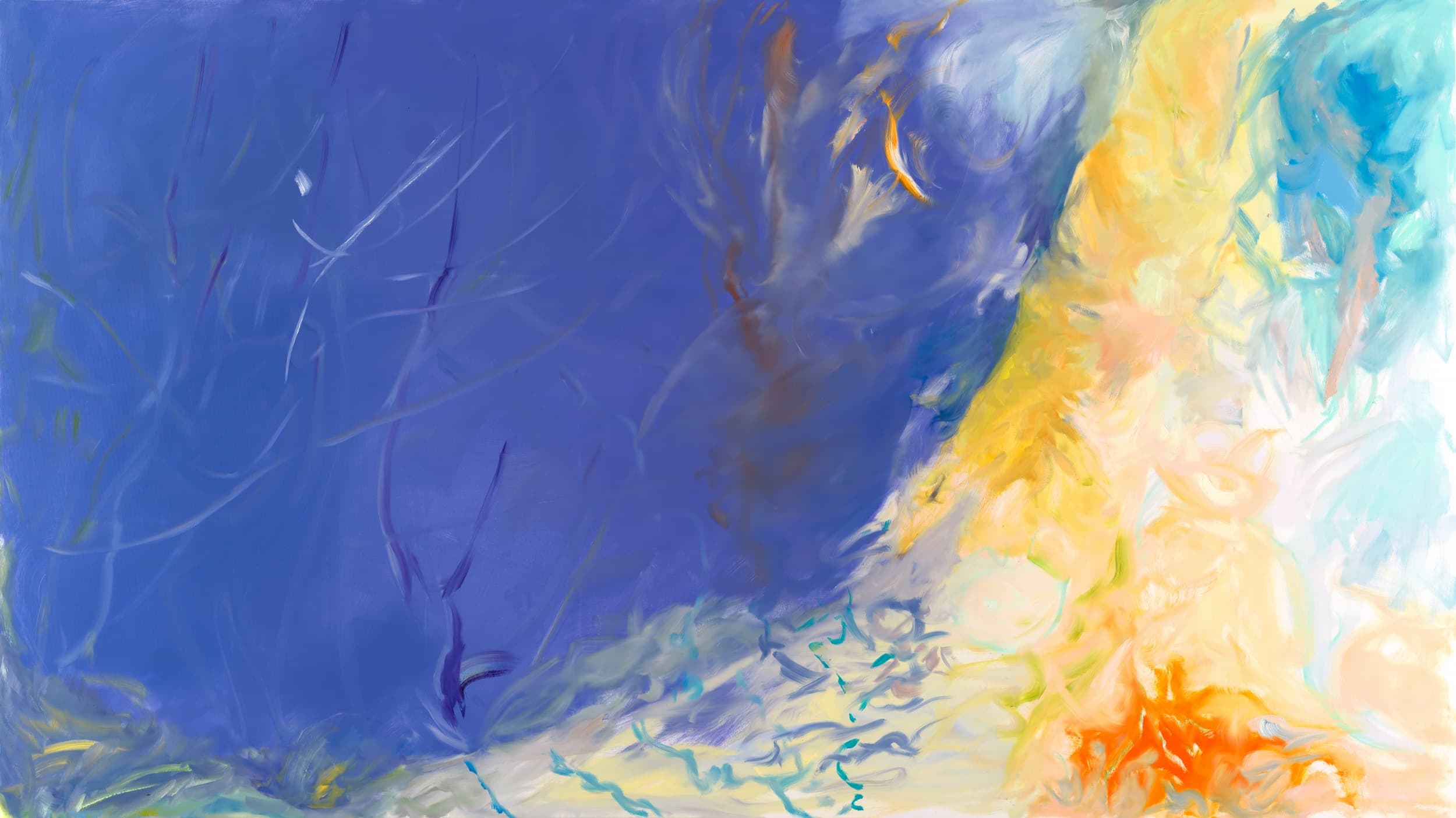
Ashley Garrett, Welling, 2025. Oil on canvas, 65 × 115 inches. Courtesy the artist and SEPTEMBER. Photo: Pierre LeHors.
The largest painting in the show is the outlier, but not for its sheer magnitude. Spanning almost ten feet across, Welling (2025) calls to mind Thomas Cole’s View from Mount Holyoke, Northampton, Massachusetts, after a Thunderstorm—The Oxbow (1836). Structurally similar to Welling, Cole’s painting pits two disparate forces against one another, inciting an epic drama via their juxtaposition. It shows a rainstorm receding over one half of the painting so it is tonally divided in two, contrasting a nearby forest saturated with rain and a sunlit plain extending to the distance. The rightmost third of Welling (2025) is dominated by a spire churning with luminous strokes of yellow, peach, and orange, whereas the several hundred square inches of purplish-blue to its left are the quietest in all of Psyche. It is the only place in the entire show where Garrett blends her marks throughout a considerable area. This restraint is what distinguishes the painting and completes the big picture—here is the eye of the storm, a moment of charged stillness at the axis of ecstatic life.
Matt Moment is a contributor to the Brooklyn Rail.