Marion Greenwood: Portrait and Self-Portrait
Beyond a written portrait of Greenwood’s life, this book provides detailed context for the historic moments and forces that enveloped her.

Word count: 805
Paragraphs: 12
Joanne B. Mulcahy
University of Alabama Press, 2025
When Marion Greenwood died in 1970, the New York Times published a measly 161-word obituary for her. It noted her art studies in New York and Paris, the frescoes she painted in Mexico in the 1930s, and the award-winning figure paintings she created in the years after—some of which, it pointed out, were held by the Metropolitan Museum of Art, Pennsylvania Academy of the Fine Arts, and Library of Congress.
A recently released biography for this maverick modern artist—the first for Greenwood—aims to tell a fuller story. It follows over a decade of research and interviews by biographer Joanne B. Mulcahy and makes the case that Greenwood belongs more securely in twentieth-century art history (albeit among those who charted less trendy paths). Beyond a written portrait of Greenwood’s life, Mulcahy provides detailed context for the historic moments and forces that enveloped her.
Greenwood’s story begins with her eccentric family based in Sheepshead Bay, Brooklyn, including her house painter father, two brothers who were commercial artists, an artistic sister, and a grandmother who was a self-taught landscape painter. Committed to the arts from a young age, Greenwood dropped out of high school and set out on her unconventional track.

Marion Greenwood with Self-Portrait, 1948. Copyright and courtesy the estate of Marion Greenwood.
She studied at the Art Students League in New York as a teen before being accepted to the Yaddo residency program. An early commission to paint a portrait of a Yaddo co-founder paid enough for her to travel to Europe for the first time, at age nineteen. While there she participated in a group show at a Parisian gallery and impressively sold four works, befriending other artists including Isamu Noguchi (who became a lifelong friend and occasional lover).
The biography details her studies in the New York studio of artist Winold Reiss, a multicultural gathering place that hosted nude model sessions where men and women could sketch together, which was deemed progressive at the time. It also explores her formative relationship with novelist and journalist Josephine Herbst, who she met at Yaddo, and how their friendship evolved into a romance and mentorship linking them for decades. Their correspondence, held at Yale’s Beinecke Library, is a major primary source for the biography and quotes from it allow us to read Greenwood’s unadulterated voice.
It was with Herbst and her husband (in a complex love triangle) that Greenwood first traveled to Mexico in late 1932—initially to expat-packed Mexico City and then to quieter Taxco. The owners of the popular Hotel Taxqueño there commissioned her to paint a mural; called Taxco Market (1933) and finished just before her twenty-fourth birthday, it made her the first woman to paint a public mural in Mexico (others had been mural assistants until then). This marked the first of her Mexican frescoes and she’d paint others over the next couple of years, some under the supervision of Mexican muralist Diego Rivera.
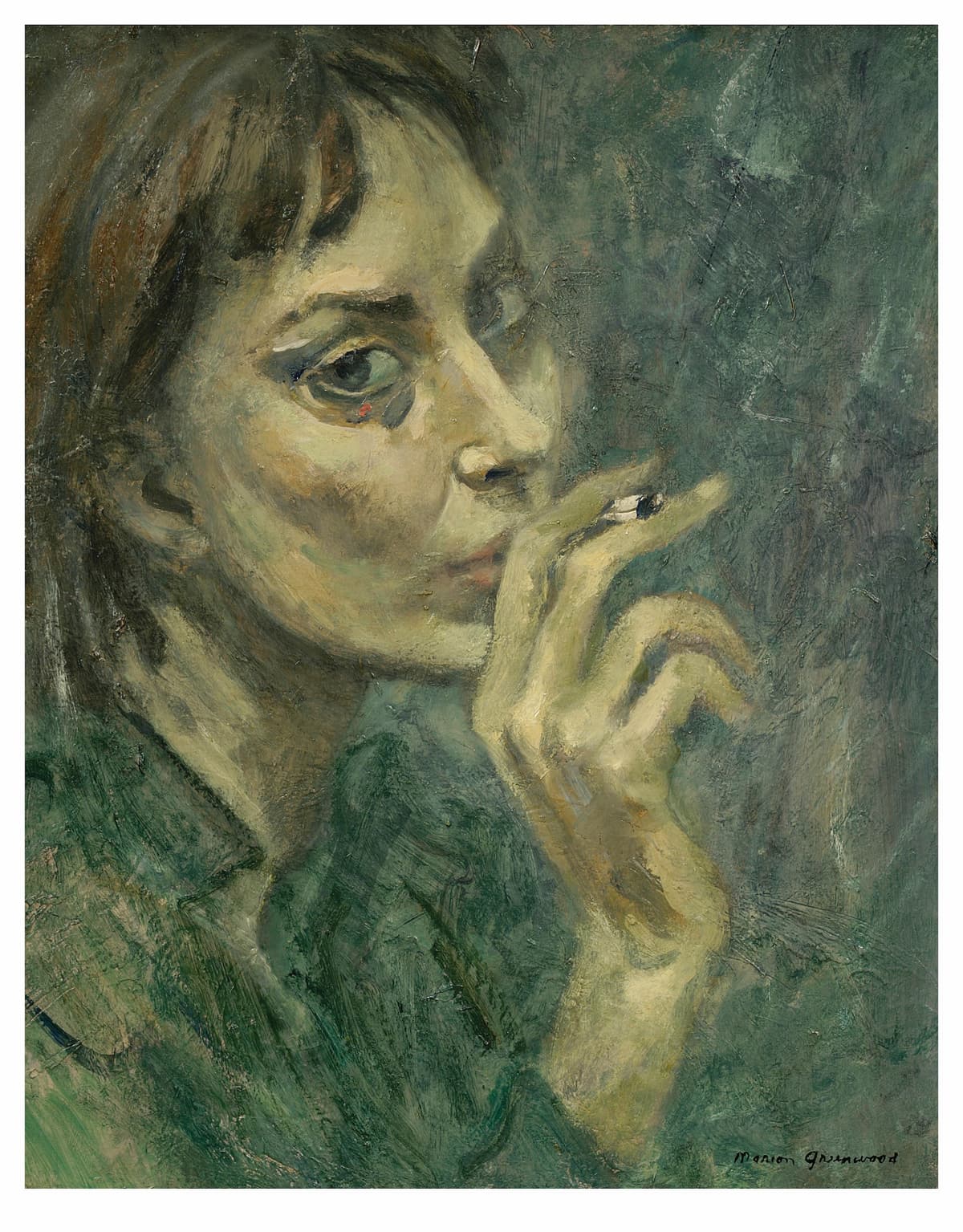
Marion Greenwood, Self-Portrait, 1954. Copyright the estate of Marion Greenwood. Courtesy the National Academy of Design, New York / Bridgeman Images.
Greenwood dreamed of painting murals in her native United States, though, and in a 1933 letter to Herbst wrote, “Oh, I’ve got so much to do if I’m only able to get walls.” Those commissions eventually came, too: a mural at the Westfield Acres housing project in New Jersey (1936–38), a post office mural in Crossville, Tennessee (1940), a mural for the Red Hook Housing Project in Brooklyn called Blueprint for Living (1940).
One of her last murals—and one that made her the subject of renewed attention over the past couple decades—was about the history of Tennessee, painted when she was a visiting professor at the University of Tennessee, Knoxville, in 1954–55. Greenwood considered this her best work in the US, but scrutiny of it decades after it was painted and after her death regarded some of the figures as illustrative of racial stereotyping. Mulcahy considers the complexities surrounding this mural, noting that Greenwood painted it at a time when the university had no Black undergraduates yet she chose to paint eight of the twenty-seven figures Black. The mural was vandalized in 1970 (for unclear reasons), then covered up, and ultimately unveiled in 2006 and transferred to the Knoxville Museum of Art in 2014.
“Marion was, in short, a woman artist determined to defy the demands of a conformist time,” Mulcahy writes. “She stayed true to her artistic impulses as the art world exercised its own orthodoxy.” Greenwood’s realism and portraiture were always out of sync with art movements of her moment, leading her to say that she felt out of tune with her abstract contemporaries.
Still, despite feeling mismatched with other artists of her day, an unstoppable creative drive propelled Greenwood’s lifelong artistic work. She put it into words, in a birthday greeting she sent her mother from Mexico: “Creative work is the only thing that makes life worth living.”
Karen Chernick is a Tel Aviv-based arts and culture journalist.