Change Change Chance: Remembering Robert Wilson (1941–2025)
Word count: 1565
Paragraphs: 30
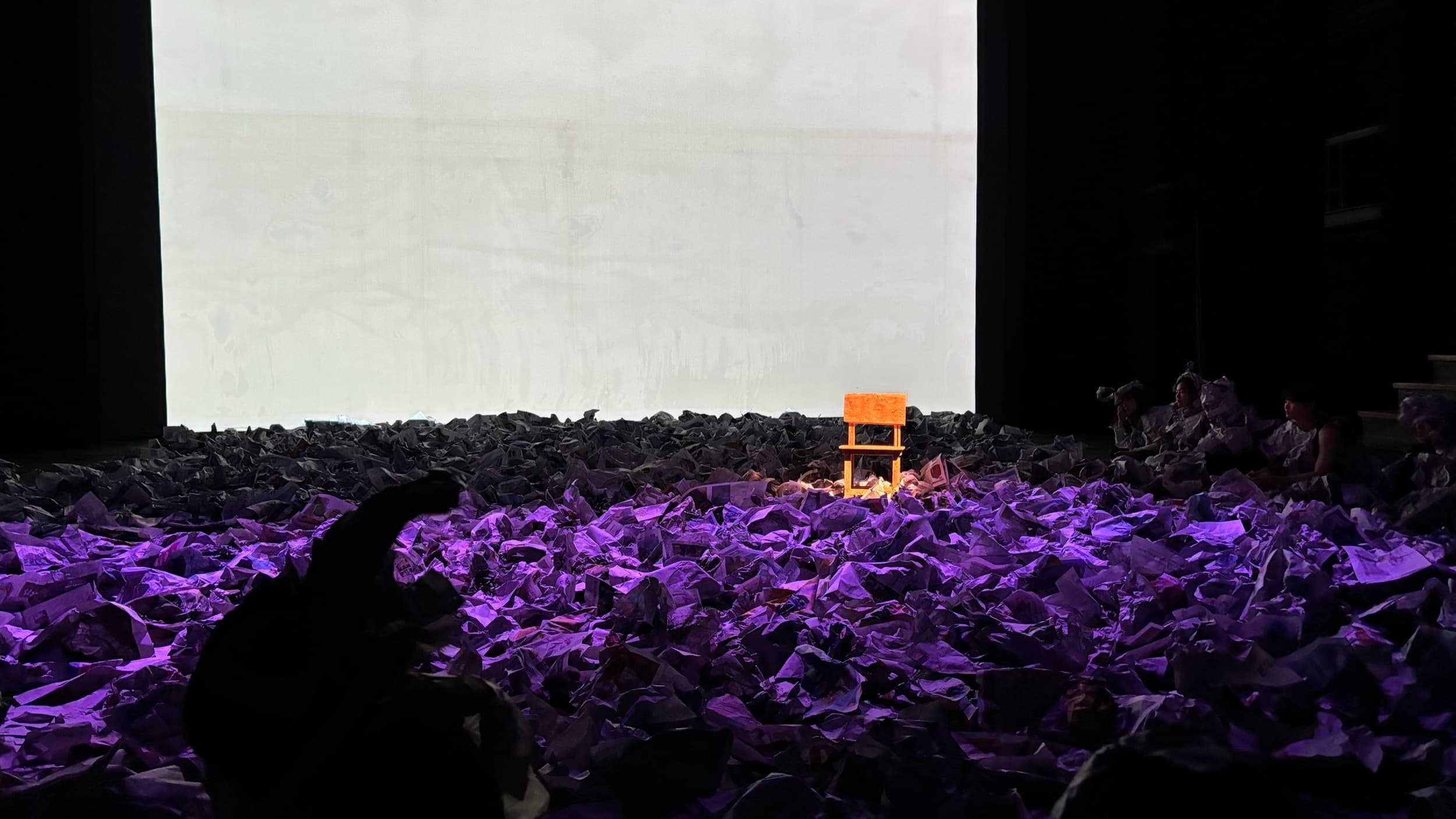
Robert Wilson workshop at the Seoul Institute of the Arts (2024). Photo courtesy SeoulArts.
One week before we were to share the stage at La MaMa Experimental Theatre Club in New York—a space that nurtured Bob’s experimental beginnings—the world learned that Robert Wilson had passed away. This isn’t an obituary; it’s a reflection on the ways Bob changed everything for those of us who believe theater is an art of time, space, and vision—a place to congregate, experiment, and reflect.
In searching for words, I return to images: a rehearsal in Berlin, the light on a teacup, a torn piece of newspaper that said “CHANGE.” This is my attempt to share some of the lessons I learned from Bob—carried within those images—about process, patience, and becoming. But first, how did I end up in Berlin working for Robert Wilson in 2009?
In 2006, fate intervened. While working at an art gallery, the elevator doors opened and out stepped Bob. “You’re Robert Wilson!” I blurted. “I am,” he smiled, amused by the recognition. He came searching for a Buddha head that had sold, but I got his email address.
That email became my lifeline in 2008. While earning my MFA in Directing at the University of Texas at Austin, I wrote asking to meet Bob at the Watermill Center’s open house, hoping for an internship on a project. His assistant replied, “Ask for me when you are here, and I will arrange a meeting with Robert Wilson.”
On a UT-Austin travel grant, I went to Long Island and waited all day. Bob was constantly surrounded—giving tours, explaining artworks from the Watermill Collection. The event wound down, the sun was setting. I stood by my rental car, defeated—but decided to try once more.
Some staffers around back said, “I think he’s out front.” Sure enough, I found him posing on a rock. The photographer took his shot and walked away. The journalist recorded Bob’s answer and said goodbye. Suddenly, we were alone—Bob’s blue eyes gazing at me. “Hello,” I said. “Hello,” he replied. “May I walk back with you?” I asked. “Yes,” he said. Lesson 1: Persistence pays.
Weeks later, he invited me to assist on a revival of Einstein on the Beach with New York City Opera, but the project was canceled due to the 2008 financial crisis. I followed up about other opportunities. He wrote, “I will do the Sonnets in March/April in Berlin; it is a creation, maybe this would be most interesting for you.” He was right. Sonnets became one of the most formative experiences of my life.
At my first rehearsal with Bob in Berlin, he was seated in the center orchestra—never taking his eyes off the stage. “The scrim is dirty,” he said. “Where, Bob?” asked someone onstage peering at the scrim. No one saw the dirt, but Bob did. He asked for a new one, and they delivered. Lesson 2: Train your eyes to see everything.
Late evenings were the only time I had alone with Bob. He’d end rehearsals around 10 p.m., and we’d work in his office until midnight, faxing Watermill fundraising letters all around the world. One night, he asked something like, “What’s it like to watch me direct?” I fumbled for an answer and said something cliché like, “It’s like watching a painter.” But a German assistant replied, “I don’t know how to say it in English. But there is no dirt.” Lesson 3: Work long. Work hard. No dirt.
Later, I watched Bob spend forty-five minutes lighting a teacup. I timed it. He adjusted and adjusted until the object wasn’t just visible—it sang. He sculpted time and space. His patience was radical in an age of speed, and his work reminded us that theater is an act of deep looking and listening.
Bob said joining the Sonnets team meant being ready to jump in for anything. One of my first tasks was building mock scenery. I was crafting a foamcore flat-screen TV when a design assistant cried, “No! Bob won’t approve. It’s not perfect. Do it again.”
Another time, Bob looked at a chair and asked, “What color should it be? Red? Can we make it red?” The hospitanten [assistants]—myself included—leapt into action. But how? No red tape, no paint—so we shredded a red plastic bag and stuck it on. It worked. The red chair was in!
Bob’s work demanded collaboration. Everyone at Berliner Ensemble worked extremely hard. The respect for craft was unparalleled. From followspot operators to performers, great care and attention to detail mattered. It was the difference between making a Mercedes-Maybach and a Mazda3. Lessons 4: Concentrate intensely. Practice patience. Details write the whole.

Sketches by Robert Wilson for Sonnets (2009) at the Berliner Ensemble.
Bob spoke in images. He always kept white paper and graphite pencils nearby. If he imagined a snake or an apple, he drew it and handed it off for someone to make it happen. Drawing was his first language.
Before leaving Austin for Berlin, I received a copy of Bob’s director’s book for Sonnets, which contained his sketches. The piece was built on theme and variation. He envisioned the scenes connecting via a figure eight. One page showed that loop with the words “kiss of Kundry” beside it—small delights for the dramaturg. Lesson 5: Don’t tell—show.
Bob leaned on his designers and dramaturg to help clarify his vision. Though he avoided telling actors what to think and explaining the meaning to his audience, behind the scenes he welcomed dialogue. He valued and listened to everyone’s opinions. It’s even possible that one of my questions sparked the genesis of a new Wilsonian motif.
In March 2009, while Bob searched for an ending image, I sent him a note with a small suggestion: “I wonder if there’s a way to illuminate the floor, like they’re walking on light?” Later, he introduced fluorescent tubes at the foot of the stage, aimed at the audience. As far as I know, from then on, floor lighting became a recurring element in his work. Whether my suggestion helped or not, or if sparked by something else, what stayed with me was how open Bob was to exploring new ideas—and how he expanded them in ways only he could. Lesson 6: Find your people, compose with everyone, and arrange ideas with care. As Anne Bogart said, “Ideas are cheap. It’s how you arrange them that’s interesting.”

Robert Wilson on stage at Berliner Ensemble directing Sonnets (2009). Photo: Luke Landric.
From his glacial tempos to his sacred treatment of light as another character, Bob’s unconventional and interdisciplinary methods inspired generations of artists and reshaped how artists and audiences experience theater.
When Bob was twenty-one, American modern dance pioneer Martha Graham told him something like, “If you work long enough and hard enough, you’ll find something.” And he did. Rooted in the fine arts, Bob developed a new way to make performance. He used what the proscenium stage allowed, and he maximized within those limitations.
Bob also cared deeply about accessibility. He wanted theater to be understood worldwide. This may be why he didn’t rely on English to carry his messages. His global collaborations and the Watermill Center redefined theater as a lab for art, not just performance. He said, “Politics divide us. Religions divide us. But the arts bring us together.”
Bob arguably redefined the “playwright.” While most are associated with words, Bob composed with images. His visual books told stories through structures, characters, light, sound, music, movement, and scenography. Without these elements, his writing didn’t exist.
The last time I saw Bob was in November 2024, when he gave a landmark lecture and workshop at the Seoul Institute of the Arts, where I now teach as Assistant Professor of Experimental Media and Performance. During an acting workshop, he covered the stage with newspapers. Afterward, I spotted a student holding a torn advertisement that read “CHANGE”—but the faint line inside the G left a second word: CHANCE. Bob signed it: “CHANGE CHANGE CHANCE for Luke. XXX B.”
Soon after, I got to work writing a new project, the ATOMIC war: a cloud is best measured when it is up, inspired by Bob’s early monumental piece, the CIVIL warS: a tree is best measured when it is down. We were scheduled to reunite on August 7, 2025, at La MaMa—seven days after he passed—to celebrate his life and launch the next chapter. Lesson 7: Get comfortable with uncertainty; the only thing constant is change.
The figure eight symbolizes Bob’s eternal influence, infinitely looping in our hearts and minds. Like all great masters, he left behind a legacy for the artists he inspired to carry forward.
I’ll never know the answers to the questions I wanted to ask him on August 7, or have the chance to give him a better answer to his question about what it was like to watch him direct, but those who knew him or about him will understand—I wish I’d told him, it’s how I imagine I’d feel watching George Balanchine choreograph.
Ironically, one of my favorite poems, written by German-Swedish poet Nelly Sachs, references figure eight, and I dedicate it now to Bob:
Am in strange parts
protected by the 8
the holy looped angel
He is always on his way
through our flesh
creating unrest
and making dust ripe for flying
Our common practice was to sign off emails with the word “love,” and that’s the final lesson—the most important lesson of all. Lesson 8: Choose love, always.
In loving memory of Robert Mims Wilson (1941–2025)—mentor, friend, and fellow Texan.

Newsprint signed by Robert Wilson (2024). Photo: Luke Landric.
Luke Landric is a contributor to the Brooklyn Rail.