MusicSeptember 2025In Conversation
VIKTORIIA VITRENKO with Ondrej Veselý
Word count: 1743
Paragraphs: 24
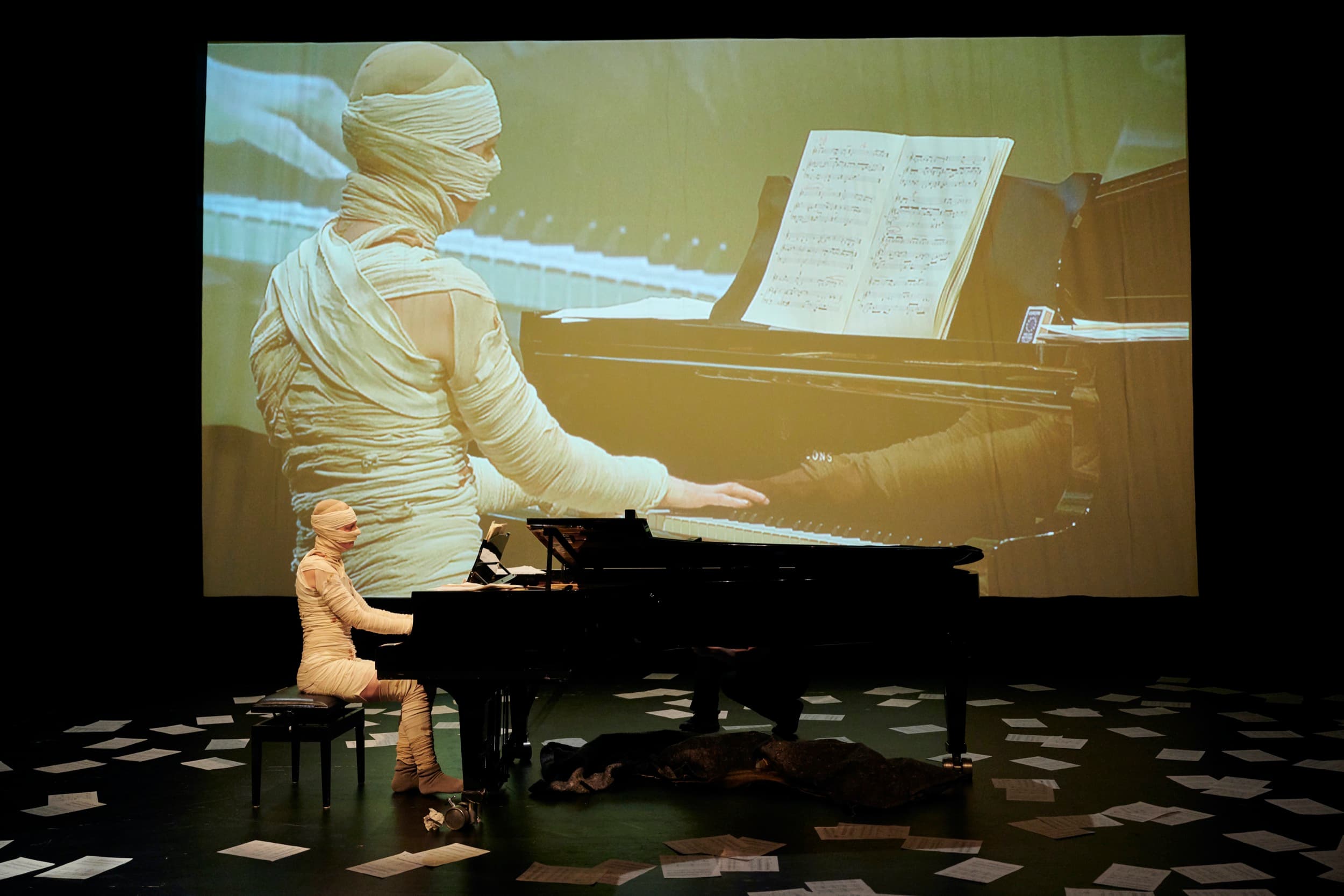
Viktoriia Vetrenko. Photo © Martin Sigmund/ECLAT Festival.
In dangerous, reactionary, confusing times, Ukrainian soprano, conductor, and curator Viktoriia Vitrenko stands out as one of the leading voices of her generation in European contemporary music. Praised for her clear, pure voice and profound expressivity, she has received international acclaim, including nominations for the German Record Critics Award and the International Contemporary Music Awards. Her debut album György Kurtág: Scenes (Audite, 2019) featured chamber music by György Kurtág. At the beginning of this year, Vitrenko released her first solo album, Limbo (Kyiv Dispatch)—dedicated to Belarusian musician and activist Maria Kalesnikava—a powerful artistic response to isolation, trauma, and political injustice, featuring vocal cycles from a compelling selection of contemporary composers includes Agata Zubel, Alla Zagaykevych, Ying Wang, Sven-Ingo Koch, and Maxim Shalygin. Vitrenko sings and accompanies herself on piano.
I discovered Limbo quite by chance when I heard a fragment of Shalygin’s songs, and I was instantly hooked by the sound and aesthetics. As I listened further, I found myself immersed in sensations and emotions that I hadn’t experienced in contemporary music for a long time. This album is powerful and penetrating, speaking deeply to the core. It evokes a subtle charm of romanticism, but within the context of contemporary sound—as an internalized feeling of the individual, whether artist or audience. In my conversation with Vitrenko, she reflected on the role of art in times of crisis, the emotional and physical challenges of performing under extreme conditions, and the complex ethical questions surrounding cultural expression in the shadow of war.
Ondrej Veselý (Rail): Limbo explores themes of isolation and injustice and is dedicated to Maria Kalesnikava, who is currently imprisoned for opposing Belarus’s regime. What inspired this project?
Viktoriia Vitrenko: It was conceived during the pandemic, in 2021, when I was sitting in my room during lockdown and couldn’t practice my singing or playing. My neighbors banged on the wall every time I started; it was a depressing state that created a lot of psychological pressure. When music is your life and someone takes it away from you, you feel trapped inside your own walls. You’re alive, but you’re not living your life; you’re allowed to exist, but not to exercise your needs or freedom.
My idea was to project the same kind of in-between state onto the imprisonment of Maria Kalesnikava. At that time, she was already in a prison in Minsk under investigation which, of course, was completely fabricated. A third reason for the project was the looming question of whether Russia will invade Ukraine. From that perspective, this kind of liminal space—of uncertainty, of being in between—made me feel it was the right time to develop the project.
Rail: Limbo addresses painful and complex themes. How did you translate these emotions into an artistic expression/project?
Vitrenko: I introduced the idea to Christine Fischer from the New Music Festival ECLAT, who had worked with Maria before. We developed the concept as a staged performance. But I always knew the music itself was strong enough to be presented without staging. It’s a unique format in contemporary music—I haven’t seen anyone else do it. Throughout, I kept asking myself, how can I portray this in-between state, this loneliness and isolation? It was clear—I had to be the sole performer. Being a conductor implies a background in piano, so the singer-songwriter idea came naturally. Then I asked myself, can complex contemporary music sound not complex, but very approachable? Out of this thinking, the format emerged: a singer-songwriter framework within contemporary music.
Rail: The selection of composers was a crucial decision for such a project…
Vitrenko: I immediately thought of Alla Zagaykevych, with whom I had previously worked, to commission pieces addressing the Russian invasion of Ukraine. I loved her idea to use poems by Donetsk poet Iya Kiva, who has lived in a state of limbo since 2014 [Editor’s note: In 2014, an armed conflict erupted in Donetsk when pro-Russian separatists declared independence, leading to the ongoing war in Eastern Ukraine]. Next, I invited Polish composer and singer Agata Zubel, knowing she would craft beautiful vocal lines essential for this project. Then my friend Maxim Shalygin introduced me to his vocal cycle Songs of Holy Fools, which I premiered in its original singer-songwriter form. I also included German composer Sven-Ingo Koch, whose songs I admire, especially those featuring poems by Jan Wagner.
Finally, Christine Fischer suggested Ying Wang for the stage performance. I wanted a diverse song cycle with different aesthetics and a performative piece to avoid being behind the piano all the time. Ying’s father, Wang Xilin, was imprisoned in China for his cultural opposition to the regime, which fits deeply into the project’s themes of political injustice and human suffering.
Rail: Liminality, which is the overarching theme of Limbo, represents personal, cultural, or aesthetic transition. Given the profound trauma caused by the Russian invasion of Ukraine and ongoing war, has your experience of liminality created space for healing?
Vitrenko: As an artist and musician, my purpose is to create a space where you can individually and very openly express yourself—be it trauma, a scream, opposition, or simply your reaction to reality. I don't think it literally helps me heal all my trauma, but it helps me to process this difficult situation. This anxiety has been ongoing since summer 2020 and is not only related to Ukraine.
Rail: Does it change your perception of musical time, and does accompanying yourself on the piano intensify the emotions you convey on stage?
Vitrenko: I thought a lot about the emotional side—how would I feel this isolation, emptiness, and vulnerability—because this program is very much about vulnerability, about allowing myself to fail on stage while completely alone. For me, that is the highest truth an artist can offer, especially compared to classical music, where everything must be perfect. This led me to ask myself, how can we respond differently when we are dying inside, screaming, or collapsing? Perfect sounds won’t convey that.
It remains vital for me to show this vulnerability on stage because the program lasts over an hour, with just me singing and playing piano, sometimes using extreme vocal techniques or quasi-folk screaming from Ukraine. It’s an intensely emotional performance, and maintaining the same level of control throughout is challenging. As I said, it would be untrue to act as if nothing were happening, to myself, my body, my voice. The voice, as an instrument, is the truest reflection of emotion. I’m not saying I fail every time, but I’m always on a fragile fringe, close to collapsing.
When recording this album, I collapsed on the fifth day. At that moment, I thought I couldn’t continue. The recording took place near Kyiv, with daily commutes through Irpin and Bucha. I saw corroded cars, ruined homes, emptiness, and isolation. That’s when I realized this was exactly what I needed to convey. If I collapsed or failed, I wanted the audience to feel it in the recording.
Rail: Just a few years ago, we could hardly imagine that basic certainties once taken for granted would be so deeply shaken. Despite this fragility, I notice some young people distancing themselves from political realities, perhaps hoping the challenges will pass. How do you see the relationship between art and politics today?
Vitrenko: That’s a valid question, and not just for the younger generation. I see this even among people my own age. Many German artists focus on issues like gender, LGBTQ+ rights, and democracy, which are important and shouldn’t be disregarded. Still, everyone has the right to remain silent… But when you face certain issues firsthand and feel compelled to express your opposition or opinion, art becomes the right medium, the right space to do so. I believe art creates a safe space, even when expressing political views publicly. In this sense, it is both an opportunity and, to some extent, an obligation—if one feels compelled—to bring these topics closer to those who might not otherwise engage with them.
Rail: Today, a common reaction to the ongoing attack on Ukraine is a general ban on Russian art. Many radio stations and festivals no longer feature Russian works. On one hand, this is understandable—there’s reluctance to promote representatives of Russian culture. On the other hand, history shows that collective guilt has often led to unfortunate decisions. I’m not entirely sure what the right approach is. How do you personally view the idea of a blanket ban on Russian music at festivals and public programs?
Vitrenko: This is a very difficult and painful question. As a Ukrainian, I support a complete ban on Russian music and art because excluding these works from international programs creates space for Ukrainian culture, or any other culture that has been systematically ignored by Western programmers. This opportunity to showcase Ukrainian culture means more to me than the ban itself. It allows greater reach and awareness of Ukraine’s rich cultural heritage, increased collaboration for Ukrainian artists, and enhanced visibility of Ukrainian art. I strongly believe that consistently integrating Ukrainian compositions into regular programming, not just as exotic or supplementary additions, will ensure their lasting presence beyond the context of this war.
At the same time, having lived in Germany for thirteen years, I have friends who left Russia years ago for political reasons. They support Ukraine, donate money, and host refugees. They are empathetic and understand the historical situation. It’s hard to turn your back on them just because they haven’t renounced their citizenship. Recently, I watched a discussion between the head of the Ukrainian Institute and a renowned Ukrainian author about the ban on Russian culture. Many arguments were made, but ultimately it seems impossible to fully ban Russian culture from festivals and venues, even temporarily. So, a change in approach is necessary. For me, the focus is on creating greater visibility for Ukrainian musicians and composers, especially female artists, and supporting other Ukrainian creatives in the best way I can.
Rail: Do you have any contact with Maria Kalesnikava? Does the Belarusian regime allow any form of correspondence?
Vitrenko: No! I know she never received my letters. The regime claims she doesn’t want to see anyone, which is obviously false. Very recently, in November, her father was finally allowed to visit her. But for a year and a half, she was completely cut off, no one even knew if she was still alive. So unfortunately, no, we are not in contact, and she is not allowed to receive any correspondence.
Ondrej Veselý
Ondrej Veselý is a guitarist, writer, and composer specializing in contemporary music, with a focus on collaboration with living composers. He is the author of Music in Music, a book on polystylism in Eastern European music, and a radio host on Rádio Devín (Slovak National Radio), where he presents programs on new and experimental music.