2nd Best Dance Company’s Light Labor
Hannah Garner’s new dance theater work laughs, tumbles, and subverts its way to an expertly unresolved and appropriately vague non-conclusion about the human condition.

Annie Morgan and Channce Williams in Light Labor, 2025. Photo: Zui Gomez.
Word count: 816
Paragraphs: 10
Light Labor
Green Lung Studio
July 24–August 2, 2025
New York
2nd Best Dance Company and its director/choreographer Hannah Garner could easily be many things they are not. Where the dances could be pleasingly pretty and abstract, they are challengingly narrative. Where those narratives could be moralistic or didactic, they are poetically silly. Light Labor, Garner’s new dance theater work performed for small audiences at Green Lung Studio is an exercise in subverting expectations and undercutting clichés.
Performed with humor, intensity, and vulnerability by Annie Morgan and Channce Williams, Light Labor places its seemingly platonic but obsessively bound-together characters (“Annie” and “Channce”) in a world both like and unlike the one outside the studio walls. It begins simply enough: Channce lying on the floor in stillness, gradually stirring to movement, and reaching out to grasp Annie’s nearby leg. The twist is that Annie narrates this process, describing Channce’s movements, their subtexts, why it’s a “powerful choice” artistically, and her authority to speak to the situation (she knows him really well).

Annie Morgan and Channce Williams in Light Labor, 2025. Photo: Zui Gomez.
This sets up one of the major conceits of the piece: that the absurd, heightened nature of performance can reveal something truthful, and equally absurd, about our pedestrian relationships and concerns. On stage, movements, relationships, and outcomes are generally predetermined—but that doesn’t make them feel any less consequential. In the proceeding seventy-five-ish minutes, the characters explore what keeps people together or drives them apart, and how we contend with our inability to control anything beyond ourselves.
A few times, Annie and Channce excitedly play a game that begins by one of them striking a pose and saying “do me,” clueing us in to an existing dynamic and rule set. “Doing” them involves engaging in a nature documentary description of the posing person (sometimes complete with a Steve Irwin Australian accent). It’s a goofy activity to watch, and it speaks to the characters’ deep desire to understand how they are seen and whether they can control it. It’s also one of the ways they wield their intimacy as both a tool for connection and a weapon for dominance (though both tool and weapon are more balloon art than hard metal).
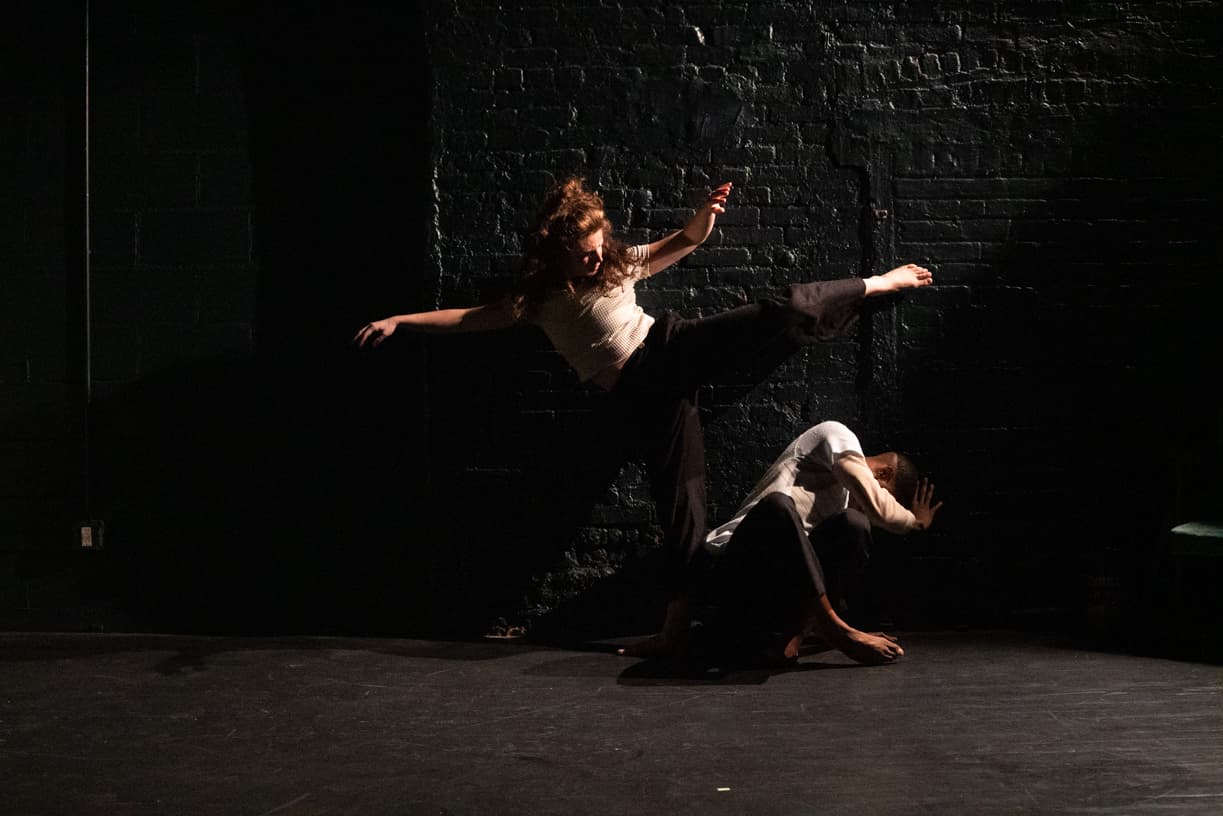
Annie Morgan and Channce Williams in Light Labor, 2025. Photo: Zui Gomez.
The choreography is robust and precise, but only to provide a safe skeleton for physicalizing the chaos of their world. When partnering, the dancers roll into and out of each other’s joints and crevices, sharing and toppling their weight effortlessly. Virtuosic movement is undercut by a self-effacing demeanor. Self-serious or wholly committed moments are paired with intentionally hokey movement or deflated by a laugh line. Near the end of the piece, Annie muses on whether or not the sun is a sentient being, aware of her status in the universe. Then, she exits and reenters dressed in an inflatable sun costume and tap shoes. Her tap solo is as complex as a seventh grader’s dance recital number, with equally as much determined focus, dramatically scored by R.E.M.’s “Everybody Hurts.” Watching her, Channce offhandedly applies aerosol sunscreen (the rare and exciting experience of smell in a dance show).
It’s difficult to overstate how much the piece relies on Morgan and Williams’s utter commitment and versatility. There is a Beckettesque quality to how seriously they take their little world and strange games. Something of foils to each other, Morgan projects with a musical theater–adjacent earnestness, while Williams’s naturalistic delivery gets many of the biggest laughs of the evening. While one of them performs a sweaty dance solo, the other sits upstage wearing sunglasses and eating Doritos. They bravely act the fool, rocking the wigs and garish makeup donned mid-show for a shockingly long time.

Annie Morgan and Channce Williams in Light Labor, 2025. Photo: Zui Gomez.
The 2nd Best physicality is a superlative example of the effortless virtuosity and casual decadence of today’s post-post-modern aesthetic. A lot of people are working in this or adjacent modes—making dances that are physically rigorous (see: high legs, big jumps, cool lifts) but strive for a Judson-like lackadaisical musculature. Garner is able to do something singular by instrumentalizing this recognizable movement vocabulary in pursuit of narrative, humor, and explicit commentary on the human condition. While remaining unpretentious, her storytelling imbues the movement with meaning, making each of the angular, carefully placed arm gestures and flung leg extensions greater than the sum of their parts.
The piece ends with a repeat of an earlier conversation where they decide to “be really present” for a while. It’s never so clear that someone is freaking out about the future as when they talk about “being present.” Annie and Channce sit in visible, vague, silent consideration for more seconds than you’d expect. The mid-reflection blackout is a perfect non-conclusion. We’ll never know if “being present” resulted in some grand revelation about life, love, and loss. For us, they’ll be frozen in time, forever considering the way things are now and the way they could be.
Hallie Chametzky is a dance artist, writer, archivist, and organizer based in New York City.