BooksSeptember 2025In Conversation
THE CYBORG JILLIAN WEISE with Alex Dueben
Word count: 2972
Paragraphs: 48
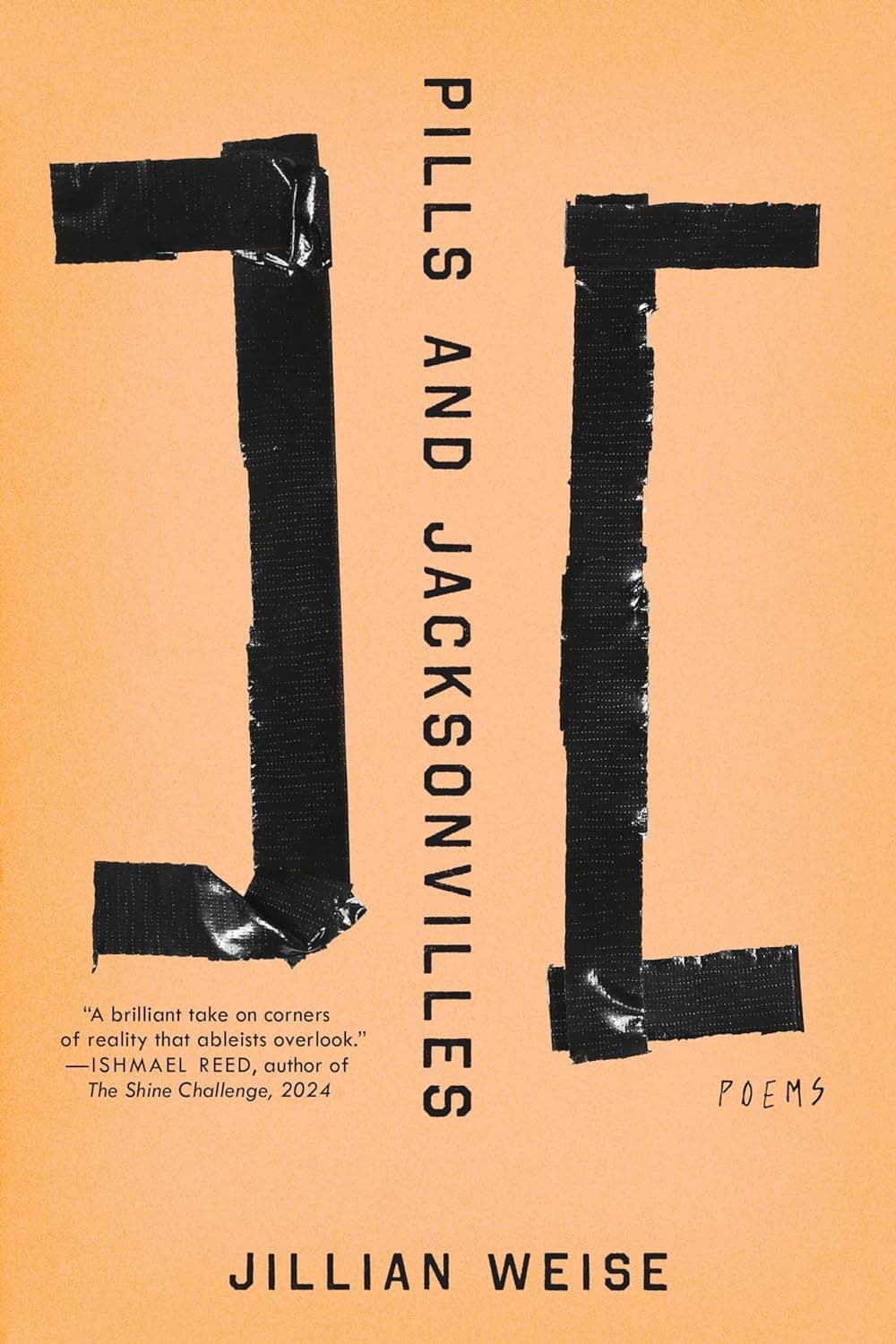
Pills and Jacksonvilles
Ecco, 2024
In 2024 Ecco published Pills and Jacksonvilles, a new book of poetry by The Cyborg Jillian Weise, and the collection has a lot in common with Cy’s previous books featuring experimenting with form, utilizing classical styles, with heartbreak and outrage, anger and sadness side by side. It is also a book that is very open about bisexuality, polyamory, and how this deeper understanding of the self can be used to consciously question poetic forms and styles.
One of the poems from that collection “So Your GF wants to Come Out as Bi and Polyamorous to Her Very Conservative Family” closes out Stephanie Burt’s new anthology Super Gay Poems: LGBTQIA+ Poetry After Stonewall, and I spoke recently with Cy about that poem, writing invectives, humor, and confounding the reader.
Alex Dueben (Rail): I really enjoyed Pills and Jacksonvilles and one of the poems people have really connected with is “So Your GF wants to Come Out as Bi and Polyamorous to Her Very Conservative Family,” which also closes out the new anthology Super Gay Poems. I’m curious about the poem and deciding on this structure of using tercets and your use of “she” and “you” and “I.”
The Cyborg Jillian Weise: I have been enamored with William Carlos Williams and H.D., so when I go to the tercet, I’m getting what I know of it primarily from them. The poem is true to life, insofar as I’ve been engaged to a poet who’s a cis man for years and then fell in love with a genderqueer poet. I decided to become polyamorous and came out to my family. I didn’t quite anticipate until read-throughs with friends that the pronouns were going to be confusing. I go by Cy professionally, but I publish as Jillian, so I’m confusing, basically. [Laughs] I am the girlfriend of the title wanting to not be myself, I suppose. Not be the first person “I" in the poem and to try to explore in art what happened.
Rail: The poem addresses “you.” It starts out as a telling of things, but then “you” becomes implicated in these events.
Cy: When you say that, it makes me think, there’s so much I wish that someone knew. How partners might support each other in those sorts of situations. I felt a complete absence of support in the direct aftermath of coming out to my very conservative family. It can be accusatory. The “you” becomes accusatory. This desire to kind of displace me as first person to explain what the “you” might do.
Rail: It is accusatory. The reader is hopefully a little uncomfortable, because we all have had those moments where we were not who other people needed us to be. The poem doesn’t let “you” off the hook, and it also makes clear that that’s not the point.
Cy: The ending, “Come Out Alive,” was just a gift. I didn’t really know where we were going with the poem when I was writing it. There’s the truth of what happened and then there’s the art of the poem. I just wrote, “Come Out Alive.” We don’t need anything except for queer people to feel as though we can come out alive in any kind of scenario.
Rail: I kept thinking about polyamory in terms of the poem, besides it being written in tercets, there are first, second and third person in the poem, reinforcing this idea that there are multiple people and perspectives and responses to this one event.
Cy: This is something that I deliberate in my work because I’m so schooled in the notion of the “thou” and “beloved,” the “I” and “you.” Becoming polyamorous troubles the way that I learned to read poetry. I hope that lots of polyamorous poets or poets with non-traditional relationship styles are coming up and into language thinking about, how do we revise or reimagine the beloved if it’s not just one beloved, but multiple romantic beloveds?
Rail: This is a poem very much in conversation with so much of your work over the years. One aspect of polyamory or bi+ identity is that it’s about this opening up. A kind of expansion of your life and yourself.
Cy: In polyamorous circles, we talk sometimes about a catalyst relationship. That’s resonant for me, because I just fell completely in love with this person. I was already in love, and stayed in love with my fiancé. It was like a lightning bolt. I wasn’t looking or experimenting or open to falling in love. It just sort of happened to me. Trying to capture that relationship was a big part of the book. Even though the relationship ended, it was transformational.
Rail: In so many of your poems, you’re very interested in dealing with this expansion of the self and change in identity. Not as an intellectual metaphor, but as something raw and visceral.
Cy: I hope that readers can feel it. I hope that the emotion comes through. It’s a book that was really vulnerable because of all of that feeling. I felt exposed because of coming out to my readership as polyamorous, bisexual—and also a dominatrix. I already was aware of the dom identity. It’s clear in the book prior to this one, but it’s the first time that I’m naming that identity. The other identities were a total surprise to me. Coming into my bisexuality, queerness, and polyamory was a huge surprise to me. I love how poetry kind of knows before us sometimes, because now when I go back to poems, I’m like, oh, I was always polyamorous. I just was being a side chick or practicing unethical monogamy.
Rail: For so many queer people—and especially for bi+ people—there is a moment of realization where things change. And almost everyone looks back and goes, I missed a thousand other signs along the way. Which is to say that one of my favorite poems in your book was “Serenade After the Fact,” which is about this.
Cy: It is. It’s about how I should have known about my bisexuality. I did know. I didn’t take it seriously. I thought it was fantasy. It goes from confusion into clarity with the presence of this incredible human being that I met.
In high school, bisexuality wasn’t really available or possible to me, but the emotion was so strong. It was so vivid. That actual woman has appeared elsewhere in other configurations in my work, because I suppose she’s a precursor to what I would find out in my thirties.
Rail: One of the threads running through the book is heartache.
Cy: I’m a yearner. If I’m happy and content, I’m probably not writing. [Laughs] I’m interested in desire, in the subconscious, and what I don’t know. I probably can’t even tell you why I write. It’s the yearning and it’s the insatiableness that is so exciting to me. That plays out practically in my romantic life. Some of it makes me think it’s practical, in terms of being a poet in the US in 2025, where I’m going to take the job in this part of the country. Then poets I fall in love with are in other parts of the country. There’s not really one location for poets. You know about the academic job market. Heartbreak comes with the art, to a certain extent.
Rail: You’ve written poems about love and desire, but there’s a lot of bittersweetness in there. Is that just the register you respond to or how you think of things?
Cy: I think so? It’s hard for me to tell. I’m figuring out how to be queer in the world and envisioning a future that isn’t cookie cutter. Marriage isn’t the goal, so what does a non-relationship escalator relationship look like? When I say I’m long distance for over a decade, people tend to still ask the question, when will you be together? At a certain point, that’s no longer a question. I’m sure some of the bittersweetness is the choice of putting the art above the love life. Which plenty of poets don’t do—probably smartly—by dating engineers or something. [Laughs] The poems I want to read are bittersweet, unhappy, unperfect. Longing for something or after someone. I love those kinds of poems.
Rail: Like a lot of people, I love your invective poems like “Catullus Tells Me Not to Write the Rant Against Maggie Smith’s ‘Good Bones’” but I’m sure you really don’t want to be a persona who just writes invective poems about other poets or poems or organizations.
Cy: I don’t ever want the poems to be a gimmick. I always mean them very sincerely. I’m still optimistic because I wait for engagement. I wait for the poet, who I’m writing an invective of, to say something back. Maybe I’m ignorant in a way in that those conversations don’t happen on the page—or maybe off the page, except for a whisper network way. I feel like if you get poets together in a room or on a Zoom, and then you get the real opinions. Who really likes whose work. When it comes to the page, everyone suddenly is in church or something. Part of my approach to the invective is having a libertine sense that I can speak frankly about poems that I sincerely have some aversion to.
Rail: I remember reading “10 Postcards to Marie Howe” which was about a poem of hers that was not very good. She’s written so many that are far better.
Cy: She has written really stunning poems.
Rail: It’s easy to talk about those poems of yours as pushing against a too polite literary culture, but they are also very thoughtful critiques of how we use language and our way of thinking.
Cy: Thank you. That’s my hope. That I can take this rant that’s somehow connected to poetics, and get it to the page. And to be funny. I definitely intend it to be fun. I don’t want to be the police and I don’t want to be some nagging, politically correct persona. I’m always looking for the really anarchic; I’ll say it since no one else will. And I’m looking for the fun.
I want to praise Natalie Shapero and her book coming out soon, Stay Dead. I’m bringing her up, first of all, because I just think she’s brilliant. But also because I often will teach my students about poets and I think there’s only one contemporary poet who, if I show you the poem you can tell whose poem it is. Like, you can tell an E. E. Cummings poem. I think Natalie Shapero does that really exceptionally right now. The work is fantastic, but it’s also singularly hers. I say that because I don’t want this reputation as someone who only tears down other poets. I tear down Maggie Smith and Marie Howe, probably because I love them, right? I have such expansive feelings about the work that I must speak about it when it hurts me.
Rail: Part of your poem about “Good Bones” is about the way it became a meme and not just the poem itself, and in your poem—I don’t want to say that you’re putting forward an alternate theory of poetics, that’s overstating it. But you are responding in multiple ways on multiple levels.
Cy: That’s very kind. That’s a very generous reading. I’m looking at Catullus’s Hendecasyllabics and I’m getting permission from him that maybe I can go after this poem and have a good time with Catullus. Unfortunately at Maggie Smith’s expense, but she doesn’t care. The thing about that poem is that people have told me that I just don’t understand that “good bones” is a real estate metaphor. Which to me is an even bigger joke. Once again, the disabled poet just didn’t get it. No, I’m asking us to look at it in a deeper, different way. There’s a lot of defense for that poem. Maybe it isn’t even so much defense for that poem as this idea that we can do this. Can we critique poems in this way? I hope so. Let’s do more of it!
Rail: One thing that the invectives have in common with a lot of your work is that you want to be entertaining and theatrical. Poems can be deep and intellectual and emotional, but you also want to entertain the reader.
Cy: Definitely. I want people to laugh. I want people to laugh at me sometimes out of felicity. I definitely want to entertain. I also want to press against what a poem is. You’ve seen the video sonnets where I’m trying to figure out a video, heaven forbid TikTok, and can be abridged into sonnet length or form. That’s about play and fun.
Rail: I feel like your sense of humor isn’t always appreciated by critics, but it’s such a key to your work.
Cy: I feel like sometimes people are afraid to laugh. I want people to feel like there’s an irreverence to the work. Deep feeling, but irreverence, too. It is actually very difficult to get people to laugh. If you can get one person to laugh at a poetry reading, I feel like you’ve done the good work for the night. Not all people—or poets—are funny. Some couldn’t make you laugh in person, much less on the page. I feel like there’s some over-estimation of sincerity in poetry. Often I’m the one looking for the laugh or the humor or yeah, this is terrible, but it’s also kind of funny.
Rail: I did want to talk about Super Gay Poems, which your poem closes out.
Cy: I was so honored by that.
Rail: I’m curious how you see the poem in relation to the others in the anthology.
Cy: I think Stephanie is brilliant. When she reached out and said, “I’m doing a book called Super Gay Poems,” I said, “Great.” When I got the book, I realized that I misunderstood the concept of the anthology. I was like, what am I doing in this book with all of the poets I admire and look up to from the past and from the present? I was astounded to be included in the book and grateful to Stephanie for my work to be situated in such a book. To be in the company of other poems. I mean, this is a highlight, right? To see how far we’ve come with women’s rights, gay rights, trans rights and liberation. It was such a wonderful experience to get the book in the mail and see that poem in a lineage with so many poets far better than me. I just feel honored to be in the book. Stephanie’s work, both as a poet and as a thinker, is incisive. I just feel humbled that she chose to write about my poem and put this in context with other poets.
Rail: You thought, it’s an anthology, I’ll be included with three-hundred pages worth of other poems. You open it up and realize, no, there’s actually not that many poems, and there’s a five page essay about you and your work.
Cy: She was so kind. We talked a bit about her essay, but I don’t think I quite realized that it was going to be a lot of Stephanie’s brilliance and a lineage of poets. We have so many anthologies. I figured, I’ll probably see twenty-five gay poets that are also my friends. This is quite different. It’s just such a highlight to be included. Especially as a poet in the South. I’m in Tallahassee now. We have a great queer and trans scene in Tallahassee, but still, it’s the South. To feel connected and plugged in through that anthology has been wonderful. I was grateful to Stephanie because nobody would publish the poem in magazines. It was maybe too long. It gave me a renewed sense of confidence in the poem itself. I was so grateful to her.
Rail: Was it the length? I know length is always an issue. Were editors confused by how you played around with pronouns?
Cy: I think it was about length and what is this roving speaker that’s addressing the “you”—wait, “you”? “I”? I think it was a difficult poem for people to get behind. I want to believe that there aren’t a lot of other poems like it, right?
Rail: That difficulty is what makes it good but also makes it hard to get an audience in the first place.
Cy: It is a difficult poem. Off the top of my head, there’s only one poem that I know of that has a dildo in it. It’s a great poem, though. It’s Carl Phillips. I don’t mean to just make a joke out of a strap on, because I genuinely want more poems of all sexualities, any sexualities. I want asexual poems where there are no toys. The complete spectrum of our sex lives.
Rail: We talked about humor before and here you wrote a poem with a dildo, but it’s not funny, it’s very serious. Just to confuse readers more about what they might expect.
Cy: As someone who works in poetry and prose, I’m thinking about bodies all the time. I’m an amputee. I already have a prosthetic. I think that there’s been such a boring limitation on bodies because non-disabled people have been writing them. Or disabled people, who are terrified someone might find out they’re disabled, have been writing bodies. I’m so grateful that in the last couple of decades, there’s been this renaissance of disabled writers who are starting to give voice and liberate us from these quite boring, non-disabled bodies that are taken as the standard. The given.
Alex Dueben has written for many publications including the Believer, the Paris Review, the Rumpus, the Los Angeles Review of Books, and the Comics Journal.