Kim Chong Hak, Painter of Seoraksan
Word count: 775
Paragraphs: 7

Kim Chong Hak, Pandemonium, 2018. Acrylic on canvas. © Kim Chong Hak. Courtesy the artist and the Kim Chong Hak Foundation. Photo: Kim Tang-Sae.
High Museum of Art
April 11–November 2, 2025
Atlanta, GA
Mountains are the first museums, I often remind my students, and not just because mountaineering and museum-going affect similar fatigues on the body. The oldest artworks are found in mountainous caverns across the world, from Indonesia and the Iberian Peninsula to the Andes and the Pacific Northwest. These prehistoric sites demonstrate the capacity of mountains to hold memory, to keepsake and preserve, often through isolation. Little wonder artists from Alexandre Calame to Katsushika Hokusai have made mountains so central to their work. Little wonder art so often returns to the mountain in times of unrest, even today.
Kim Chong Hak, Painter of Seoraksan, the contemporary Korean artist’s first US museum survey on view at the High Museum of Art, returns once again to the mountains—specifically, Mount Seorak, the titular Seoraksan and largest peak of the Taebaek Mountain range that runs along the eastern coast of the Korean Peninsula. Kim, whose family was displaced from the north during the Korean War, studied art and lived abroad before settling on Seoraksan in 1979, making its diverse climate his primary subject. Since then, the artist, who continues to paint, has produced a body of work both movingly quiescent and surprisingly boisterous. His most famous works consist of large-format landscapes dotted with forest flowers and meandering kudzu; for instance, the four-panel Pandemonium (2018)—which fills the museum’s walls until it wraps around the corner—is a lesson the artist takes directly from the mountains, their forests curving up to the verticality of the peak, surrounding the viewer.
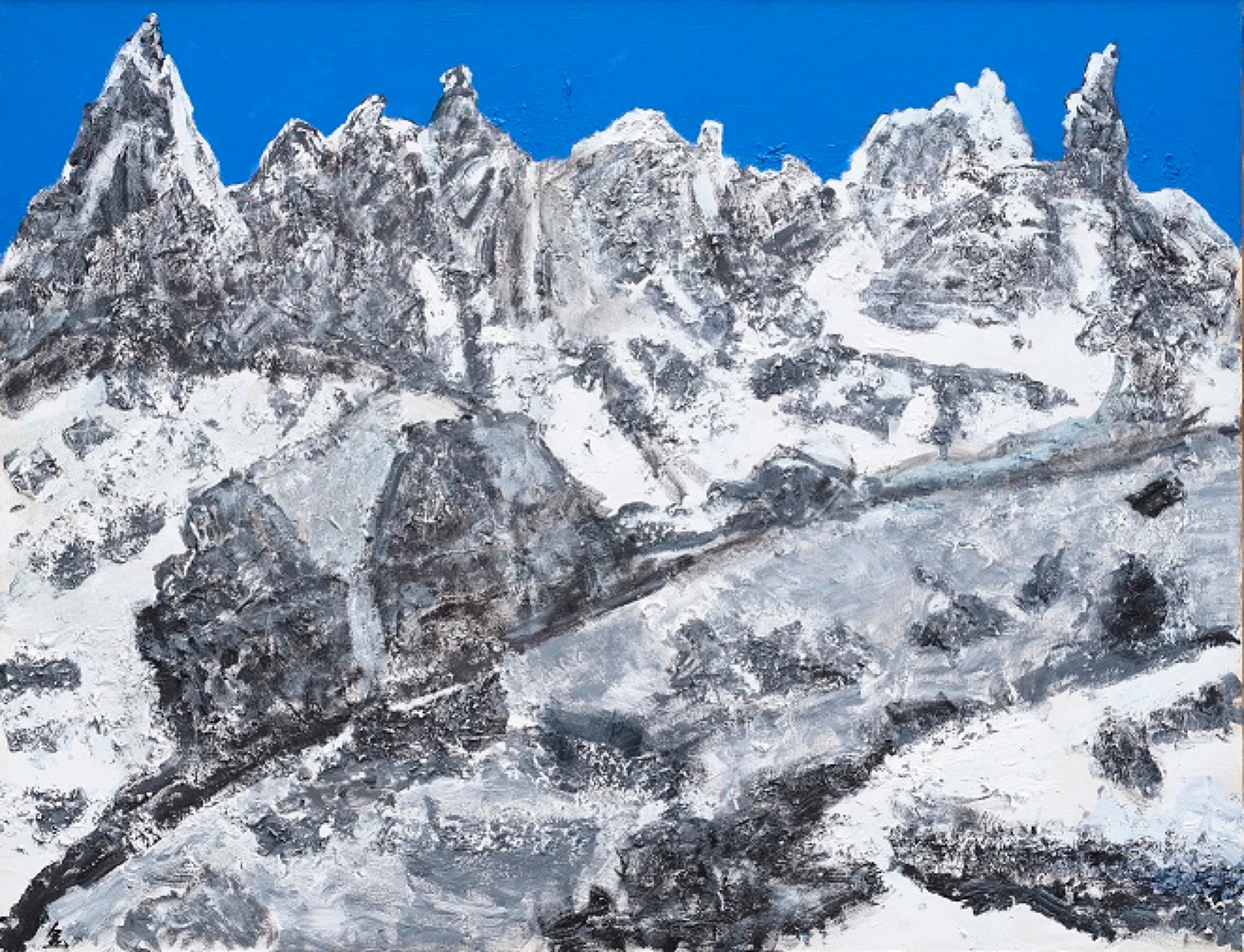
Kim Chong Hak, Snowy Mountain, 2008. Acrylic on canvas. © Kim Chong Hak. Courtesy the artist and the Kim Chong Hak Foundation. Photo: Kim Tang-Sae.
The show opens with Kim’s earliest works, largely abstract pieces following various trends of the early-1970s, from Dansaekhwa to Post-Minimalism. An untitled 1978 work draws together informal and abstract tendencies, while its surface hints at older inkwork techniques. (The influence of traditional and folk arts, another theme of the exhibition, is explored through a collection of objects installed throughout the show.) Rather than follow a chronology, the exhibition chooses to bivouac back and forth across Kim’s mature works, marshalling them into interconnected sections devoted to the seasons. Such an organizing principle emerges organically from the works themselves; as the artist puts it in the catalogue for the show, “I spend all four seasons with the mountain, drawing spring in spring, summer in summer, autumn in autumn, and winter in winter.” The choice to take this process so seriously and make it the structural core of the show is laudable, perhaps in part because it reveals what is always true: no two springs, two summers, or two autumns are ever alike. The subtlest variations between days, weeks, and years give Kim’s work its most felicitous edge.
Consider two of the more striking pieces, Grey Mountain (1978)—one of the earliest of Kim’s mature paintings—and Snowy Mountain (2008). Both are winter landscapes, yet everything from the handling of the paint to the framing of the mountain-face above the tree line could hardly be more dissimilar. The first, with its dabs and flicks of grey-blue paint forming neat rows up the rockface, appears shadowy and barren, an effect accentuated by the dry brush pulled across the surface (evocative of another admirer of mountains, Paul Cézanne). Snowy Mountain, by contrast, sees Kim overload his brush, pushing the paint around until the thickened facture rolls like stormy waves. Against this, the introduction of blue to his gray palette brightens the bedrock, while above the turgid spackle of paint we glimpse the stark, flat field of blue that only a winter sky can deliver.

Kim Chong Hak, Untitled (Winter), 2017. Acrylic on canvas. © Kim Chong Hak. Courtesy the artist and the Kim Chong Hak Foundation. Photo: Kim Tang-Sae.
Winter, the writer and translator Yoko Tawada observes, is the time of the year of deepest thought, the season of the most profound isolation; the profoundness of that isolation, she notes, is also the moment of deepest creativity. Perhaps it was the same creative isolation promised by the mountain that drove Kim so decisively to it: “I ran away to Mt. Seorak. I wanted to run away from my family and from the art world … I wanted to truly be alone.” In summiting the mountain, in rising above its tree line, the artist could grasp that moment of isolation again and again, finding winter, spring, and summer all in one day. For the mountain is, in fact, not just a museum of art, but of the seasons too. And so is Kim’s art. Though the artist is better-known for those blossoming spring and fall foliage pictures—of which there are many excellent examples throughout the show—it is in his more austere winter paintings that he most reveals himself.
Jonathan Odden is a writer based in New York.