Special ReportJuly/August 2025
Thinking about Deborah Kass’s “The Art History Paintings,” 1989-1992
Word count: 1954
Paragraphs: 12

Installation view, Deborah Kass, The Art History Paintings 1989-1992, at Salon 94, New York, 2025. Courtesy of the artist and Salon 94 @Deborah Kass. Photo Credit: Elisabeth Bernstein
Myriad terms hint at the pugilistic arena of references and realities that Deborah Kass was wrestling with when, between 1989 and 1992, she conceived and created her series “The Art History Paintings.” E.g.: postmodernism, multiculturalism, identity politics, feminism, visibility, market share, cultural specificity to name a few. Regarding cultural specificity, Kass takes on the chauvinist Ab Ex/Post-Pop cake; she slices it up, appropriates, and recombines fragments of the white male modernist, Abstract Expressionist, and Pop masters. Kass slyly reveals, even exaggerates, the messages encoded—often hidden in plain sight—in these iconic borrowings and dribbles. In doing so, she draws attention to their chauvinist allusions and exclusionist assumptions. In a phrase, she cuts them down to size.
A Jewish lesbian, a suburban teen, Kass came to artistic maturity as a New York painter at a time when the macho man was the eighties painterly paradigm. A feminist admittedly in awe of her “master” predecessors, she was naturally angry about her specific—and women’s in general—marginalization. To know Kass is to recognize a highly opinionated woman with a great sense of humor and irony. Did I mention Kass’s rigorous cultural analytics and just plain chutzpah? Despite a spate of negative early reviews, this series was the one that in effect launched her career. Yet this three-year body of work has been somewhat overshadowed by the artist’s subsequent, much more extensive “Warhol Project” (1992–2001) and the startling presence and prominence of her recent monumental sculptures OY/YO (2015) in at least three notable public spaces. For so many reasons, including the lingering blur of negative criticism, it is a perfect time to look again, closely, at "The Art History Paintings," to read the series attentively, and to recognize its significance.
I was privy to Kass’s thinking while she was making these pictures, interrogating shards of her Pop-macho riffs, and not least asking where her (and my) queerness and Jewishness stood within the contemporary art firmament. Was there even a place for them? The J-word (that unspoken Jew taboo) was conspicuously absent from the official, evolving, institutionally sanctioned multiculti moment, not least its acknowledgement in the art world. Yet the Jewish issue was oozing out, slowly but surely. Inevitably, that is, for anyone willing to notice its absence. Kass’s Jewish pictures were, I began to realize, only one tip of a modestly scaled iceberg.
Originally exhibited in 1990 at the Simon Watson gallery, Kass’s recent show of “The Art History Paintings” was spectacularly reprised in February 2025 at Salon 94 on Manhattan’s Upper East Side. This allowed the public to reexamine and rethink what had obviously become an important, if not historic, series—one that certainly helped move the chauvinist, ethnically oblivious needle. The series helped displace the macho-bravado of eighties Neo-Expressionist painting into the nineties with its attention to identities, uncertainties, as well as the specific place of painting within that discourse.

Deborah Kass, Subject Matters, 1989-1990. Enamel, gold lead and acrylic on canvas. 63 x 135 inches. Courtesy of the artist and Salon 94©Deborah Kass
Emerging smack in the middle of “The Art History Paintings” series Kass’s Subject Matters (1989-90) ranks, as the artist claims, to be her first Jewish picture. I was a curator at the Jewish Museum at the time. That picture was certainly grist for Kass’s and my incessant conversations about the feminist/lesbian-gay/Jewish mill. Was there even space for the J-question within the multicultural ethos so prominent at the time? Despite being ripe for harvest, no one seemed ready, and few cared. Experiencing that painting then and using it as a basis for conversation between Kass and me was revelatory as it was also among a group of other artists and cultural producers. Ultimately this broader cultural framework expanded the multicultural matrix, further exposing the actual multiplicities, complexities, specifics, and even possibilities of identity. Looking at the series as a whole, and Subject Matters (1989-90) specifically, offers insights that have not been previously articulated. That is in addition to both historical (yes, more than 30 years is considered history) and current contexts.
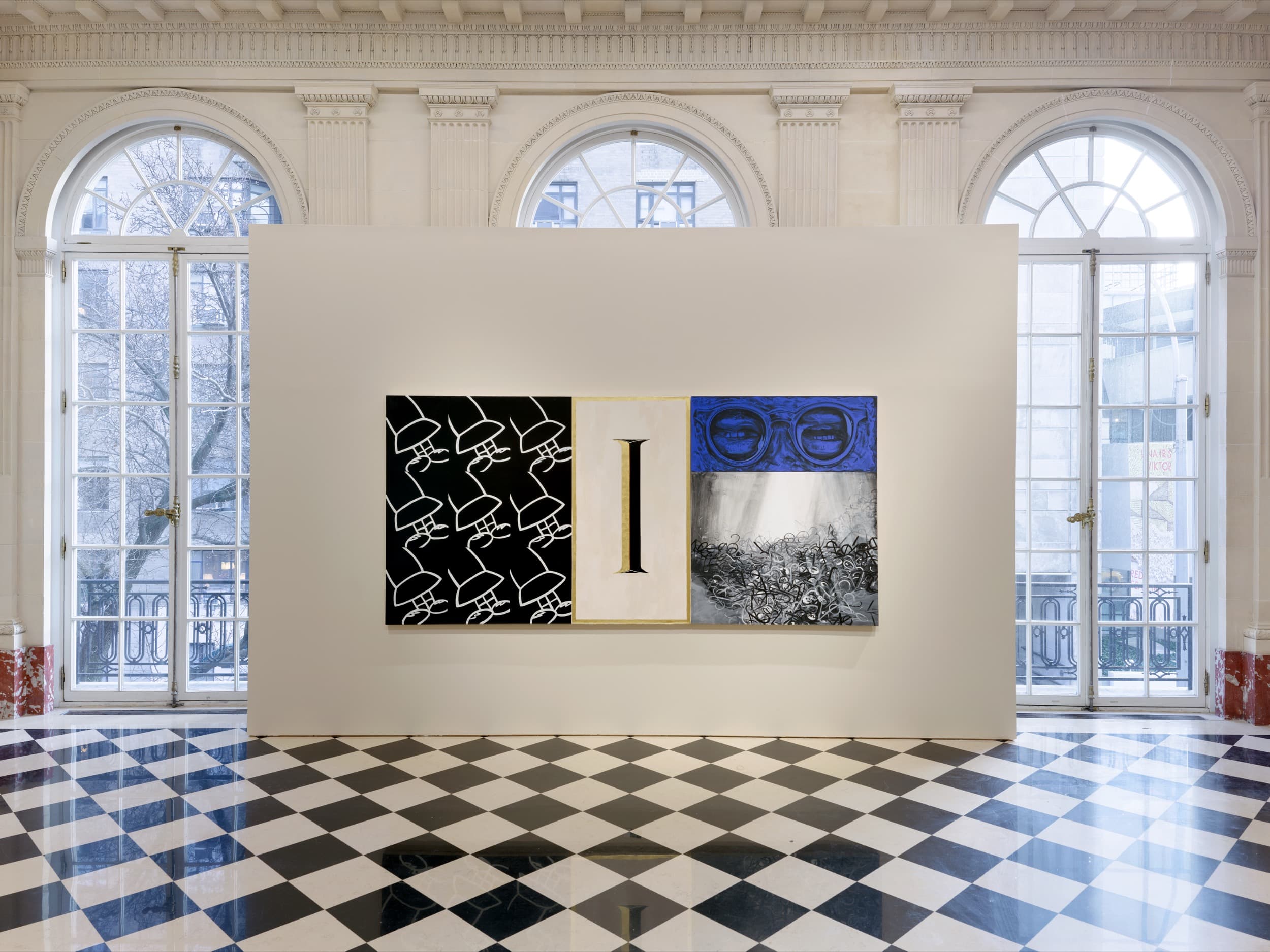
Installation view, Deborah Kass, The Art History Paintings 1989-1992, at Salon 94, New York, 2025. Courtesy of the artist and Salon 94 @Deborah Kass. Photo Credit: Elisabeth Bernstein
As a large horizontal nearly twelve-foot-long painting, the geometric configuration of Subject Matters seems straightforward. Frequently discussed, the canvas is arranged in four compartments: on the left a black square features nine headless Lucy comic characters from Charles Schulz’s Peanuts, at the center of the canvas a white vertical rectangle bearing a partly gilded letter “I.” This Roman-typeface, medieval manuscript-like character is at once a letter, a pronoun, a symbol, as well as a virtual abstraction of the human figure. (Of course, Kass also refers to Robert Morris’s palpably self-referential I-Box [1962].) But Kass’s letter “I” is the live focus of the painting’s logic, its central, some might call it navel-gazing, gist. The picture’s oracular title also hints at its multiple and multi-valent meanings. The painting’s right side is broken into two horizontal quadrants. The top contains a two-dimensional image of Jasper Johns’s irreverent, ironic, and now iconic sculpture The Critic Sees, 1967, in which famously a mouth (of the critic) substitutes for what should evidently be a set of evaluating eyes that should appear behind the so-called critic’s optical aide. Situated at the bottom right is a representation that rhymes with and ultimately collides with image of eyewear, a redux of the vitrine from the Auschwitz display showing the iconic, terrifying, and mute heap of eyeglasses once belonging to the victims of Nazi mass murder. The critic who sees with his mouth looks down on the now useless optical supports of the blinded, silenced, slain victims. Kass adds to the implied tragedy in the accumulated material remains of the slaughtered with a spectral illumination borrowed (dare I say appropriated?) from Rembrandt. During Rembrandt’s time, such dramatic illumination was a suitable code for religious revelation, be it miracle or tragedy. Here it also functions as a synecdoche for memory, that being horror and inhumane reality.
There is an inherent riddle to the engimatic title of Subject Matters; there are many ways to read, to interpret, and to pronounce its two-word lingo. Meanings shift radically depending on the viewer's focus on a particular part of speech. Spelled identically, nouns can become verbs, and vice versa. They can be a deadpan coming together of two nouns, or an imperative collision of noun and verb. Thus, the Duchampian-infected title is a key to the complexity of this picture’s meaning and intent. The other pictures in the series offer analogous representational and linguistic potentials: words and images, text and representation at serious play. Could these layers of text and imagistic exponential-entendre be Kass’s yoke between Duchampian exponential word play and the playful, obsessive, and analytic tradition of Talmudic (rabbinic) commentary? (Here deconstruction might be a more accurate contemporary term for commentary.) Ultimately, the painting is about sight and the sites of subjectivity for Kass; about seeing and blindness, at once physical, metaphorical, and moral. As the artist claimed, her painting takes on the sites of power: the art world, the art market, art history and criticism. Feminist critic Laura Cottingham pointed out at the time that Kass’s borrowings from high art and popular culture went against modernism’s inherent chauvinism and exclusion. For Cottingham, it pushed against the un-self-reflexive celebration of form. For Kass and many other feminist post-modernists, subjects emphatically matter.

Deborah Kass, Emissions Control, 1989-1990. Oil, acrylic, flashe, and enamel on canvas, 60 x 133 1/2 inches. Courtesy of the artist and Salon 94©Deborah Kass.
Most of Kass’s art history pictures might also be considered latter-day, postmodern pictograms. These contrast with earlier pictographs (e.g. of Adolph Gottlieb) with their internal enigmatic shifts of meaning between images and symbols. On the other hand, for Kass the shift of the symbolic connotations is found at the juncture between and among the images she chooses. Their connections to each other provoke a visual and verbal frisson. For example, she can turn Andy Warhol’s societally critical, if deadpan, advert-based Before and After of 1961 on its head by adding a mythological element of fairy tales. In this case a climactic Disney moment changes the meaning of Warhol’s purposefully clinically deadpan “before and after” surgical results. Cinderella’s glass slipper becomes the specific heroine’s and female consumers’ general “happily ever” in the promised “after” nose job. Kass asks: Is it contradictory to consider the diminution of a body part as consumption? Warhol’s Before and After (1961) implies consumer society’s standards of American beauty. Kass’s appropriation of Warhol’s already appropriated advert for aesthetic surgery offered Kass another insider link to Jewish contemporary culture. In the fifties, sixties, and seventies, such aesthetic surgery, then common and readily available, was particularly prevalent among Jewish teens who grappled to look less “ethnic” and more “American,” at least according to pervasive advertising and Hollywood influences. Nose jobs also became tropes for American comedy.

Deborah Kass, Before And Happily Ever After, 1991. Oil and acrylic on canvas, 72 x 60 inches. Courtesy of the artist and Salon 94©Deborah Kass.
Kass’s plumbing of the Jew mechanism continues with her painting How do I Look (1991) whose central face is that of the prescient, art collector, salonnière, writer, and not least famous European-based, Jewish-American lesbian, Gertrude Stein. Pablo Picasso’s famous portrait of Stein, Gertrude Stein (1905-06), is deployed by Kass as a vertical image. The portrait bisects Kass’s sinuously reworked, now nearly monochrome, draftsperson-like image of Gustave Courbet’s famously infamous post coital depiction of two lesbians, The Sleepers, from 1866. Coincidentally, the painting had been barred from public display in Paris until 1988, just before Kass began her “The Art History Paintings” series. Once again Johns’s The Critic Sees (1967) appears. The circular, ironic meanings of Johns’s title is well-matched, if not surpassed by Kass’s titling of her picture How do I Look (1991) which again can be read and interpreted linguistically depending on the potential placement of its missing punctuation.
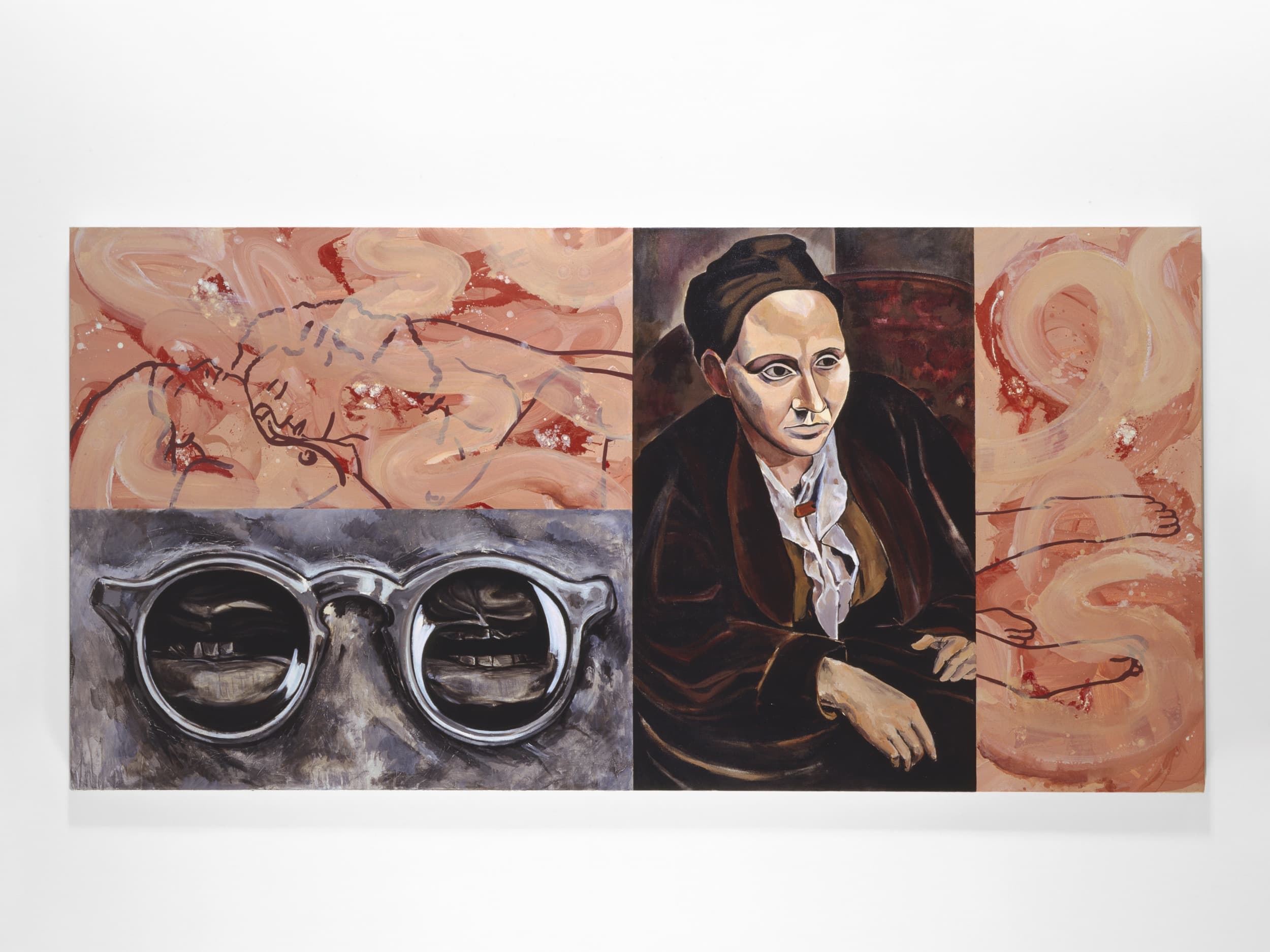
Deborah Kass, How Do I Look, 1991. Mixed media on canvas, 50 x 100 inches. Courtesy of the artist and Salon 94©Deborah Kass.
How do I Look (1991) hints at sexual explicitness that Kass also interrogates and seeks to turn upside down. She admits that in this series she plays fast and furiously with appropriated near-pornographic and outright pornographic images, challenging legal, moral, and artistic definitions of its producers and audiences. Whether it’s the Kass self-concocted droll Talking Dick (1990), the rectangular image on the far-left side of her 1989-90 painting Emissions Control or the demeaning male-gaze on women’s breasts and backsides taken from David Salle’s work at the time, pictures like Read My Lips (1990) and Nature Morte (1990), can be read variously given their specific and differing audiences and titles. (“Read My Lips” of course is a play on George H.W. Bush’s unfulfilled promise not to raise taxes.) The Salle-like image, the play on potential visual and verbal meanings, create collisions/frissons reverberating with, against, and among others in Kass’s selections. Is the splayed frontally posed naked man, flaccid penis fully exposed, in Portrait of the Artist as a Young Man (1991) meant for straight female or queer-male titillation? Or is his sex organ simply the generator for the appropriated piece of a Jackson Pollock drip with its already over-analyzed symbolic/mythological ejaculation.

Deborah Kass, Portrait of the Artist as a Young Man, 1991. Oil, enamel and acrylic on canvas, 84 x 66 inches. Courtesy of the artist and Salon 94©Deborah Kass.
Making Men #4 (1992) is focused on the violence of certain male sports, in particular two-men wrestling and the so-called underlying male homo-social behavior so clearly and smartly articulated by Eve Kosofsky Sedgwick at the time. The Pollock-esque cum-shot below intimates—make that articulates—the potential consequences of straight male homosocial bonding, while the dance step instructions riffed from Andy Warhol’s well-known series demonstrates a more formal, more distanced, if indeed fey, approach to two-person, same-sex, personal interactions. Evident in these examples is the fact that Kass plays fast and furiously with images and representations, as well as words and texts to distill multiple connotations and implications from images appropriated from both high art and popular culture. With this, the social, political, and ethical issues of the early nineties can be reexamined thirty-five years later in the context of 2025. That said, the theoretical basis of multiculturalism of thirty-five years ago, which had been considered by some a “failed ethos,” is offered for reexamination in the light of our current, threatened, practicum of Diversity, Equity, and Inclusion.
Norman L Kleeblatt is a curator, art historian, and critic.