Young Joon Kwak: RESISTERHOOD
Word count: 1075
Paragraphs: 9
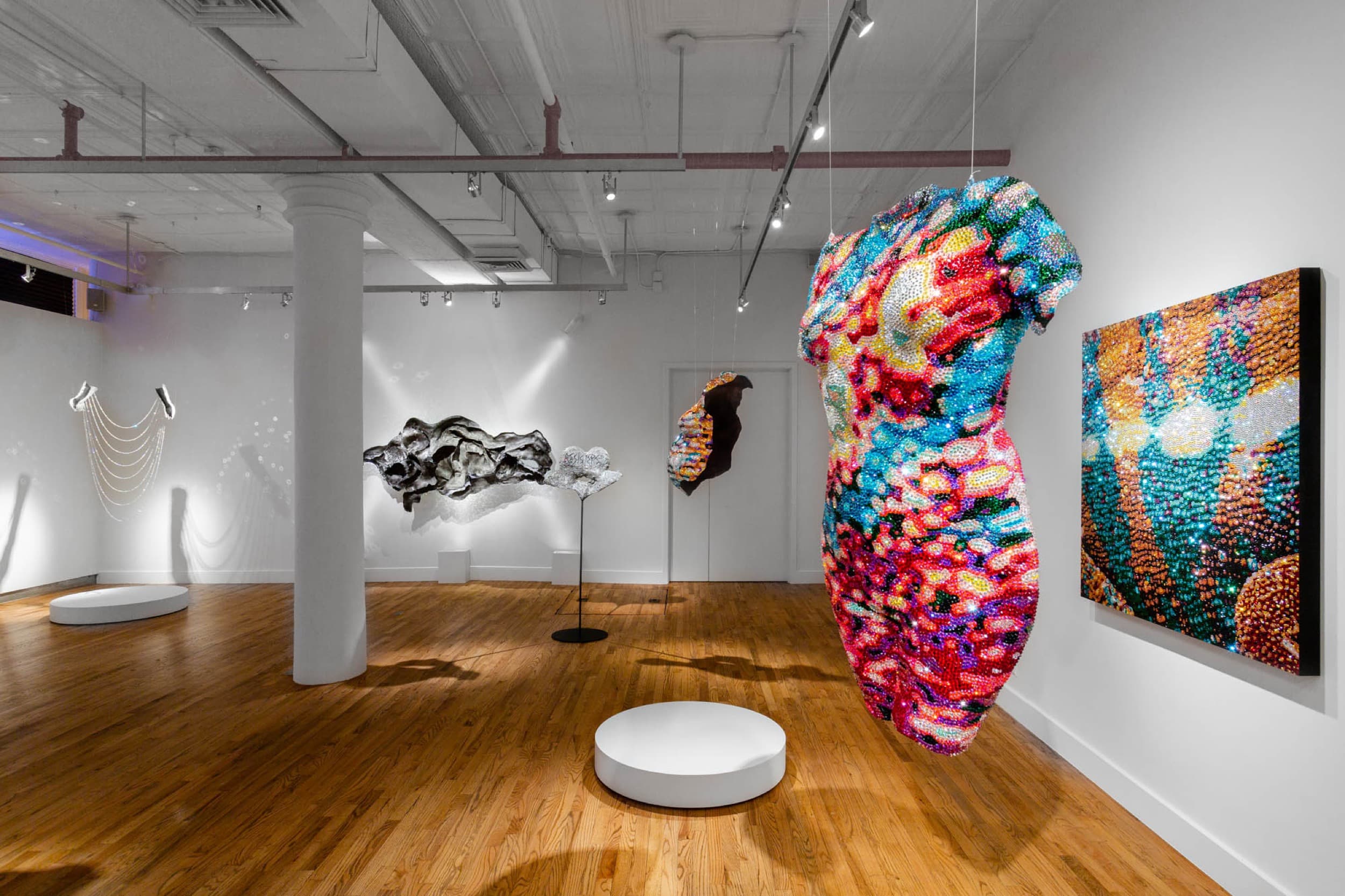
Installation view: Young Joon Kwak: RESISTERHOOD, Leslie-Lohman Museum of Art, New York, 2025. © Leslie-Lohman Museum of Art, New York. Photo: Daniel Terna.
Leslie-Lohman Museum of Art
February 14–July 27, 2025
New York
When you see yourself in the mirror—after a shower or before bed—where do your eyes go? The ridge of your nose, a scar, your crotch? Do you focus on the parts you admire or want to change? What do you celebrate—and do you feel worthy of it? Walking into Young Joon Kwak’s RESISTERHOOD, unfolding in the Leslie-Lohman Museum’s modest, intimate gallery on Wooster Street in SoHo, you’re probably not naked, and you won’t be faced with a mirror. But you will have the opportunity to gaze at, and communicate with, the artist’s shimmering, suspended body molds, cast in fragments and floating mid-air. And again, the question arises: Where will your eyes go? To what degree do these figures align with the ideal to which you hold yourself to, and to what degree will you care?
Pushing forward into the gallery, past the headsets that deliver a sonic landscape which both accompanies and animates the sculptures, you can feel at first overwhelmed—if not delighted—by the range of forms before you. Some hang suspended from the ceiling by what looks like fishing wire, others perch atop slender stands, many protrude from the walls. A few feel like inverses of others, their hollow sides exposed either to us or to the wall, their rhinestone coating alternately visible or hidden from view. Most are lit at sharp diagonals, their reflective surfaces bouncing light between one another, refracting it so that parts of the walls and floors shimmer like the inside of a jewel box.
In line with the artist’s practice of blending sculptural experimentation, performance, and community engagement to challenge norms and create space for marginalized identities to be celebrated—intuitively, authentically, and without the patronizing gaze of the culture vulture or the burden of meeting a diversity quota—Kwak’s investigation of the body urges us to reconsider who, and what, deserves to be idealized. Instead of flat, cisgender, white, able-bodied ideals, Kwak uplifts bodies in flux: queer, trans, hybrid, gloriously complicated.
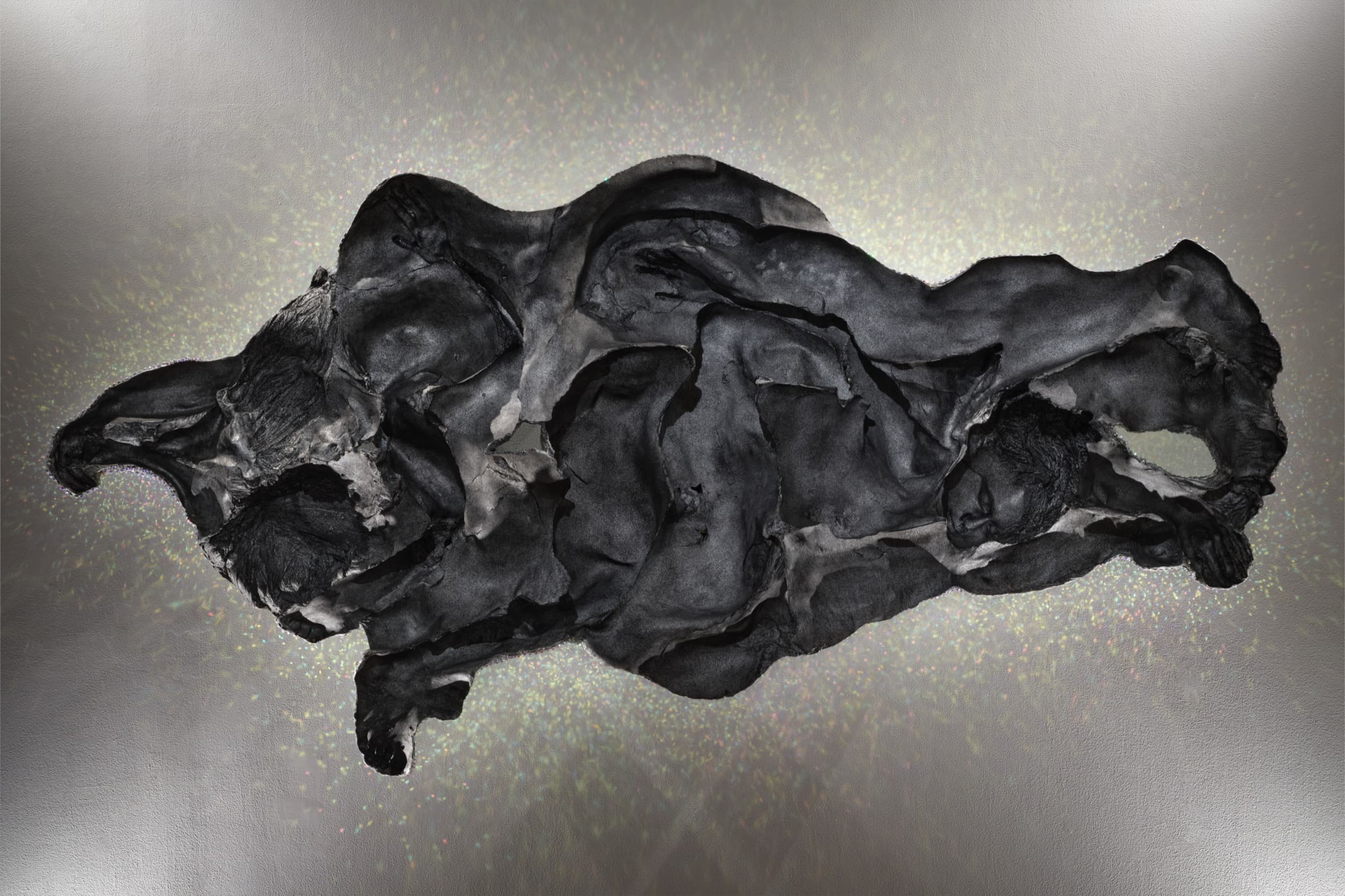
Young Joon Kwak, Femmmes (Nic, Toria, Yara), 2025. Urethane resin, soil, glitter, rocks, aluminum, nickel silver, glass rhinestones, wax pigment, steel armature. © Young Joon Kwak and Commonwealth and Council, Los Angeles. Courtesy the artist and Commonwealth and Council, Los Angeles. Photo: Paul Salveson.
In the sculpture Femmmes (Nic, Toria, Yara) (2025), Young Joon Kwak uses materials that feel both glitzy and scrappy—urethane resin, soil, rocks, glitter, rhinestones. The only work against a far wall in the back of the gallery, it sits imposingly, commanding you toward it. As you stand before it, trying to decipher what it is exactly you’re looking at, you may think the form looks almost geological at first, like a hunk of molten terrain or the aftermath of some collapse, but still within it holds the faint impressions of real bodies—heads, hands, feet. These are the traces from a failed mold made during an outdoor performance with three nonbinary femme collaborators. That failure—the silicone didn’t cure, and only fragments remained—became the heart of the work. The longer you stay investigating, running your eyes along awkward jutting clumps of rock and resin, the more pieces of evidence emerge of bodies being touched, pulled, torn apart. The small intended space where an elbow might have dug in, the long curving edge where you imagine a neck whipped itself around. The back of the sculpture, covered in rhinestones which are withheld from our gaze and reflected only on the wall via strategically placed light shooting from angles on both the floor and ceiling, lifts this fragmented image to a place of exaltation, maybe—if a little tacky (which still feels purposefully gay). By letting the mess and intimacy of the original performance remain visible, the sculpture becomes a form of care—an embodied, shining archive of queer bodies holding and being held, even in pieces.
Kwak’s monoprints, 뽀뽀 (The Kiss) (II) (2023) and My Fat ***** (II) (2024), created by pressing silicone casts of bodies and garments directly onto paper, mirror these casts hung just in front of the wall. The pieces draw from the lineage of Yves Klein and David Hammons but are inflected with a distinctly queer, Korean feminist perspective. The bodies visible in these works are flattened and distorted, maintaining a “graphic anonymity" that speaks to the very real precarious visibility of queer and trans lives. The two femme individuals kissing in 뽀뽀 (The Kiss) (II) are not out to their families in Korea, where, as is pointed out in the wall text for this work, there are still no national protections for trans people against institutional discrimination. The work invokes the widely spread online political aphorism regarding the current state of queerness in the mainstream: “Visibility without protection is a trap.” Here, Kwak’s use of these semi-legible forms resists narrative fixity, instead suggesting transformation, emergence, and potentiality. From the necessary obscuring of identity emerges the possibility for their viewer to place themselves in the work.

Installation view: Young Joon Kwak: RESISTERHOOD, Leslie-Lohman Museum of Art, New York, 2025. © Leslie-Lohman Museum of Art, New York. Photo: Daniel Terna.
These figures—partial, stretched, bruised, kissed, and held—expand the possibilities for how we can see ourselves. Kwak invites us to reconsider what in ourselves is worth preserving. What parts of yourself will you refuse to compromise even if it means losing your protections?
After I got home from the show, I scanned a picture of the QR code provided at the gallery entrance for the soundscape created by Xina Xurner, the performance/music duo of Young Joon Kwak and Marvin Astorga, and described as a “collective sonic invocation of queer resistance, pleasure, and communal healing.” I turned the volume all the way up and stood in front of my mirror, late afternoon sun pooling across the floor, and ran my fingers along the scars that line my hairline, under my breast, on either side of my thighs: the marks that tell the story of my own resistance against normative ideas of what it means to be alive. As the celestial, kaleidoscopic noise turned my room into a kind of personal opera—light flickering off the window onto the mirror, lighting me up in a way not dissimilar to Kwak’s sculptural bodies—I felt like I was, in this exercise facilitated by the music, taking part in the community work integral to their practice. A gesture like what might’ve been put on by Mutant Salon, the nomadic “beauty salon” and collaborative performance space founded by Kwak in 2012 that allows queer, trans, POC, womyn, and mutant communities to “celebrate an ethos of transformation and critical togetherness.” In my reflection I realized I looked like I was floating, exalted. Not just ideal, but divine. Like Kwak’s figures, I saw myself as something equally worthy of reverence.
Elle Gordon is a writer based in New York. Her reviews and essays have appeared in The Sun Magazine, The Cut, and elsewhere. She is a Production Assistant at the Brooklyn Rail.