The Other Shakespeares in the Parks
New York Classical Theatre, Hip to Hip, and Hudson Classical Theater Company Endure and Delight
Word count: 1840
Paragraphs: 24
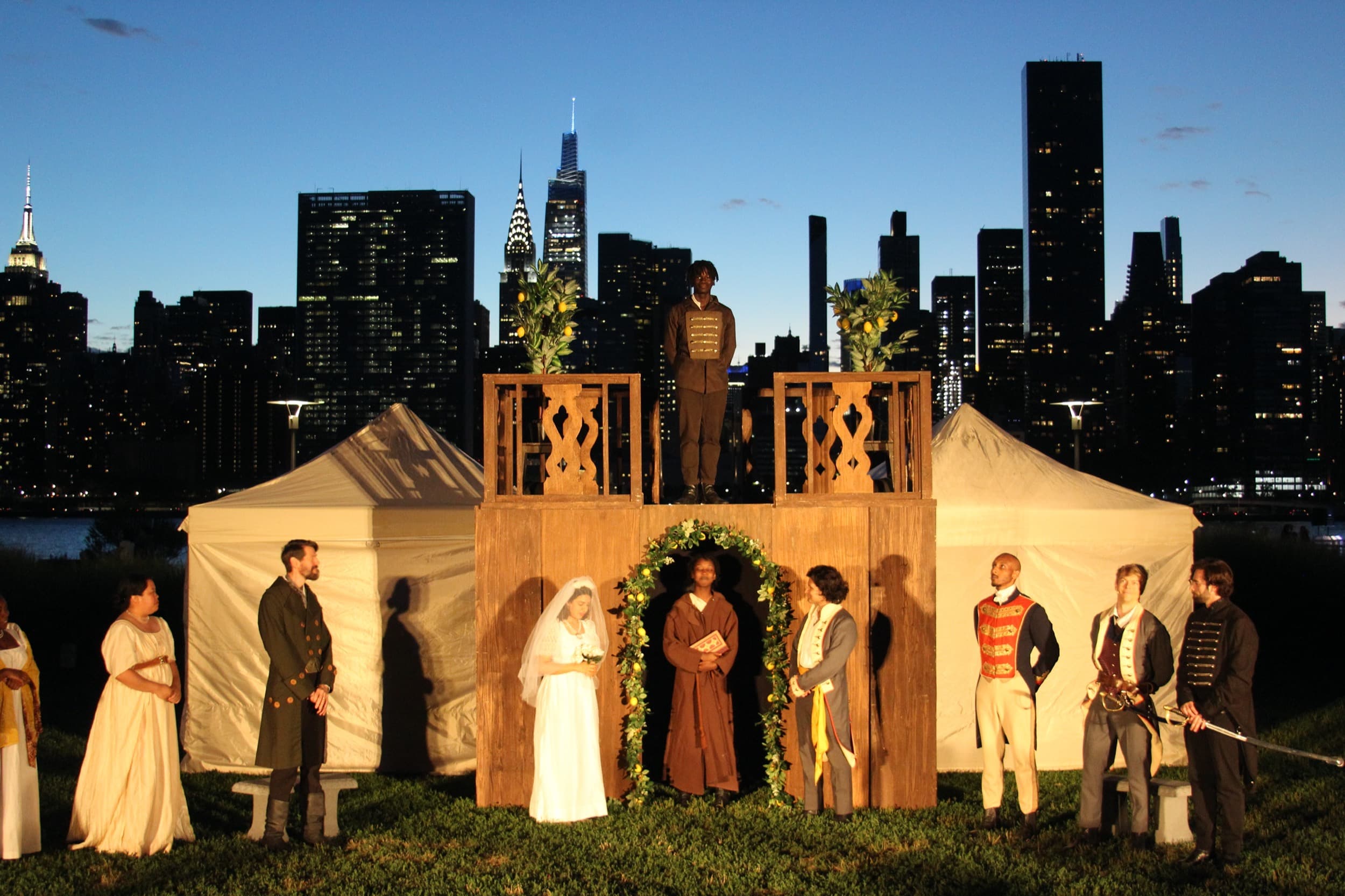
Hip to Hip performance at Gantry Plaza State Park. Photo: Julian Voloj.
Shakespeare directors sometimes speak in early modern metaphors. “It’s kind of like when the Spanish Armada attacked England during Queen Elizabeth I’s reign—you know the story, right?” asks Stephen Burdman, the Founding Artistic Director of New York Classical Theatre when discussing how his company survived 9/11, a recession, Hurricane Sandy, and the pandemic. “The English survived because they had smaller, more nimble ships, and they were able to get around. We have come out of every major catastrophe stronger.”
When New York audiences think of free Shakespearean park performance, they might first think of Central Park’s Delacorte Theater, the Public Theater’s home since 1962 for Shakespeare in the Park productions with Broadway-level tech capabilities and all-star casts (this season’s Twelfth Night will feature Lupita Nyong’o, Sandra Oh, and Peter Dinklage).
But the city boasts many parks, and many companies bringing free Shakespeare to local communities, including Burdman’s New York Classical Theatre, the Queens-based Hip to Hip, and the Upper West Side’s Hudson Classical Theater Company (HCTC).
At a newly frightening moment for arts funding, the three companies continue to offer all of their programming free of charge: they all depend on audience donations for substantial pieces of revenue. It’s not surprising, then, that the bank-breaking Broadway revival of Othello starring Denzel Washington and Jake Gyllenhaal came up organically in multiple conversations with these companies’ leaders: according to Burdman, al fresco, free Shakespeare is a low-risk investment for parents because “you’re not spending a hundred dollars—or I would just say 917 dollars a seat—to see this and then worrying that your child has a tantrum and you have to run out.”
HCTC’s Executive Artistic Director Susane Lee adds, “We’re kind of the opposite of whatever they’re doing on Broadway.”
In recent years, HCTC’s expenses were just under 50,000 dollars; Hip to Hip’s costs are about twice that. Both companies pay everyone who works on the show but don’t have salaried employees; their leaders don’t get paid beyond their roles on individual shows. NY Classical, with two full-time and three part-time year-round staff and all Equity contracts, hovers around a 550,000 dollar budget. (For contrast, the Delacorte Theater’s current renovation was projected to cost 78 million dollars.)
The leaders of both Hip to Hip and HCTC hope to get back on track to expand towards year-round salaried positions as they continue to rebound from pandemic losses. In 2019, Hip to Hip’s Artistic Director Jason Marr said the company had their biggest season ever, touring fourteen venues in all five boroughs; they’ve scaled back to Queens in the years since. “There’s so much money in New York City,” Lee said. “We just need a little bit of it so we can pay people what they’re worth.”
But Burdman, Marr, and Lee (along with HCTC’s founder Nicholas Martin-Smith) all are experts in scrappy resourcefulness, and they’ve been that way since the beginning.
In 1999, Burdman, a computer science major who got involved with theater in college so he could skip class, was in his early thirties working for another company when an entire cast he was directing urged him to start his own. The next summer, NY Classical was born in Central Park off 103rd and Central Park West. Since then, he’s directed thirty-nine of the company’s forty-eight plays, including All’s Well That Ends Well this summer, playing Central Park, Carl Schurz Park, and Battery Park in June and July.

Anique Clements, Damian Thompson, and Carine Montebrand in New York Classical Theatre's Henry IV. Photo: Sarah Antal.
NY Classical’s signature aesthetic is what Burdman has termed “panoramic theatre”: the audience moves with the actors from place to place, gathering up their picnic blankets and scurrying over the next hill after King Hamlet’s ghost or whatever the moment might demand. Performing panoramic theater means “we’re not just acting outside but everything about the environment becomes not just the playing space but the characters’ living space,” said Anique Clements, who will star as Helena in this summer’s All’s Well.
Actors don’t pretend that the park isn’t there—“a tree is something familiar to the character,” Clements said. And although Burdman preserves Shakespeare’s language, he will tend to cut references to physical environments that don’t appear in the park. “Hey, Imogen’s going outside to have a nap on a picnic blanket in the park,” Burdman offered as an example, citing Cymbeline.
Sometimes the weather gets in on the drama, too. In one particularly popular NY Classical production in 2011, audiences boarded the ferry to Governors Island to join the English army in invading France. During a rainy performance, Burdman recalled, “We’re all wet, and there’s this beautiful rainbow and the audience is just like, ‘Oh my God,’ and I’m like, ‘Yup, we planned it that way.’”
Site-specific work is at the heart of Hudson Classical Theater Company, too, but they’ve called one specific site home from the beginning. Founding Artistic Director Martin-Smith had performed with another Shakespeare company at the Soldiers’ and Sailors’ Monument in Riverside Park on 89th Street in the 1990s. He realized the space could be used not just as a proscenium but as a three-quarters thrust stage with actors and audience intermingling. For the 2004 launch of the company, known pre-pandemic as Hudson Warehouse, Martin-Smith staged The Tempest with the audiences surrounding the action on three sides, sitting on benches and walls. “I had the shipwreck on the stairs,” he said.
Looking back on that first season, “I never imagined it would be this,” Martin-Smith said, but “everyone came to see it so we decided to do it again and then we did it again.” These days, he shares leadership with Lee, who joined in 2010, and they put on three plays each summer by three different playwrights, always including one Shakespeare. They’ll begin their season this year with Julius Caesar in late May before presenting Lee’s adaptation of Sense and Sensibility in June and July and Henrik Ibsen’s The Lady From the Sea in July and August. Unlike NY Classical or Hip to Hip, HCTC’s productions often re-imagine the plays’ settings—like a Jane Austen adaptation in the 1950s—but they maintain strict fidelity to the verisimilitude of whatever time period they choose. “We’re very detail-oriented on our shows, nothing can stray,” Lee said. “The tie clip has to come from 1813 or we’re not using that tie clip.”
If guiding the audience from place to place is NY Classical’s central aesthetic, immersing the audience in the architecture and environment of the Soldiers’ and Sailors’ Monument, which overlooks the Hudson River, is HCTC’s. The Riverside Park Conservancy supplied Martin-Smith and Lee with grass seed, which they used to nurture their stage. For decades, the company has considered themselves to be “stewards of the space,” Lee said. They know the environment inside and out, including how the park’s lighting will affect the storytelling at different moments in the summer. “Choosing that August play is kind of tricky because the sun goes down earlier,” Martin-Smith said. “Whatever play you choose you have to know those last fifteen minutes, it’s going to be dark, and the lights will come on. Doing The Merry Wives of Windsor was a no-brainer because everyone’s fairies holding candles.”

Austin Reynolds and Nicholas Martin-Smith in Hudson Classical Theatre Company's Macbeth. Photo: Susane Lee.
While NY Classical and HCTC strive to blend their productions into the natural environment, Hip to Hip takes a different approach: at each tour stop, the company shows up three or four hours before curtain time in a twenty-foot box truck. A team of about ten people, including cast members, erects a set, lights, an audio setup, and tents for costumes, props, and dressing rooms.
Uniquely among the smaller Shakespeare companies, Hip to Hip uses wireless microphones since “it’s New York City, so the human voice sometimes just can’t compete,” Marr said. “The plays are so much about the language, it seemed to us pretty important that the audience hear every word.” (At the un-amplified NY Classical, meanwhile, actors rehearse a “helicopter cue” for the moments when they’re drowned out: the entire cast looks up, watches the offending plane until it passes, and then continues the scene once the noise has dissipated.)
Marr launched Hip to Hip in 2007 with his wife, Joy, who still frequently acts in Hip to Hip productions. “At this point, I’m not doing all the heavy lifting myself,” Marr said, “but I still drive the truck.” Hip to Hip’s tours of Hamlet and The Tempest kick off in repertory in August across Queens: last year, they stopped at six parks across the borough, plus short stints in Jersey City and Southampton.
Although Hip to Hip’s commitment “to the Aristotelian idea of spectacle” has “definitely caused me some stress over the years,” Marr said, it’s also crucial to the community’s relationship to the work. “What I hear from audiences is that they really appreciate our efforts to give them that spectacle, to give them that sense of going to a theater to see something special.”
Each of the three companies has built up a dedicated following in local neighborhoods, buoyed by close relationships with the parks departments in each location. When HCTC rehearses at the Monument in May, Lee said, “people come by the park and go, ‘Oh my God, you guys are back, thank God.’” One of NY Classical’s board members began attending shows as a twelve-year-old and will soon bring his own children to their first Shakespeare production.
Returning audiences can see actors grow into larger roles as the seasons pass—at HCTC, one Horatio became a Hamlet in the company’s next production. “These are the rare actors in my point of view,” said Lee, reflecting on the heat and the wind and the rain that her performers face, “because doing outdoor theater in the summer is really hard and it’s not for everybody. You have to really love to do it.”
All three companies pride themselves on offering kids their first encounters with Shakespeare. Thirty minutes before each performance, Hip to Hip actors lead a pre-show program called Kids & the Classics, introducing the youngest audience members to the plot and characters and, Marr added, giving “them an opportunity to get their sillies out so they can sit down and invest in the play.” One HCTC regular once brought a grandchild in middle school to their Hamlet: she was so excited that she insisted on stopping by Barnes & Noble on the way home to pick up a copy.
And Clements recalls a particularly thrilling moment of audience engagement during a combat scene in NY Classical’s production last season of Henry IV, a battle between Hotspur and Prince Hal. The actress watched as an eight-year-old boy glued his eyes to Hotspur and acted out the scene alongside him, “including falling down and dying when Hotspur got stabbed … and it was the sweetest and most beautiful thing.” Where else can “a kid run up onstage with you and just perform and it be okay?” Maybe the boy in the park doesn’t realize he was connecting to Shakespeare, Clements imagined, “but maybe he does and he’s just had a moment in time to fall in love with it.”
Dan Rubins is a theater journalist, arts nonprofit leader, and composer based in New York City. He writes theater criticism for Slant Magazine and Theatermania and is the host of the podcast The Present Stage: Conversations with Theater Writers.