Word count: 1541
Paragraphs: 17
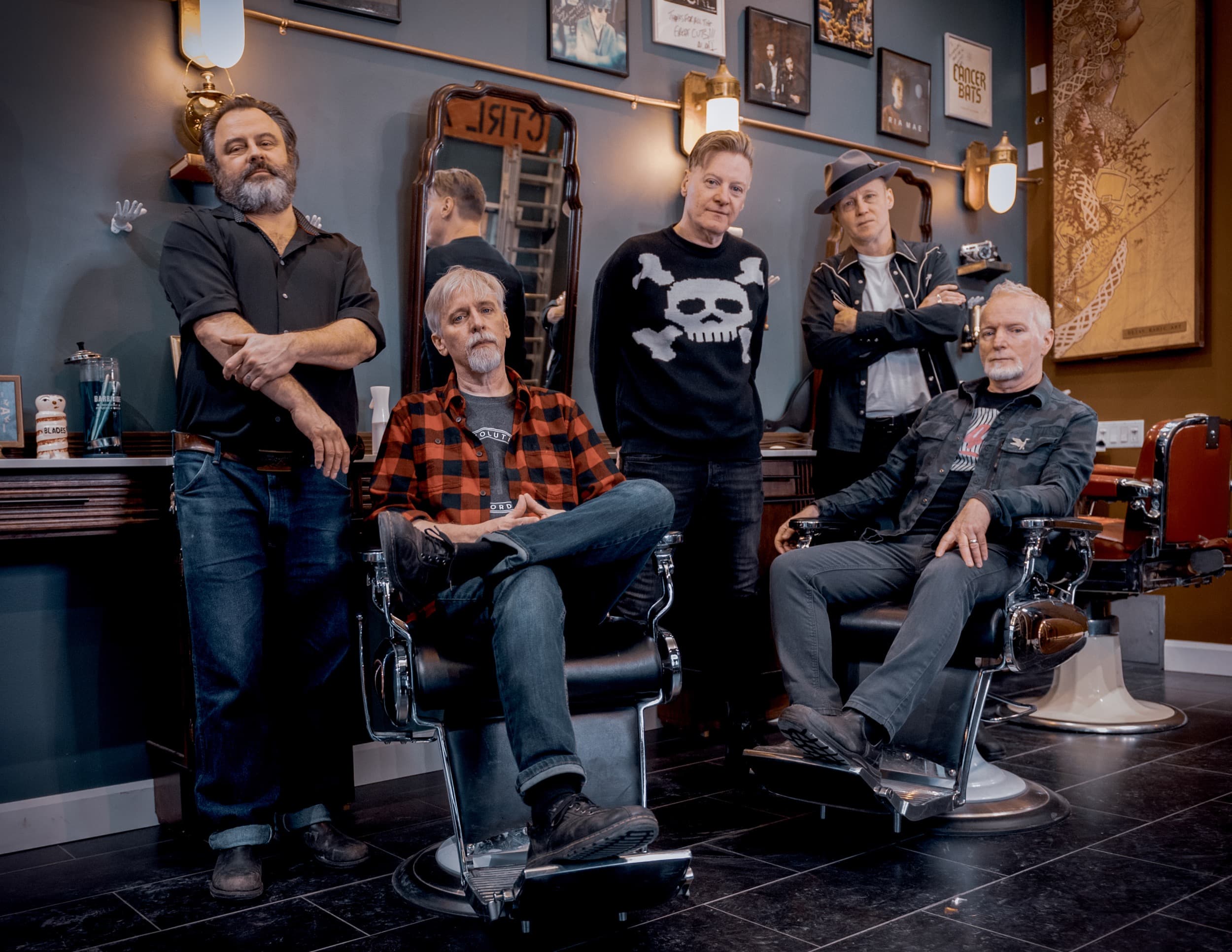
Lowest of the Low. Photo: Robert Ciolfi.
Ron Hawkins has been writing ballads about working class heroes and revolutionary soldiers, penning anti-fascist and anti-capitalist songs for more than forty years. For much of the last three-plus decades he has written, recorded, and played with the Toronto-based indie rock band Lowest of the Low. Their seventh studio album, Over Years and Overnight (Sonic Envy), was released in May.
Suzanne Cope (Rail): As someone familiar with your work since your beloved first album Shakespeare My Butt (A&M Records)—that “Golden Albatross” as you’ve called it, from 1991—do you see this latest album as being the logical evolution from where you started?
Ron Hawkins: You know, we learn with every record how to be us. Through the last two records we finally unlocked the mystery of how to record ourselves. We’ve had every scenario—from the giant Abbey Road-like studios, to being produced by a Grammy-winning superstar, David Bottrill—but all of the records have something about them that nag at me in terms of not quite sounding like us. And the last two records we made in our rehearsal space and then in our own little studios at home. And then Michael McKenzie, our guitar player, mixed them. My watermark is always London Calling. That’s a perfect record because it captures the undiluted piss and vinegar of The Clash. And then there are these beautiful sprinklings of horns and Latin percussion and things on it that just clean it up a little bit, but they don’t take any of the edge off it. And I think that’s what we found. And it’s taken us, you know, it’s taken me forty years to figure out how to do that.
Rail: Speaking of The Clash, and knowing that you have toured with Billy Bragg and played some of the same clubs as Peaches, in Toronto, how do you see yourself in relation to these artists who are considered explicitly political?
Hawkins: I have a very long history with Merill Nisker, who is Peaches, who used to be in a band called Mermaid Cafe, which was very much a Joni Mitchell-influenced folk band. And they were always very social commentary based. But Merill had a sort of a reinvention at some point and became Peaches and does what they do now. It was an interesting thing to see somebody completely remake themselves as an artist.
From what I know about The Clash, their politics were very scattered and not very informed. I mean, their hearts were in the right place, and they were very smart, but they were not particularly organized about what their belief systems were, and it was very malleable. And the funny thing is, having gone out with Billy, he started out in the same area—politically—as I am, but from knowing him, I would say that I’m much farther to the left than Bill.
Rail: That’s interesting, because many of your fans might not consider your songs as explicitly political as these artists’.
Hawkins: Early in our career, we had a band called Popular Front, where we were hitting the very capital “P” politics, and I was trying to do that as a songwriter. But what I took away from it was that I’m just not good enough at it. There was something not there; there was no magnetic pull to it for me, whereas when I started to embed my politics into stories about real people and just kind of have the fact that “life is politics,” it will be in the songs anyway. That’s when it started to really resonate with people. And so I don’t as often go down the very doctrinaire political path of songwriting because I don’t think I’m as good at it.
Rail: How do you see the lyrics, the storytelling aspect, and the style or genre of music coming together?
Hawkins: I’m a little bit like Chuck D in terms of I consider folk music to include punk rock music and hip-hop. I consider this “the people’s music.” So, my definition of punk rock is probably a lot wider than some other people’s in terms of what it can hold. Because to me, it’s really the philosophy of why you’re making the music that makes you a punk. Not what kind of guitars are being played or what kind of clothes you’re wearing. So to me, I’ve only ever made folk music all my life—and I don’t think too much about those labels—but, that’s storytelling and it’s just what I got good at, you know? I think it’s just the pair of shoes that I put on that I went, “Oh, this feels right.” And I can see by the resonance with other people that this is the kind of art that I’m best suited to make, and it’s the thing I’m the most obsessed about. And of course, because of my politics, the stories are about working class people, or other people who don’t usually get the limelight in pop music.
Rail: Your previous albums have taken on the point of view of anti-fascist freedom fighters during the Spanish Civil War, and have explicitly called out the ills of present-day capitalism and authoritarian leaders within the stories you tell. How would you place Over Years and Overnight in terms of its lyric point of view? It seems a little more subtly political.
Hawkins: I was joking about this is how much of a contrarian I must be. During the first Trump term, we did the albums Agitpop (Warner Music Canada) and Welcome to the Plunderdome (Sonic Envy), and now, when the whole country is teetering on a fascist dictatorship, we wrote a more friendly, poppy, hooky, less political record. It’s the politics of people again, but there’s more love songs and stuff.
Agitpop and Welcome to the Plunderdome were just out-and-out socialist records because I really believe the phrase “socialism or barbarism.” I think we have two options moving forward, which is to start giving a shit about each other, to start organizing collectively, to fight for a community in which we all support each other—and the only economic and political version of that I know of is socialism. Or there’s barbarism, which is what we seem to be tilting into, not just in America but all over the world. And, you know, we see it in Canada as well, in certain parts of our space. But I would say that this new record is, if you pull back: “What does that mean? What does socialism mean?” Really it’s about humanism and how we make a society that respects and sustains everybody. That kind of humanism, I think, is more what’s in this record, asking: “Hey, how are you doing? You good? You know, I’m your friend. I’m looking out for you. We got your back.”
Rail: The way you are talking about Over Years and Overnight, reminds me of the research I have been doing—as you know—for my book about anti-fascist groups forming during World War II, and the way any kind of protest or political writing can help bring people together, and can help them work toward a common cause.
Hawkins: This made me think of your book too. The beautiful thing about reading about these people is that it’s not like they walked out fully formed. They sculpted something out of nothing, and it was a mess, and it wasn’t anything, until it was something. And not just music—I feel like that’s what art’s role is. I think back to this question about growing up thinking that we were going to change the world. I can’t remember what I thought it meant then, but what I know now is that, to me—like, when we’re talking about this idea of billionaires being hollow—they’ve lost what it feels to be human, you know, because they have everything they want. Nobody’s meant to be that way.
So I think the great thing about art is: you go to the show, or you go to a gallery, and you see things, and you feel more human when you leave. It ties you right back into your humanity. And when you leave there, you feel like you’re part of something. I would say this to Billy Bragg when I used to go see him every summer in Toronto. I don’t know what he’s doing backstage. Is he doing jumping jacks or something before he comes out? Because he would come out and, boom, he’d be right in it. Billy made people feel like: when you go into the street, if you’re a baker, be the best baker you can be. Be the best bicycle repair person.You know, when you feel that energy, when you leave, you’re like, “I’m gonna do what I do and put my whole heart into it.” So you leave there just feeling as human as you can be. And I believe when people feel human, they start to care more about each other. And these big movements of positivity, movements of building something collectively are possible because you feel truly human. That’s what I want to do as a songwriter and as a band and as a punk rock kid, and I think that’s what art is meant to do.
Suzanne Cope is the author of the books Women of War: The Italian Assassins, Spies and Couriers Who Fought the Nazis (Dutton, 2025) and Power Hungry: Women of the Black Panther Party and Freedom Summer and Their Fight to Feed a Movement (Chicago Review Press, 2021). She is a professor at New York University and lives in Brooklyn with her husband, the musician Steve Mayone, and their children.