An Odyssey through Jack Whitten’s Use of Afro Picks
Word count: 832
Paragraphs: 5
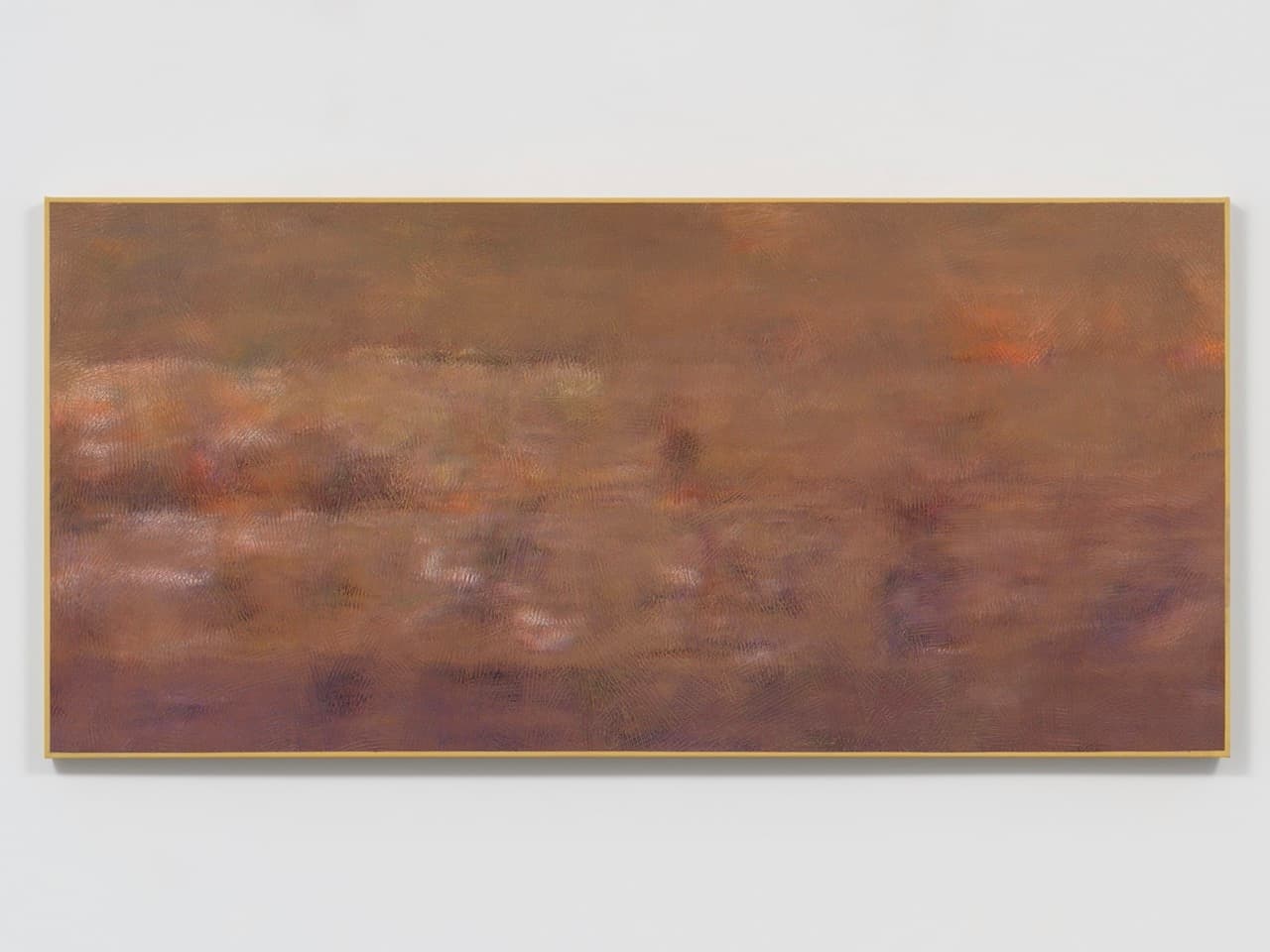
Jack Whitten, King’s Way II, 1971. Acrylic on canvas, 50 ½ inches × 9 feet ¾ inches. Jack Whitten Estate. Courtesy Hauser & Wirth. © Jack Whitten Estate. Photo: Christopher Stach.
The Afro pick transformed Jack Whitten’s painting process at a definitive moment in both his career and US history. In 1970, he used the hairstyling device in the painting Homage to Malcolm, five years after the political leader’s assassination. Then a year later, the same tool is part of his production of King’s Way II, a painting done in remembrance of another assassinated Black leader, Martin Luther King Jr. In these works, Whitten confronts the political and historical reality of watching and living with the killing of Black civil rights leaders. Never was the Afro pick intended as a paintbrush, and yet it serves as a foundational tool for Whitten to explore abstraction as both a form of aesthetic expression and a mode of sociopolitical practice.
In a 2009 interview, Whitten refers to Afro picks as the “Afro-comb.” Similarly, art critics and curators indiscriminately adopt the same terminology to refer to Whitten’s use of the object. On the surface, “Afro pick” versus “Afro-comb” might appear as a matter of semantics. But, a discussion of Whitten’s use of the term adds important connotations and significance to Whitten’s painterly process and exploration of form. The term “Afro pick,” and not “Afro-comb,” is widely used in Black vernacular culture. I attribute Whitten’s use of the term as a way to evoke a six-thousand-year-old history dating to ancient Egypt and other early African civilizations, where such combs found their origins and initial use, and also to denote his process of literally combing through the painting surface and applied paints. Nevertheless, the term “Afro picks” and associated Afro hairstyles elicit a complex set of counter-revolutionary and cultural politics, which increasingly entered the public sphere after Malcolm X’s and King’s deaths, and which are associated with photography—a medium Whitten ascribes outsized importance to in the history of painting.

Jack Whitten, Homage To Malcolm, 1970. Acrylic on canvas, 8 feet 4 ½ inches × 9 feet 11 ½ inches. The Joyner/Giuffrida Collection. © Jack Whitten Estate. Photo: Christopher Burke.
To understand the implications of the Afro pick as a painting tool requires understanding Whitten’s interpretation of photography as a medium of representation. In his studio, sometime between 1968 and 1969, before he experimented with Afro picks, he wrote on the wall the following phrase: “The image is photographic; therefore, I must photograph my thoughts.” He elaborated, “I went around thinking that I was a camera and that I, my brain, was operating as a camera.” In a moment that he himself described as “a revelation,” and as having the feeling of a “mental breakdown,” he was recognizing the profound ways in which photographs structured Black peoples’ own experiences, like his own, of their racial identity and history, just as it was negatively creating an environment where the state justified the surveillance of and violence against Black people. Whitten’s exploration of the Afro pick follows such “a revelation,” and suggests an attempt on the part of the artist to reckon his painting practice and subject matter with a world created by photographs. Interestingly, Whitten assigns importance to photography but never takes pictures, never uses actual pictures when painting, and never adopts a figurative or social documentary visual language or subject matter. Of note, both Malcolm X and King wore their hair naturally but never stylized it as Afros. Nevertheless, Whitten uses the Afro pick at a time of its increasing association with the Black Power and Black is Beautiful movements to consider in non-figurative ways the loss, legacy, and imprint of monumental political and historical figures. In essence: What happens in life and art when a politics of racial pride and self-determination at any costs displace generally non-violent Black respectability politics of older generations? What does it mean to consider Whitten’s canvas and mode of abstraction as spaces of self-determination and not ones of romanticized idealization?
Whitten locates political agency and commentary not in explicit figural imagery, but instead in the material and tactile. What does it mean to reflect on the trajectory of Black struggles for civil rights and social justice using a tool associated with ideas and imagery that seemingly run counter to adopted sociopolitical ideologies? Tellingly, it is only decades after their making that Whitten exhibits his works dedicated to Malcolm X and King, leaving us to imagine in quiet, subtle ways the place and impact of these works within Whitten’s masterful works, which only grow in scale from the 1970s to the 1980s. One observation is the ways in which he produces non-figural, abstract portraits of seminal Black cultural and political icons, including Ornette Coleman, Maya Angelou, and Barbara Jordan. The Afro pick ignites curiosity in Whitten to scale up the painting tool, leading himself to make a saw and later the “Developer,” which ironically draws its name from the photography darkroom and printing of film. While Whitten’s application of the term “Afro-comb” dates his political and popular cultural views, it also reflects a period when the promise and future of Black freedom struggles remained unfilled and uncertain. His paintings were that search for a better, sometimes elusive world, which is not always visible or clear to the human eye.
Drew Thompson is a historian of art and visual culture and an independent curator. Recent exhibitions include Benjamin Wigfall and Communications Village at The Dorsky Museum of Art and Virginia Museum of Fine Arts and SIGHTLINES at the Bard Graduate Center Gallery. He is the author of the monograph Filtering Histories: The Photographic Bureaucracy in Mozambique, 1960 to Recent Times, and he is at work on a book provisionally titled Coloring Black Surveillance through Polaroids: The Poetics of Black Solidarity and Sociality.