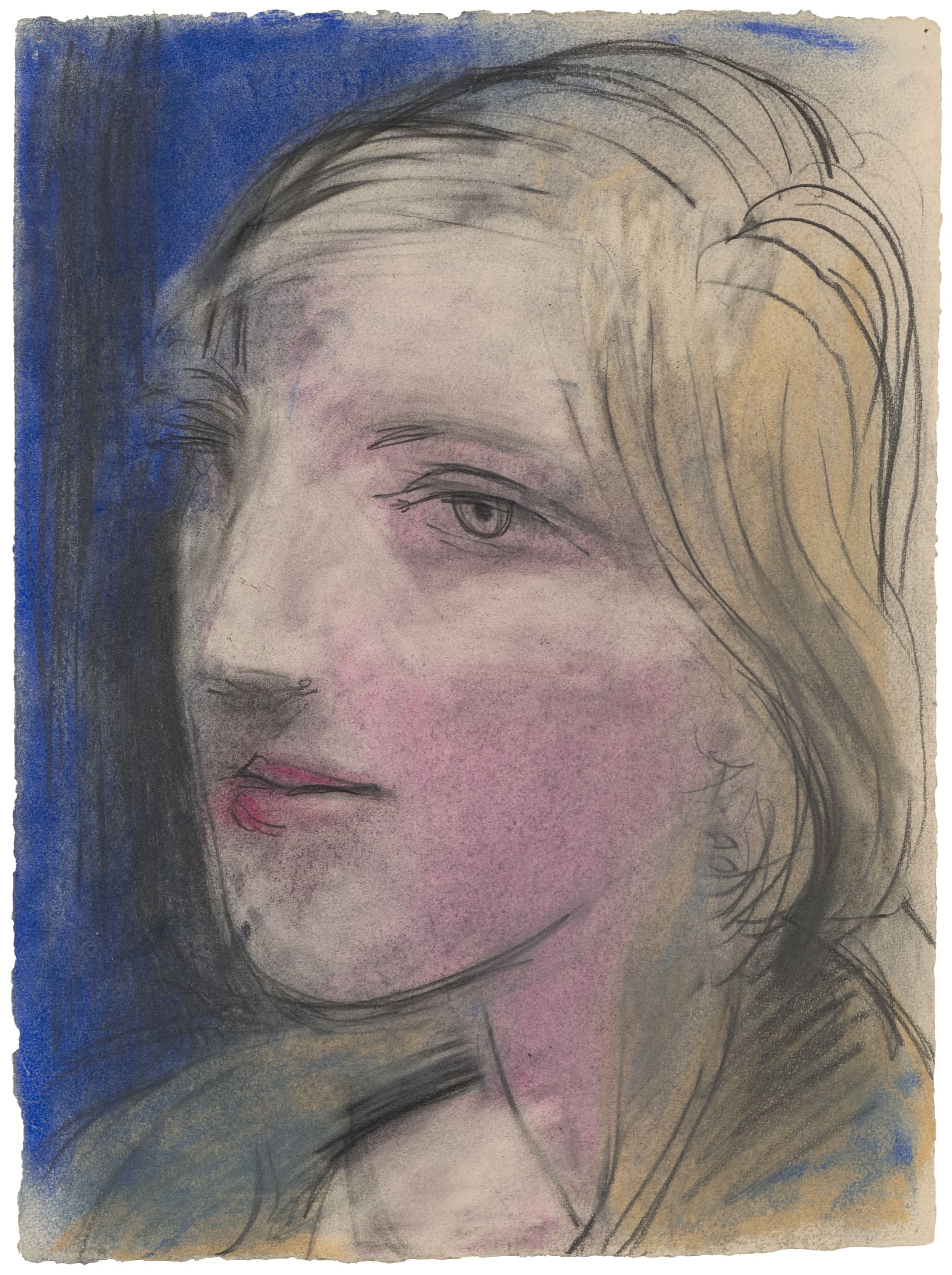
Pablo Picasso, Portrait de Femme (Marie-Thérèse), 1936. Pencil, watercolor, and pastel on paper, 13 3/8 x 10 1/8 inches. © 2025 Estate of Pablo Picasso / Artists Rights Society (ARS), New York. Courtesy Gagosian. Photo: Sandra Pointet.
Word count: 915
Paragraphs: 10
Gagosian Gallery, in collaboration with Paloma Picasso
April 18–July 3, 2025
New York
This magnificent show of some sixty-eight pieces by Pablo Picasso—from an 1896 self-portrait drawing to an anonymous Tête oil on canvas from 1971—is Gagosian’s last show at 980 Madison Avenue. The conceit governing the exhibition is a version of Goethe’s “elective affinities,” which is the idea that, in defiance of chronology, works from various moments in Picasso’s more than seventy-year productive life will “speak” to one another and generate connections.
This once-in-a-lifetime opportunity to see a vast array of works by Picasso not ordinarily available to us debunks the notion of progress in the arts that Picasso himself inveighed against in a statement to Marius de Zayas, in 1923:
The several manners I have used in my art must not be considered as an evolution, or as steps toward an unknown ideal of painting. When I have found something to express, I have done it without thinking of the past or future. I do not believe I have used radically different elements in the different manners I have used in painting. If the subjects I have wanted to express have suggested different ways of expression, I haven’t hesitated to adopt them.
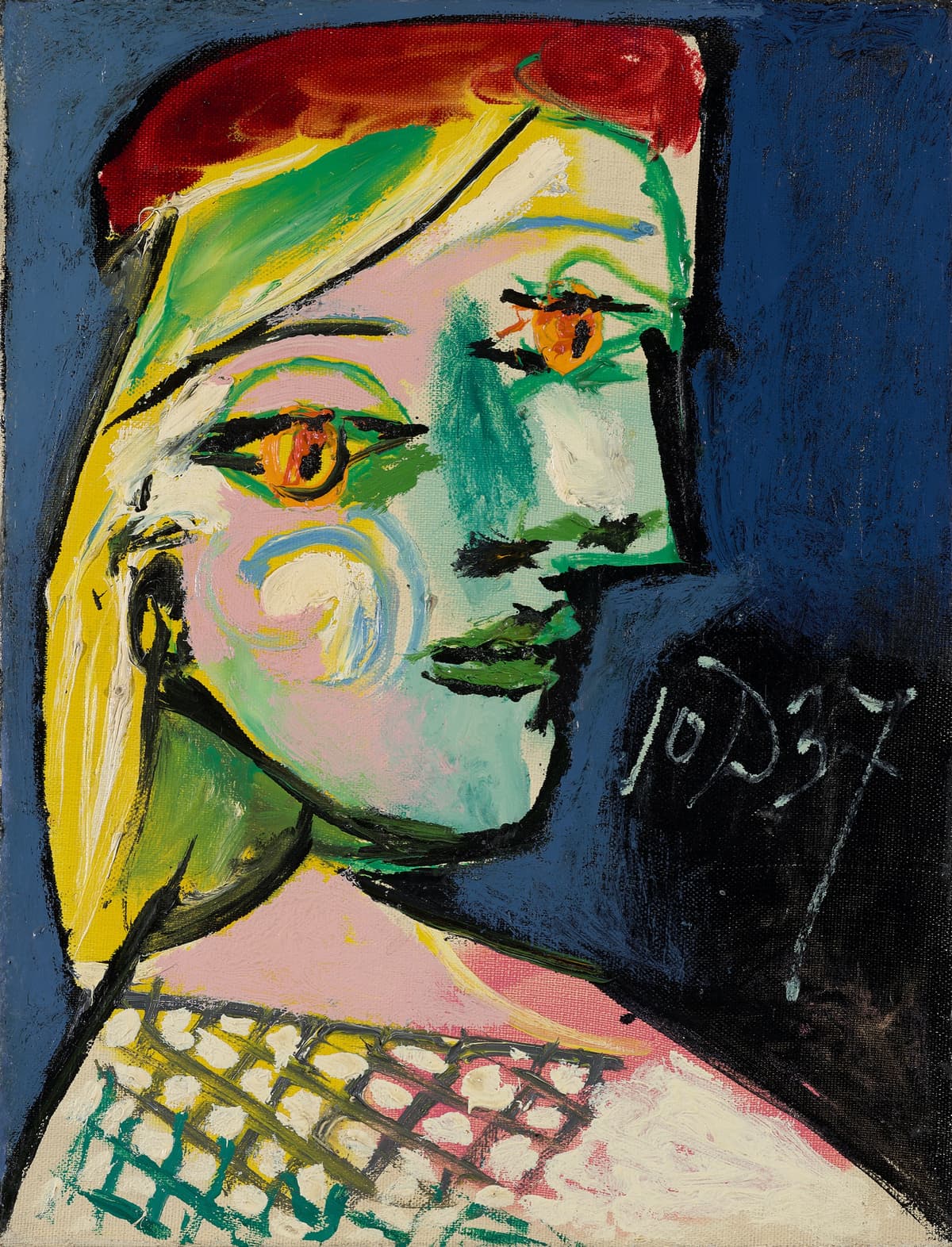
Pablo Picasso, Portrait de Femme au Béret Rouge (Marie-Thérèse), 1937. Oil on canvas, 13 3/4 x 10 5/8 inches. © 2025 Estate of Pablo Picasso / Artists Rights Society (ARS), New York. Courtesy Gagosian. Photo: Sandra Pointet.
This helps us to understand how Picasso could paint in several styles at the same time, and how, for instance, he could compose a poignantly sentimental and figurative pencil, watercolor, and pastel-on-paper Portrait de femme (Marie-Thérèse) in 1936 and an astonishing post-Cubist Portrait de femme au béret rouge, an oil on canvas in 1937. These small (both about 13 by 10 inches) works could be by two different artists. That said, if we discard evolution, we still return to the fetishizing of stylistic changes and their relationship to historical moments.
Picasso’s visceral reaction to the Spanish Civil War (1936–39) finds its maximum expression in the monumental Guernica of 1937. There are three paintings from 1937 here: the portrait of the woman wearing a red beret; a Femme au béret bleu assise dans un fauteuil gris, manches rouges; and a Femme au vase de houx. We might be tempted to find politics in the red beret, but we would be stymied by the blue beret and the vase of holly. In other words: even context is a dubious source of meaning in the case of Picasso. The blue beret portrait does indeed resonate with a Cubist Femme assise au fauteuil rouge (ca. 1918), so we see that what matters is the portrait convention—a woman seated on a chair—rather than a historical moment, as if Picasso could return to the same motif whenever the spirit moved him and paint it in his style du jour.
The three self-portraits in the show from 1896, 1897, and 1907 document significant moments in Picasso’s transition from Barcelona to Paris. The earliest, a pencil sketch, represents the artist as a boy of fifteen, his hair cascading over his forehead; it is a period piece and not at all revolutionary. The Autoportrait of 1897, charcoal on paper, shows a new Picasso: his hair is brushed back as he stares past his easel, enraptured. It is the same haunted face of the celebrated self-portrait of 1901, where the twenty-year-old Picasso, no longer a teenager, shows the ravages of a Parisian winter. The stare is still ecstatic, but the unnatural colors of Picasso’s Blue Period show him moving swiftly away from figuration. The pencil sketches of 1907, his Autoportraits buste et tête, relate directly to the 1906 Autoportrait à la Palette, where the face derives from ancient Iberian sculpture, the palette a kind of shield and the empty right hand a defiant fist. This is pure change, not evolution, no matter how tempting it is to find a progression.

Installation view: Picasso: Tête-à-tête, Gagosian, New York, 2025. Artwork © 2025 Estate of Pablo Picasso / Artists Rights Society (ARS), New York. Courtesy Gagosian. Photo: Owen Conway.
This same process of constant change is present in Picasso’s often sidestepped career as a sculptor, represented here by work from as early as 1905 and as late as 1961. Too often we hear the refrain, “and he also made sculpture,” when the fact is that Picasso is one of the great sculptors of the twentieth century. An early bronze, Tête de fou (1905) recalls the Family of Saltimbanques (1905) painting of Picasso’s Rose Period in its touching depiction of a wistful performer. But the real surprise among the sculptural work here is the monumental Petite fille sautant à la corde (1950), which at 60 inches tall, simultaneously takes us back to the Picasso of the thirties and forward to Willem de Kooning’s 1960s Clam Diggers. Children appear more and more frequently in Picasso’s paintings during the late thirties, but the girl jumping rope suspended in midair takes infantile iconography to a new level. More playful, yet also adumbrations of Marisol’s sculptures of the sixties, are the small peg dolls Picasso made for his daughter Paloma—dolls made for her that are named after her. We are fortunate to be able to see these highly personal pieces, Paloma Picasso’s fittingly sentimental contribution to this grand show.
Those of us fortunate enough to have performed the “Gagosian two-step” (going up to the sixth floor then navigating the stairs down to the fifth) to see wonderful shows—those of Cy Twombly and David Reed come immediately to mind—will miss this space because the descent to the lower floor always added a note of surprise and delight. Picasso: Tête-à-Tête is a not-to-be-missed farewell, a grand finale in the best sense of the term.
Alfred Mac Adam is Professor of Latin American literature at Barnard College-Columbia University. He is a translator, most recently of Juan Villoro’s Horizontal Vertigo (2021), about Mexico City.