The Spectral Stage
Past meets future as dancer and choreographer Xin Ying duets with Martha Graham’s digital ghost, transforming dance preservation into supernatural communion.
Word count: 1121
Paragraphs: 10
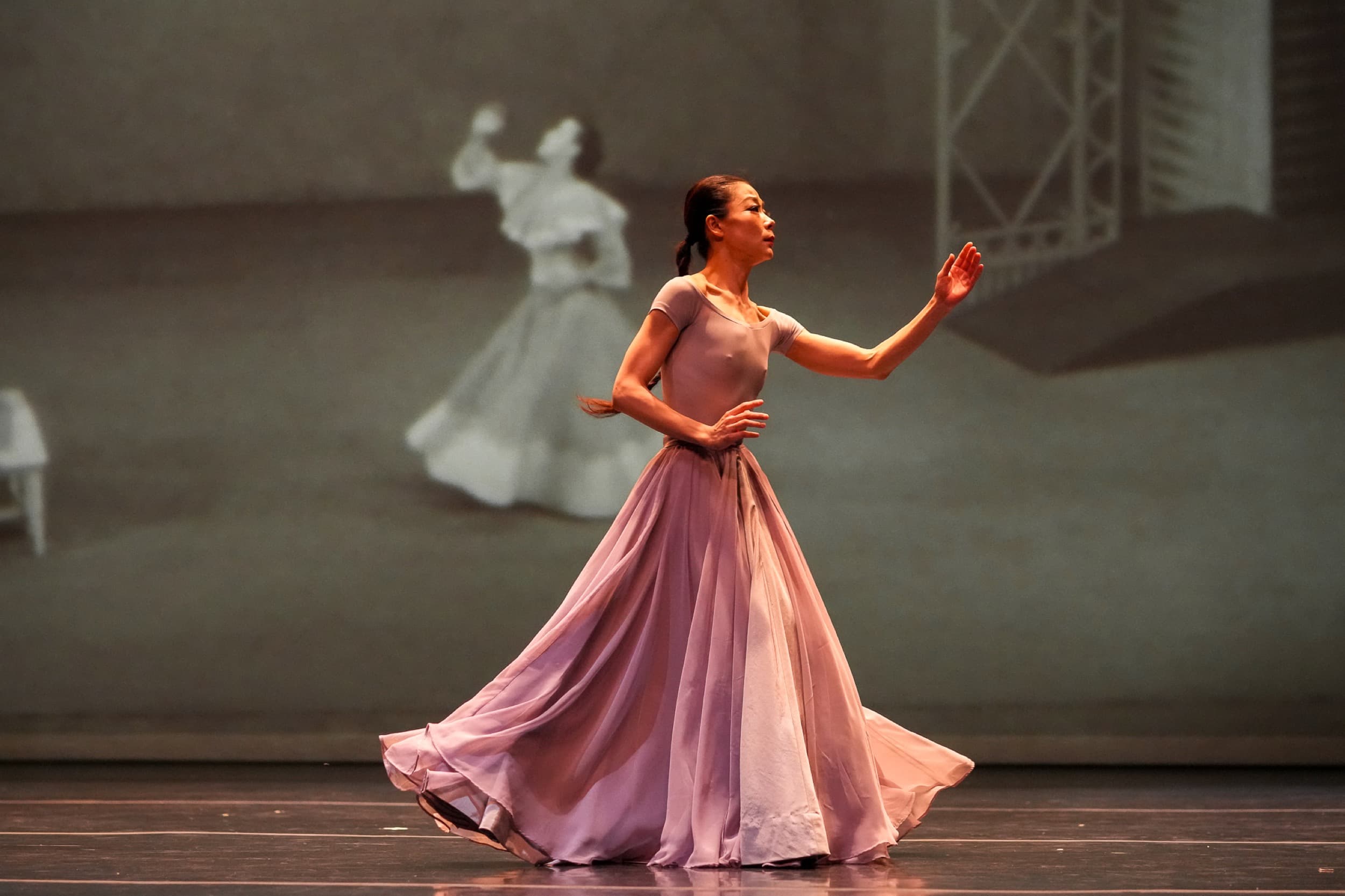
Xin Ying in Letter to Nobody by Xin Ying in collaboration with Mimi Yin. Photo: Brian Pollock.
Letter to Nobody
Joyce Theater
April 2, 4, 10, & 12, 2025
New York
Bathed in white light and costumed in a fitted pink bodice and floor-length skirt, Xin Ying crosses the stage while Martha Graham, similarly costumed but projected on a backdrop screen in black and white, moves upstage toward a bench on stage right. The figures repeat their diagonals, floating over the stage as they cross and vee. This visual composition mesmerizes: the two dancers—one live, and one archival—exchange gesture and direction in interwoven communication. The Joyce Theater’s audience is silent as the auditorium swells with Martha Graham’s distinctive voice reciting lines by Emily Dickinson: “I’m Nobody! Who are you?/ Are you – Nobody – too?/ Then there’s a pair of us!”
As Graham and Xin simultaneously move into an arabesque, their torsos cantilever parallel to the ground, left legs swooping their long dresses into a wing. I recognize this image as the 1940 photograph Letter to the World (Kick) by Barbara Morgan, which captures Graham in this position and is now reproduced on t-shirts, coffee mugs, and totes. Andy Warhol amplified the image in his 1986 screenprint, infusing Graham’s costume with bright pink.
While The Kick has become iconic, Letter to the World itself is no longer performed in its entirety. The archival footage drawn upon for Letter to Nobody is from 1940, the year the piece premiered, and, unavailable on YouTube, is rare. Graham’s piece explores Emily Dickinson’s inner landscape, represented by several characters, most significantly the One Who Dances, played by Graham, and the One Who Speaks, who recites Dickinson’s poetry and letters, mainly from the beginning of the Civil War. It is hardly accidental that Graham chose poems from this period of upheaval at the time the United States was heading into the Second World War. By excerpting passages and rearranging moments from Dickinson’s biography, Graham constructs a nonlinear frame to explore death, inheritance, and the intermingling of past and present that constitute psychic reality.
Translating Graham’s process into her own, Xin’s gestures sync with the One Who Dances, and they often complete each other’s patterns. Equally powerful are moments when Xin moves in tension with Graham, mirroring otherwise fluid movements with micro-glitches and reverberations. When she moves directly toward the One Who Dances, as if rushing to meet her, I feel I am watching a split atom on a collision course. Before she arrives, however, the figure on the screen vanishes, dissolves into thin air. Dislodged from its archival stability, the film begins to move as if inventing itself on the fly. Figures evaporate and reemerge. The chorus enters for a social dance scene. They speed up, reverse, and move backward as the soundscape transitions from its classical register and spoken text into beatboxing.
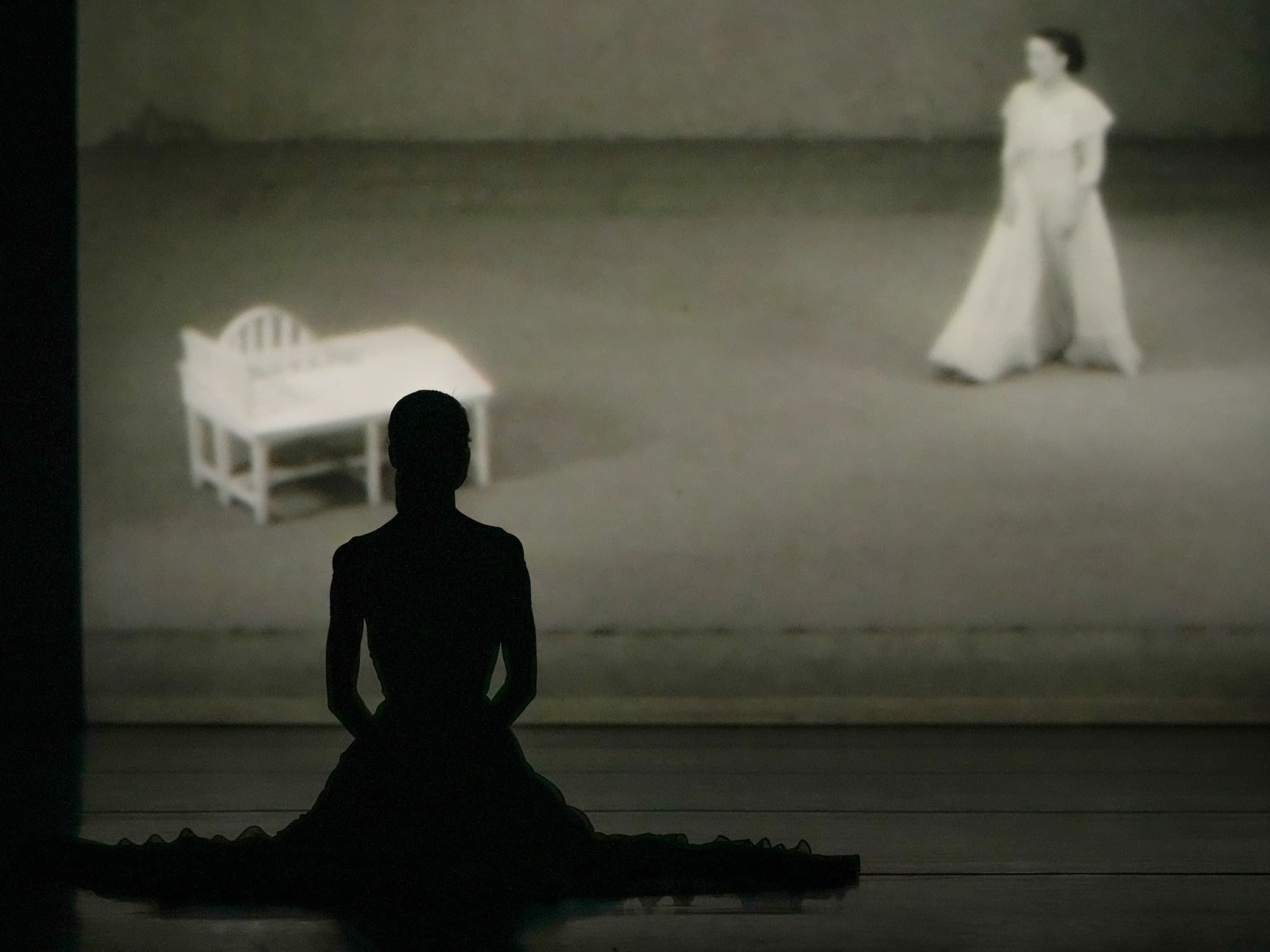
Xin Ying in Letter to Nobody by Xin Ying in collaboration with Mimi Yin. Photo: Brian Pollock.
While Graham’s movement is fairly fixed into its archival groove—she’s captured on film, after all—multi-media artist Mimi Yin, listed alongside Xin as choreographer, has freed Letter to the World from static historicity. Yin’s interventions reshape the dance into an arc that begins where the original piece ends (with Graham walking across the stage to sit on a bench alone), and then introduces male figures into the scene (Erick Hawkins and Merce Cunningham), and ends with Letter to the World’s social dance party scene, which comes at the beginning of the original. Yin also shapes the score, working with generative AI to create the Martha Graham-like voice that recites Dickinson’s poetry (there is no known archival recording of her reading the work). The structure Yin creates might be read as a micro-history of the Graham company itself, which began in 1926 with solos and trios for women and grew to include men over a decade later. By the end of her career, Graham, whose last work premiered in 1990, the year before her death, had embraced a collaborative process of choreography.
The result of this technological and artistic fusion between Graham, Xin, and Yin is quite personal, a communion between artists. Simultaneously, Letter to Nobody makes visceral the fact that there is no such thing as a solo. So too does the company’s larger centennial celebration and ongoing archival and technological exploration. During the 2025 March Studio Series event, NEW@Graham: Graham and Tech, a live demonstration fed ChatGPT and Vondy instructions for a moving image based on Graham’s choreography and Hyunju Kim demonstrated a three-dimensional model for dance notation. The April 1 season gala unveiled the MarthaBot, an OpenAI 4.0 model that responds to users as if she were Martha Graham, created by artist and creative technologist Kate Ladenheim in collaboration with Xin.
Martha Graham purists might object to computer-generated speech and avatars that blur lines between fact and fiction, although others might argue that Graham has always been mythological. Alongside tech collaborations and meticulously reproduced favorites from the repertory, the company’s comprehensive approach to legacy programming includes several solos recently reconstructed by Virginie Mécène from photographs of pieces otherwise completely lost to time. Beyond the official company and school, a licensing program grants other professional companies and educational institutions access to her repertory. Even audience members will be given the opportunity to dance alongside Graham at Jacob’s Pillow this summer via Lamentation: Dancing the Archive, an installation that allows users to engage with a 360 degree film of this iconic solo, created by Xin with Ladenheim, Katherine Helen Fisher, and Alan Winslow. As the MarthaBot has replied when asked, “Who are you?”: “The core of my legacy is not fixed; it is a spine that bends, a gesture that aches, a contraction that pulls the universe inward for just a moment.”
As Letter to Nobody progresses, I’m so absorbed by Xin’s interactions with her filmic counterpart, that when the work radically shifts, it is like a transition in a dream: beautifully seamless and startling. Martha Graham now fills the screen, sitting at her dressing table in a Chinese-style jacket, hair coiled atop her head. “There comes a moment,” she tells her audience while looking into the mirror, “where she looks at you in the mirror.” As the camera zooms in tighter, I study Graham’s face, thinking that she looks so much like Xin. It is then that I realize her face has been infused with Xin’s face, her voice softening into Xin’s voice, now uttering the lines, “It is through you, her love, her hope, her fear, her terror, is to be expressed.” “Xin,” I think to myself, “there is Xin, who is Graham, who is Xin.” At this moment, the screen goes dark and an amber light bathes Xin, now onstage in a shining gold unitard, crouched in a long, insectoid-like lunge. She is beautiful and metallic and unsettlingly posthuman.
Karla Kelsey is the author of seven books, most recently Transcendental Factory: For Mina Loy (Winter Editions, 2024) and is the editor of Lost Writings: Two Novels by Mina Loy (Yale University Press, 2024).