Word count: 975
Paragraphs: 13
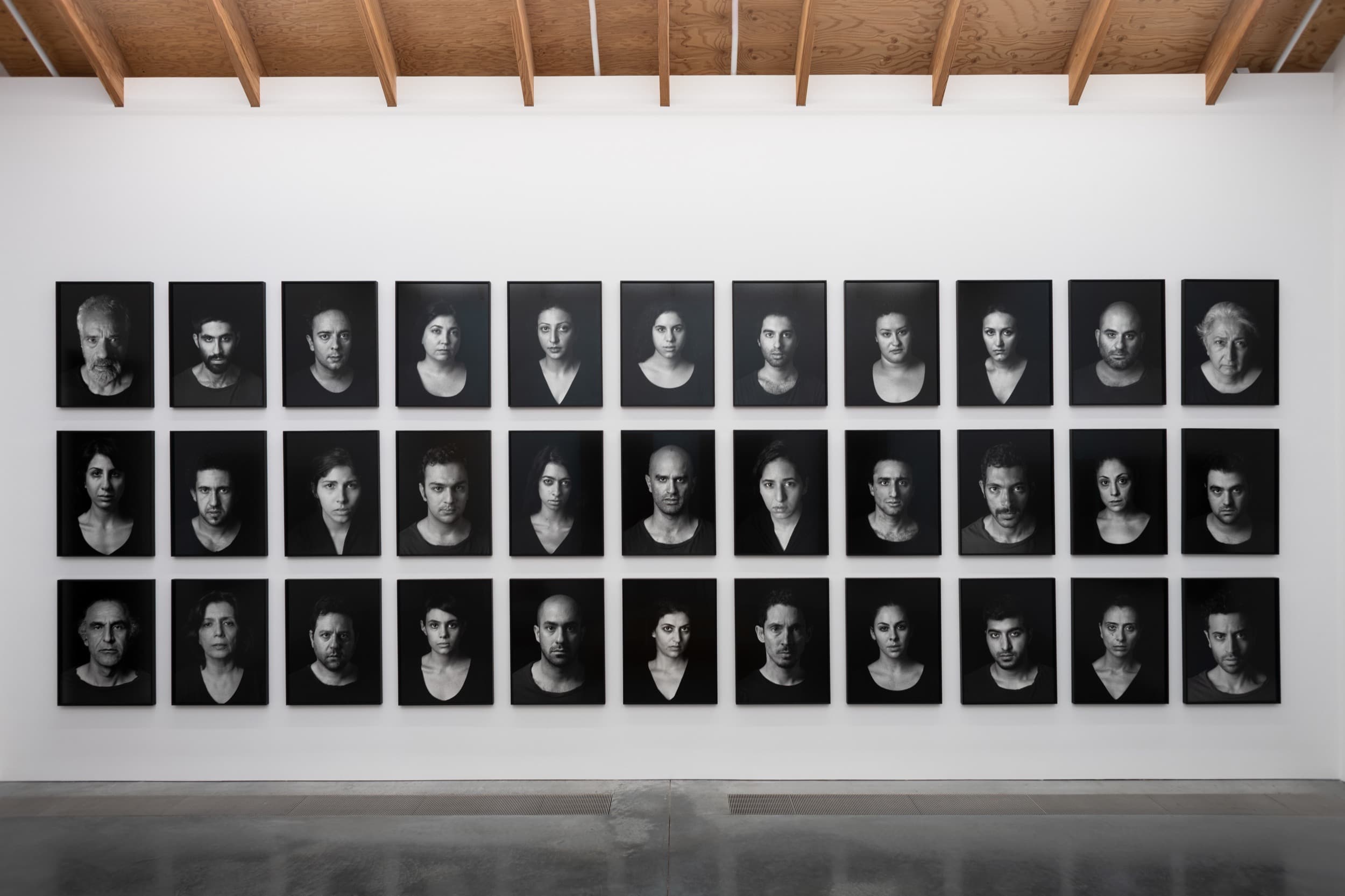
Installation view: Shirin Neshat: Born of Fire, Parrish Art Museum, New York, 2025. Courtesy the Parsish Art Museum. Photo: Gary Mamay.
Parrish Art Museum
April 20–September 1, 2025
Water Mill, New York
The eye travels a precarious edge in Born of Fire, a riveting exhibition of work by Iranian-born artist Shirin Neshat. It features three of her acclaimed photographic series: “Women of Allah” (1993–97), “The Book of Kings” (2012), and “Land of Dreams” (2019). It also includes two double-channel videos, The Fury (2022) and Land of Dreams (2019), and a full-length Land of Dreams movie (2021), which will screen at the museum in August. Each of these works presents themes of alienation, repression, and identity through the lens of an artist shaped by dual cultural traditions.
In a recent interview, Neshat recalled the pivotal moment in her life when, as a student in Berkeley, California, she realized that she could not return home to her family in Iran. The fundamentalist regime established after the 1979 Islamic Revolution shattered the secular world of her youth. “My life was lived in the West,” she explained, “but Islamic and Persian culture is the source of my art. It lives between these two worlds.” Her bold photography and elusive films reflect this duality, traversing the psychic Iranian/American divide. While veiled women in chadors may seem remote from tattooed cowboys in the American Southwest, they turn out not to be. Neshat uncovers uncanny parallels between lives shaped by Islamic authoritarianism, and lives that reflect the failure of the American dream.

Shirin Neshat, The Fury, 2012. Two-channel video installation, HD video monochrome. Courtesy the artist and Gladstone Gallery. © Shirin Neshat.
The exhibition’s photographic works weave myth, poetry, and memory into portraits of individuals who have lived through historical upheaval. “Women of Allah,” Neshat’s first photographic series, was inspired by the 1979 revolution—initially supported by devout women who took up arms against the shah’s secular regime. However, it wasn’t until she briefly united with her family in 1991 that Neshat fully grasped the consequences of Islamic fundamentalism on the suppression of women’s rights. She was also deeply concerned with the resulting broad perception of Iranian women as inherently passive and submissive.
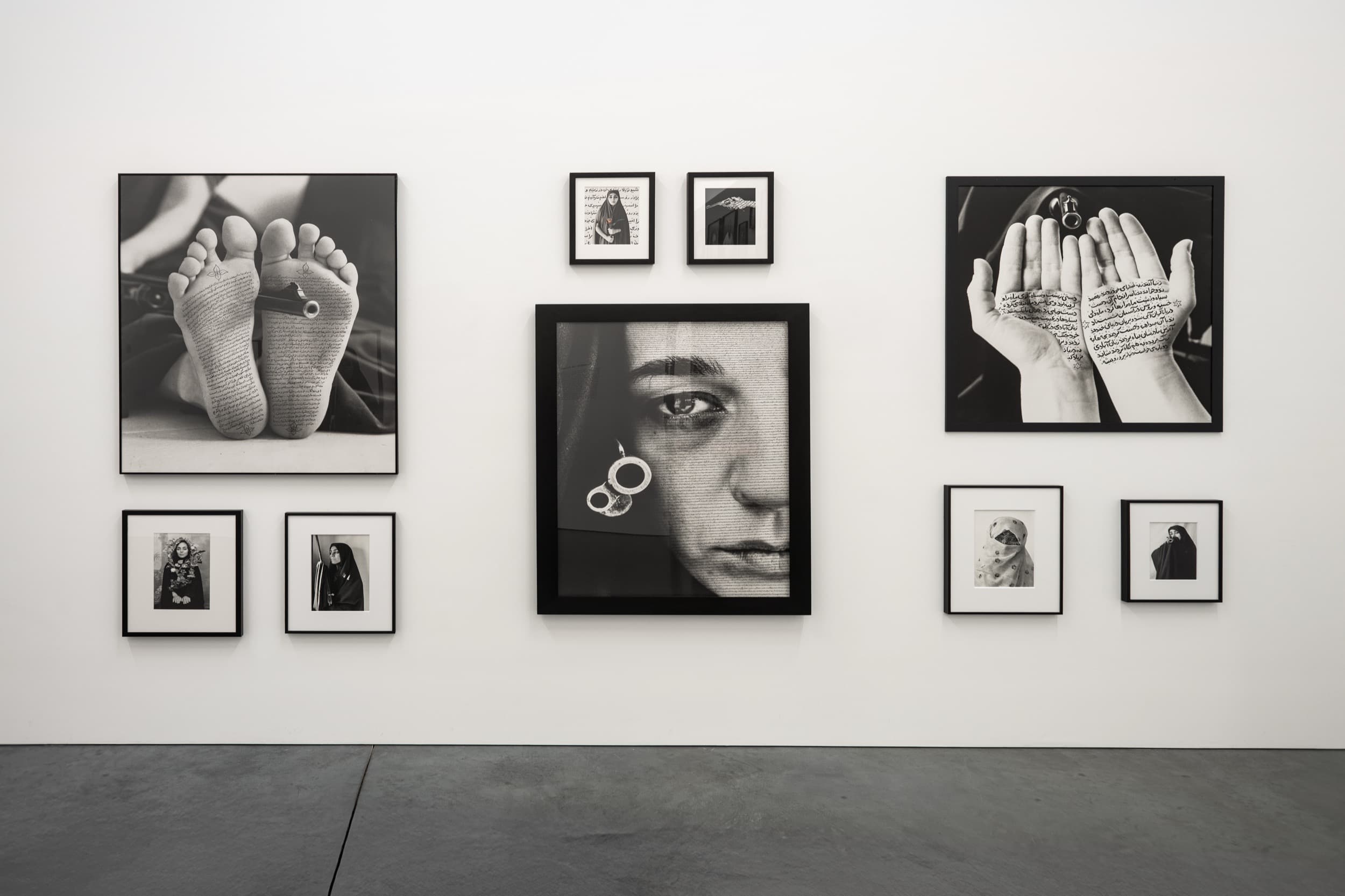
Installation view: Shirin Neshat: Born of Fire, Parrish Art Museum, New York, 2025. Courtesy the Parsish Art Museum. Photo: Gary Mamay
“Women of Allah” honors their spiritual grit. The images depict veiled warrior-like women brandishing rifles or tenderly holding a child’s hand. Haunting and evocative, these portraits are overlaid with handwritten Farsi calligraphy that partially obscures the women’s faces. Elegant and enigmatic, this script is illegible to most Western viewers, underscoring the inaccessibility and complexity of these women’s lives. When translated, the calligraphy reveals verses by two influential Iranian poets: Tahereh Saffarzadeh, known for her religious themes, and Forugh Farrokhzad, a provocative feminist voice. By merging their divergent perspectives, Neshat exposes the internal conflicts within Iranian identity, while gesturing toward broader global struggles—such as the US Supreme Court’s 2022 reversal of Roe v. Wade, a chilling reminder that women’s rights remain precarious.
In “The Book of Kings” (2012), Neshat draws inspiration from the Shahnameh, a tenth-century Persian epic poem blending myth and tumultuous ancient Persian history. The following prophetic lines from the poem capture the spirit of resistance in the 2010s, during the Arab Spring uprisings:
When tyranny spreads, the hearts of people burn
But patience grows as rebellion takes its turn.

Shirin Neshat, Divine Rebellion, 2012. Acrylic on LE silver gelatin print, 62 x 49 inches. Courtesy the artist and Gladstone Gallery. © Shirin Neshat.
Neshat categorizes contemporary revolutionaries into three archetypes—the Masses, the Patriots, and the Villains. Gone are the veils and rifles. Similarly dressed, the Masses are presented in a grid of identical frames, their powerful gazes and body language conveying their impassioned emotions. To tighten the weave of ancient history and contemporary defiance, Neshat painted ancient battle scenes on the bodies of villains, etched the images with modern poetic calligraphy, and added drawings of mythical creatures inspired by Shahnameh illustrations.
In 2019, Neshat journeyed through New Mexico to explore the American half of her identity. The “Land of Dreams” photo series documents this odyssey through remote parts of the Southwest where she encountered a diverse cross-section of Americans—Native, Black, Hispanic, Asian, and white—living on the edge of society. Invited into their homes, she interviewed them about their lives and asked them to share their dreams. Dressed in quintessentially American attire, these individuals seem trapped in a fractured “melting pot,” reflecting the elusive promise of the American dream. In capturing the courage and dignity of US citizens for whom the American dream is an ongoing nightmare, Neshat blurs cultural divides and highlights humanity’s shared struggle for freedom and self-determination.

Shirin Neshat, Simin, 2019. Digital c-print with ink and acrylic paint, 81 x 54 inches. Courtesy the artist and Gladstone Gallery. © Shirin Neshat.
Land of Dreams, the video installation, follows Simin (Neshat’s alter-ego played by Sheila Vand), a young Iranian woman assigned during the Trump era to interview American subjects about their dreams. In the video, the analogies between Iranian autocracy and the US political climate remain subtle. Those comparisons become sharper in the full-length film. The movie—a humorous but surreal cautionary tale—features Simin as a census worker reporting to a board of creepy bureaucrats who analyze American dreams. At night, Simin reenacts these dreams in Farsi, streaming them online. Is she a government spy? An Iranian agent? Does it matter? With irony and wit, Neshat poses questions so many Americans are afraid to answer.
By contrast, The Fury (2022) is stark and devastating. This 16-minute fictional video exposes the sexual and emotional abuse of women held in Iranian prisons, a piercing portrayal of trauma that transcends geography and time. The double-screen film follows the path of a former prisoner, now free, as she roams the streets of Brooklyn, broken and disoriented. Yet even in her madness, she is met with empathy by neighbors who embrace her and understand her agony.

Installation view: Shirin Neshat: Born of Fire, Parrish Art Museum, New York, 2025. Courtesy the Parsish Art Museum. Photo: Gary Mamay
Throughout Born of Fire, Neshat presents women as complex, autonomous individuals—spiritual, fierce, vulnerable, fractured, defiant. Whether they are warriors, mothers, dreamers, or survivors, their humanity refuses to be contained by societal, political, or religious constraints. Neshat’s work is a profound meditation on the human cost of repression, and a call to witness those living in the crosshairs of tyranny.
Joyce Beckenstein is a writer living in New York.