Word count: 885
Paragraphs: 9
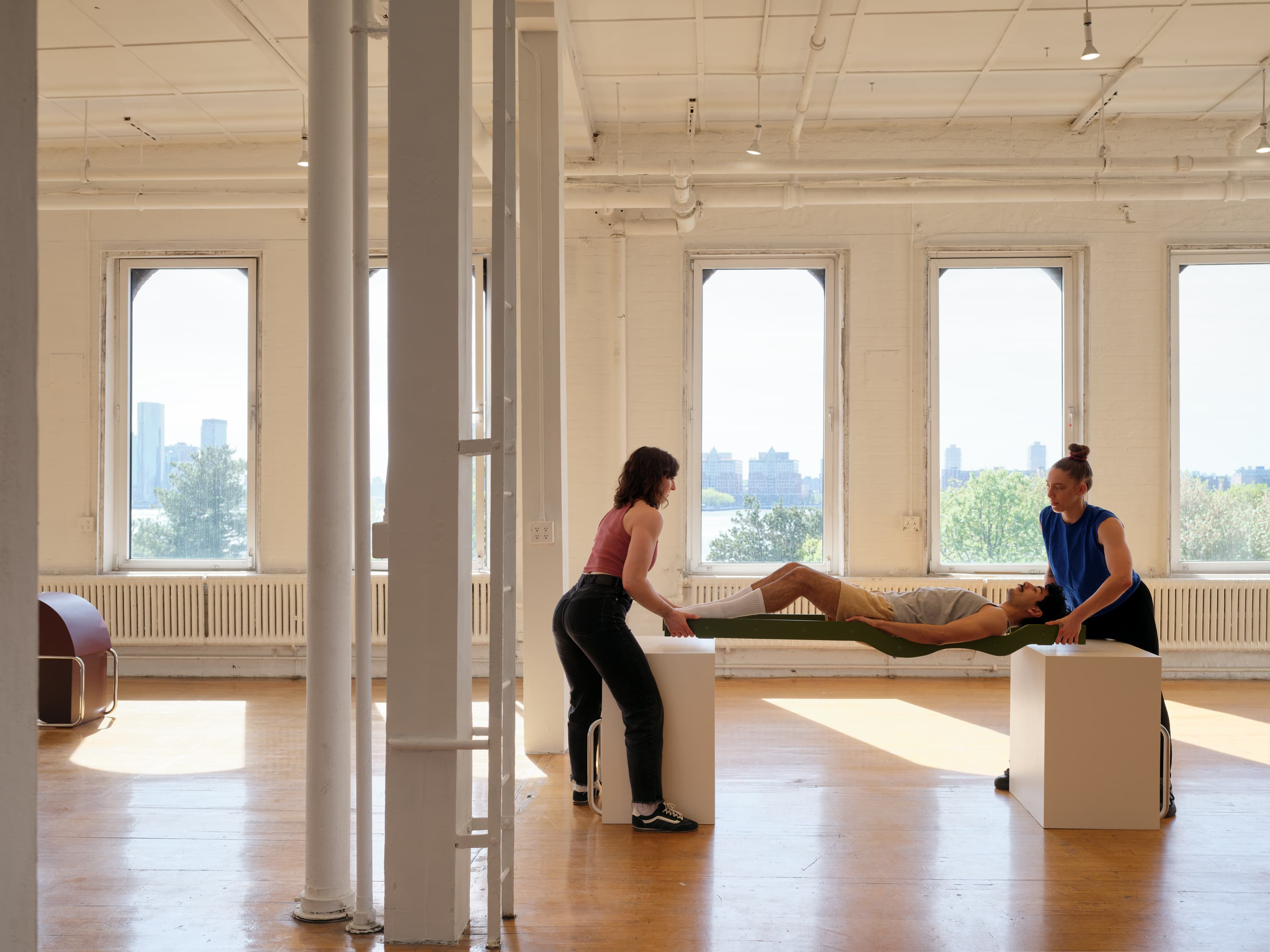
Installation view: Gordon Hall: Hands and Knees, The Kitchen, New York, 2025. Courtesy the artist and the Kitchen. Photo: Jackie Furtado.
The Kitchen
May 1–May 31, 2025
New York
Gordon Hall’s show Hands and Knees at The Kitchen consists of a series of floor-based sculptures made from pairs of chrome cantilever chairs, a design popularized by Marcel Breuer. Each piece has a twin seated at an equal distance from their partners. The metal curvature repeats for each support, and the seats have been replaced with plywood volumes: cubes, pyramids, and other fundamental modernist forms. In one pairing painted burgundy—one chair occupied by a cube, the other a sphere—the forms swallow up the chrome that supports them. The weights of the two shapes push into one another as they fill the gaps of the chairs’ negative spaces, each becoming a kind of pared-down body that now takes up residence in this seat—a body in waiting.
Hall’s abstraction of the sitter into a blank volume projects a certain type of silence, a dampening of affect. This type of suppression might be conflated with a lack of feeling, but instead I feel a rush of emotions when I contemplate the way we so often contort our bodies and pack away our selfhood when confronted with the unknown. This feels like a particularly queer way of thinking about expression, as one must build up strategies of compression and mutability to keep in step with the modes of survival that are required to exist within normative space and time. Last October at the Pulitzer Arts Foundation, Hall spoke directly of the influence of Scott Burton’s practice of creating sculptures that served as public seating during the AIDS crisis. In this, he participates in the queer tradition of expanding on the informal ways a marginalized community creates its infrastructure.
Beside the opacity of Hall’s colored plywood surfaces, I caught a flicker of movement in the refraction of color in the steel chrome that surrounds them. The metal reflected all the local color and light of the gallery, capturing, mutating, and molding these bits of otherness into the geometric formal perfection of the works. This play of light provided a reimagined alignment, one that offers a view of transformation within the confines of stillness. This sense of dynamic change and mutability is only reinforced by the performance that accompanies and completes Hall’s sculptures.

Installation view: Gordon Hall: Hands and Knees, The Kitchen, New York, 2025. Courtesy the artist and the Kitchen. Photo: Jackie Furtado.
Four elongated boards stand at attention, leaning against the gallery wall. Though abstracted they are legible as gurneys, dollies, ladders, or balance beams. They are also waiting, as eventually two performers take one away and return with a third performer lying on the now horizontal board. As they cross the gallery, the speed of their movement counterpoints the light from the windows, which has been slowly moving in the opposite direction. These two cadences fall in and out of sync throughout the performance. The board is then placed across two sculptures and returns to stasis. In the flex of the chair as it takes on load, I felt the precarity of its support, and a measure of relief upon realizing that all points of contact would hold. I tuned into the tenuousness of the connections that support us all when we are at our most vulnerable. This action repeated itself as more performers resting on boards were placed on the sculptures. I began to take closer note of the bodies that lay across these sets of supports. Two legs dropped through a hole in a red gurney-like board; arms dropped towards the ground while the performer’s chest pressed into a blue molding. The flesh of the performers is framed by the devices that hold them. In that framing I saw how each moment of connection created the fragment of a larger experience.

Installation view: Gordon Hall: Hands and Knees, The Kitchen, New York, 2025. Courtesy the artist and the Kitchen. Photo: Jackie Furtado.
Desire and fear can take us out of the present moment and distort our perceptual relationship to lived experience. The multiplying temporalities in the gallery—the stasis of Hall’s geometric forms, the flicker of light on chrome, the movement of the gurney-bearers—participate in these ruptures, which now include the ticking breath of the resting performers. The time that passes is always held in relation to the time we have left. It inserts itself as a module within our expectations of what we want to get done in this life. The longer the wait the more we have sacrificed. These feelings can be unbearable, and here Hall gives us the space to tune into these moments when our focus is not overwhelmed by the endless and hyperactive demands of day-to-day reality. Light plays over a heart beating as it lays in wait.
I began to empathize with the forms that supported the bodies of the performers, not because I saw a mirror of myself but because Hall has created a container of patience that asked me to feel. A leg hanging through a cut hole oscillated between a formal gesture and vulnerable flesh. I sat and waited, not for something to happen but for something to shift. The sunlit floor called me back to the constant movement of time, each moment seamlessly slipping into the next. The chairs, carriers, and resting performers punctuated the simplicity of this movement.
Hall reminds me of how fruitlessly we attempt to exert control over the uncontrollable, and the inconsolable tension of simply waiting to see what will happen.
Tony Bluestone is an artist who lives and works between New York City and the Catskill Mountains.