Word count: 840
Paragraphs: 9
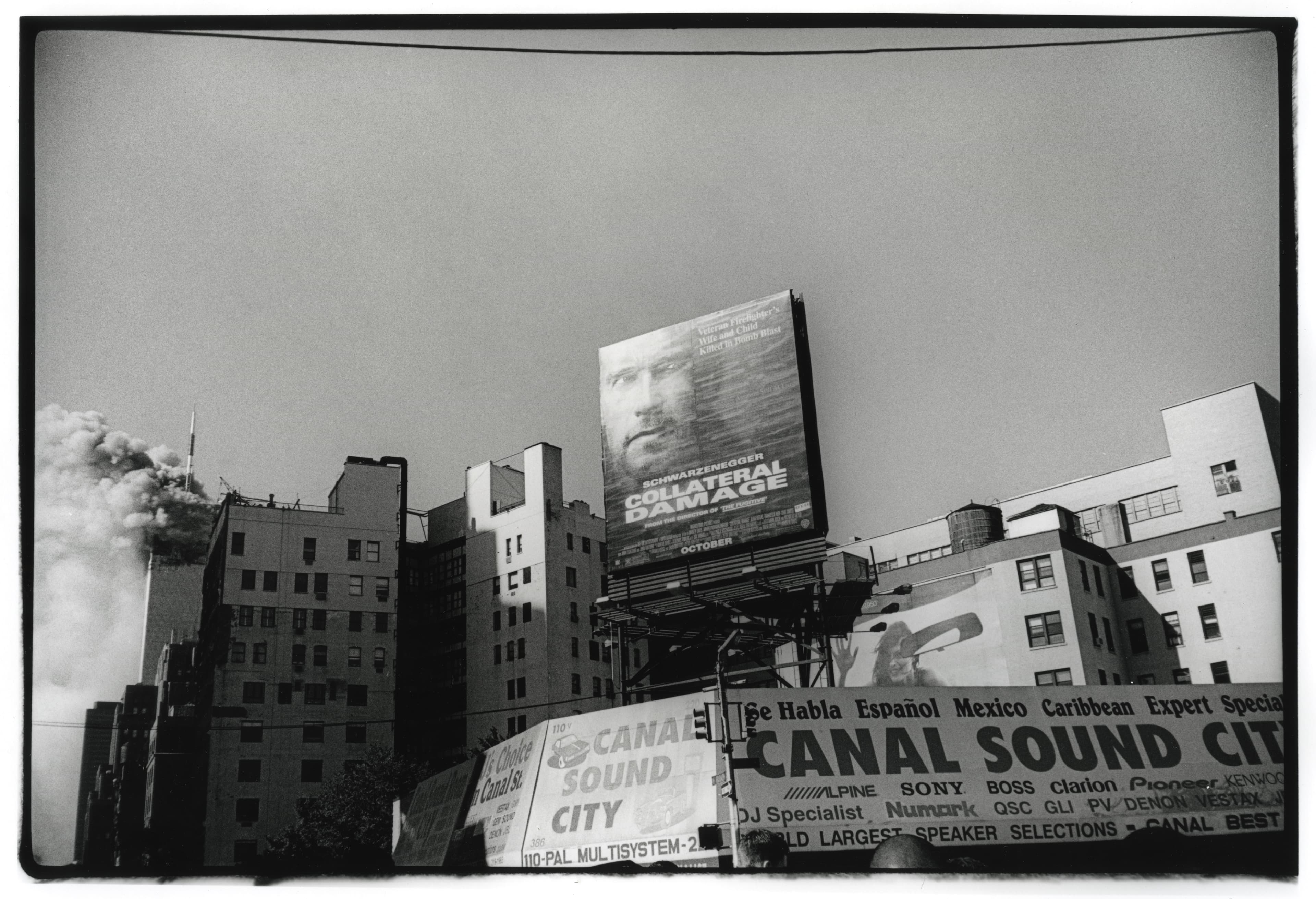
Dona Ann McAdams, September 11, 2001, 2001. Black and white photograph. Courtesy the artist and Pratt Manhattan Gallery.
April 18–June 7, 2025
Pratt Manhattan Gallery
New York
A predilection for perceiving temporal synchronicities, patterns, and movements unfolding in the visual field explains the pure poetry of so many images in Dona Ann McAdams’s current show at Pratt Manhattan Gallery. Culled from her photographic memoir, Black Box (Saint Lucy Books, 2024), the retrospective exhibition reveals her process of heeding subtle, intuitive presentiments of great images soon to be revealed. This photographer’s seeming ability to anticipate synchronous human or compositional gestures—imminently to be performed by crowds of strangers on ferries or foreign city streets, or by elemental natural forces in her immediate environment—has informed the intricate choreographies of scores of her photographs.
McAdams’s visual sixth sense, or imagistic precognition, is evident throughout her oeuvre. And when immersed in the sense-surround of the current exhibition, one gets the feeling of being caught up in a dance. There’s a rhythm and flow the viewer can access, like catching the moment when a school of fish changes direction or a flock of swallows pivots as one. Or like the murmuration of starlings the artist describes in the final pages of her photographic memoir, Black Box. That’s the magic. McAdams’s photographs have long revealed what it is (or one of the things) that’s so strange about her, and so pure—her attenuated connection to the ephemeral, unfolding moment, which plays out as sheer prescience and, artistically, very, very good luck. As much as skill and artistry, mystery and magic characterize McAdams’s photographs. They also benefit greatly from fantastic timing, an engaging narrative quality, and an intriguing way of intimating the stories hovering behind (or under) the images.
McAdams’s intuitive knack for forecasting dynamic events coinciding in the visual environment underwrites the searing message of September 11, 2001 (2001), where a billboard advertising the movie Collateral Damage touts the story of Los Angeles firefighter Gordon Brewer (Arnold Schwarzenegger), who seeks to avenge his son's and wife's deaths at the hands of guerrilla terrorists. In the far left of the frame, the tableaux of an act of guerrilla terrorism of incalculably greater scope plays out. In a terrible synchronicity, the North tower of the World Trade Center is in the process of collapsing in clouds of smoke and dust. When McAdams tried to find the billboard a short time later, standing in the exact location from which she’d taken the shot, it was gone. The film studio had pulled the film, and would wait until the next year before releasing it to the public. But it wouldn’t be long enough. The public couldn’t watch it, wouldn’t see it. It flopped at the box office and sank beneath the waves of the post-9/11, real-life scenario of thousands dead or suffering from life-changing injuries and illnesses.
McAdams similarly waited far longer to release (or even to print) her photograph of that sad, oracular synchronicity, holding off for nearly two decades. Her ethicality around her process combined with her strange magic (her intuition for potent images about to emerge from the ether into the light of day where they will affect eventualities, manifest influence and possibly pain) is impeccable. Like every good witch, she won’t wittingly cause harm, which isn’t to say she won’t release painful images. It’s just that she won’t do it gratuitously. There will invariably be some social, aesthetic, or humorous value to a McAdams image, even if teasingly enigmatic or obscure. This is why so many of her photographs have emerged as social, cultural and political activism that bears strange fruit years or decades after they were taken.

Dona Ann McAdams, ACT UP, Waldorf Astoria, 1990. Black and white photograph. Courtesy the artist and Pratt Manhattan Gallery.
Potent images like ACT UP, Waldorf Astoria (1990) have had an eldritch way of coming full circle. This past March, on the eve of new breakthrough drugs that could eradicate AIDS altogether being released, the Trump administration cut funding for HIV studies and AIDS research, and dismantled the program for AIDS relief distribution overseas. McAdams describes the circumstances surrounding the making of the photograph in her memoir:
One day in the early Nineties when the first George Bush was in town, we all went to protest in front of the Waldorf Astoria where Forty-One was staying. People were dying of AIDS and Bush was doing nothing about it. I needed perspective. I needed height. I needed to look down on the protest coffins.
The person holding up a horizontal casket in the center foreground looked up at McAdams and said, “be careful,” as she shimmied up a lamppost to get the shot. The sympathetic rapport forged in that brief moment of mutual concern was indelible, caught in the photograph and stored in memory, emerging into the present from shadows and light. He was Assotto Saint, a Haitian-born performer, editor, poet, and AIDS activist who’d danced with Martha Graham. McAdams wouldn’t learn his identity until many years later. When she did, she wanted to give him a print of the photograph, but he had died of AIDS only a few years after it was taken.
Yvonne Owens is a contributor to the Brooklyn Rail.