Dispatch 60: Senator Booker’s Stand
Word count: 1052
Paragraphs: 19
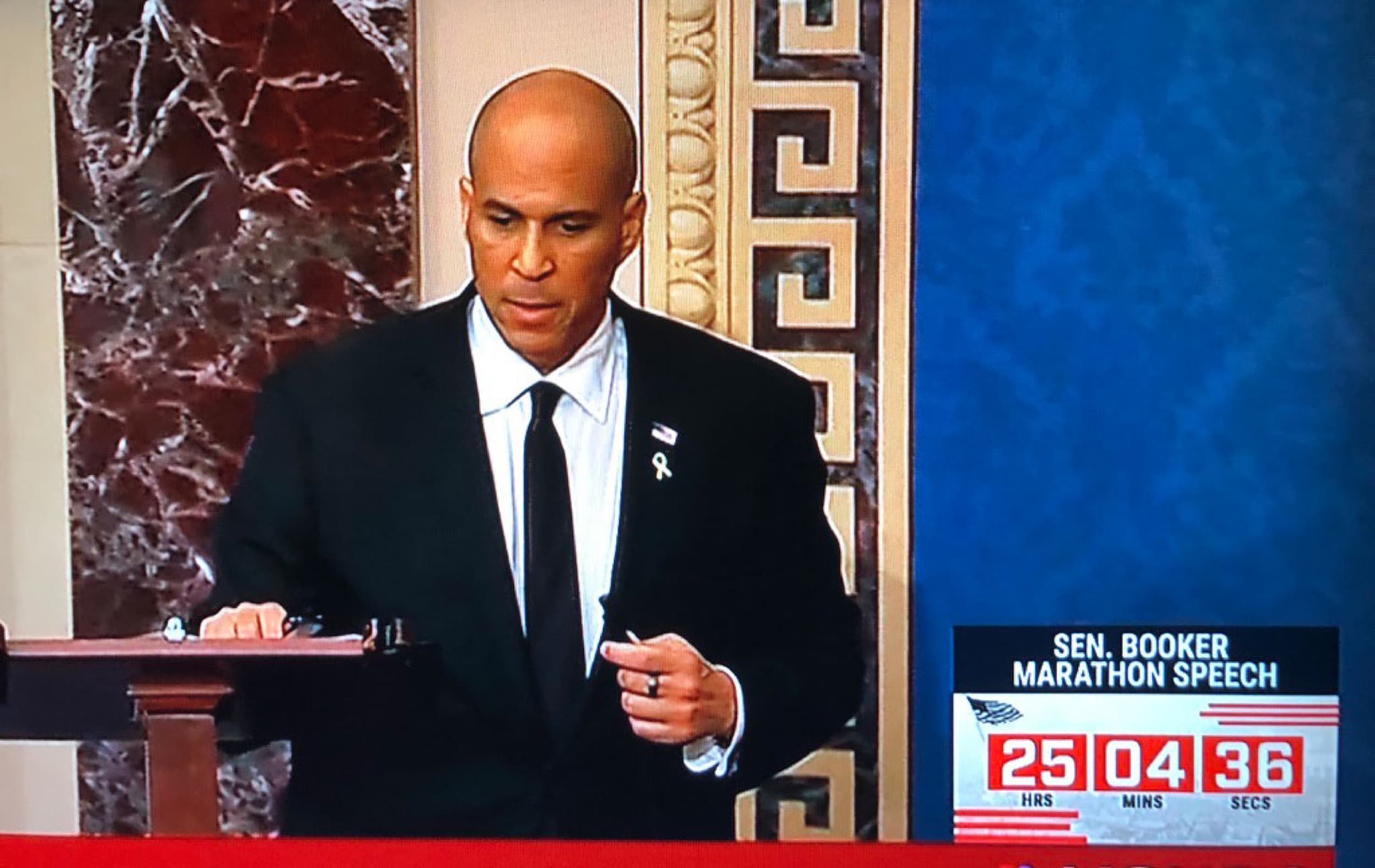
Something shifted in America on April 1. If you were listening closely, you might have heard it move.
It had always bothered Senator Cory Booker of New Jersey that the longest speech on record in the US Senate was made by Senator Strom Thurmond of South Carolina. Segregationist, racist Thurmond used that speech to filibuster the Civil Rights Act of 1957, the first significant civil rights legislation since Reconstruction. He talked for 24 hours and 18 minutes to keep the bill from coming to a vote, but it passed anyway, and was signed into law by Dwight Eisenhower.
Many other conservative Southern Democrats had used filibusters to block or delay civil-rights legislation for decades, including anti-lynching measures in the 1930s, but Thurmond took it to a new level in 1957. Thurmond participated in filibusters of the Civil Rights Act of 1964 as well, and then became a Republican to support Barry Goldwater for president.
Thurmond was the champion of White Southerners’ resistance to civil rights, and was re-elected to the Senate for 48 years, retiring in 2003 as the oldest Senator ever, at age 100.
Sixty-seven years after Thurmond’s 1957 speech, Senator Booker surpassed him in endurance, holding the floor forty-six minutes longer, and certainly in eloquence. But he especially surpassed him in passion. Booker stood to protest the second presidency of Donald Trump and what Trump is doing to destroy the country, and he did it in a detailed and highly effective manner. He said that too many people were surrendering to cynicism in the face of the move toward autocracy of the Trump regime, and he felt he had to stand up and speak against it, to try to turn the tide.
And in the process, Booker gave voice to the Democratic opposition to the Trump autocracy. It was what we had all been waiting for since Trump’s inauguration. It was a magnificent act, a truly inspiring one.
Strom Thurmond was 55 years old when he gave his speech, and Cory Booker was 55 when he gave his. Thurmond sustained himself by sipping orange juice and eating bits of ground steak and pumpernickel bread. Senator Booker prepared for his marathon speech by fasting for days. When he began to talk on Monday, he had not eaten since Friday and had not had water since Sunday night. During the speech, he became very dehydrated and began to cramp up. By the time he yielded the floor, he was in considerable pain. It was an incredible act of endurance and strength.
When he rose to speak, Booker invoked the memory of his mentor, the great civil rights leader John Lewis: “I rise tonight with the intention of getting in some good trouble. I rise with the intention of disrupting the normal business of the United States Senate for as long as I am physically able. I rise tonight because I believe sincerely that our country is in crisis … These are not normal times in America and they should not be treated as such in the United States Senate. The threats to the American people and American democracy are grave and urgent, and we all must do more to stand against them.”
And at the end of his speech, Booker again invoked the memory of John Lewis: “He said for us to go out and cause some good trouble, necessary trouble, to redeem the soul of our nation. I want you to redeem the dream. Let’s be bold in America.”
“My efforts today are inadequate to stop what they’re trying to do. But we the people are powerful.” About besting Senator Thurmond, Booker said, near the end of his speech, “To hate him is wrong, and maybe my ego got too caught up that if I stood here, maybe, maybe, just maybe, I could break the record of the man who tried to stop the rights upon which I stand. I’m not here though because of his speech. I’m here despite his speech. I’m here because as powerful as he was, the people are more powerful.”
But, he warned, the people are going to need to rise up, as they did for civil rights, putting their bodies on the line, to stop the Trump take-over. Otherwise, all will be lost.
A spokesman for President Trump dismissed Senator Booker’s speech and called him “a spoof.”
Booker pumped himself up for his twenty-five-hour-plus marathon by listening to the Gospel song, “Stand:”
(What do you do) when you’ve done all you can
And it seems like it's never enough
And what do you say when your friends turn away
And you're all alone
Tell me what do you give when you've given your all
And it seems like you can't make it through
Well you just stand, when there's nothing left to do
You just stand, watch the Lord see you through
Yes after you've done all you can, you just stand.

Elon Musk didn’t stand in Wisconsin, he jumped two inches in the air wearing a cheesehead and then handed out two big novelty checks for a million dollars each to voters. But the rest of the voters of Wisconsin told him “Trump is for sale, but we are not,” and handed Musk a resounding defeat in the State Supreme Court race.
Trump seems to be stuck in the 1980s (and sometimes the end of the 19th century), and Musk is stuck in the 1990s (or the pre-1990s apartheid South Africa). Both are hell-bent on doing irreparable harm to the infrastructures of health care, social security, and scientific research, as well as to civil rights and to America’s standing in the world.
Trump’s ridiculous tariffs may do irreparable harm to farmers and bankrupt the country just as he bankrupted all his companies. Instead of curbing inflation and lowering costs for food and energy, as he promised, Trump has just enacted a $6 trillion regressive tax increase on the American public, that will kill growth and employment, raise inflation, and probably cause a recession.
Musk’s cheesehead is a perfect symbol for Trump’s fake populism: the richest man in the world showing his contempt for the people he’s trying to buy off. His fake populism act has now exceeded its sell-by date and the stench is overpowering. How much longer can the Trump Act endure?
David Levi Strauss is the author of Co-illusion: Dispatches from the End of Communication (The MIT Press, 2020), Photography & Belief (David Zwirner Books, 2020), Words Not Spent Today Buy Smaller Images Tomorrow (Aperture, 2014), From Head to Hand: Art and the Manual (Oxford University Press, 2010), Between the Eyes: Essays on Photography and Politics, with an introduction by John Berger (Aperture 2003, and in a new edition, 2012), and Between Dog & Wolf: Essays on Art and Politics (Autonomedia 1999, and a new edition, 2010). In Case Something Different Happens in the Future: Joseph Beuys and 9/11 was published by Documenta 13, and To Dare Imagining: Rojava Revolution, edited by Strauss, Michael Taussig, Peter Lamborn Wilson, and Dilar Dirik, was published by Autonomedia in 2016, and in an Italian edition in 2017. The Critique of the Image Is the Defense of the Imagination, edited by Strauss, Taussig, and Wilson, was published by Autonomedia in 2020. He is Chair Emeritus of the graduate program in Art Writing at the School of Visual Arts in New York, which he directed from 2007-2021.