Andreas Gursky: Inherited Images
Word count: 732
Paragraphs: 5
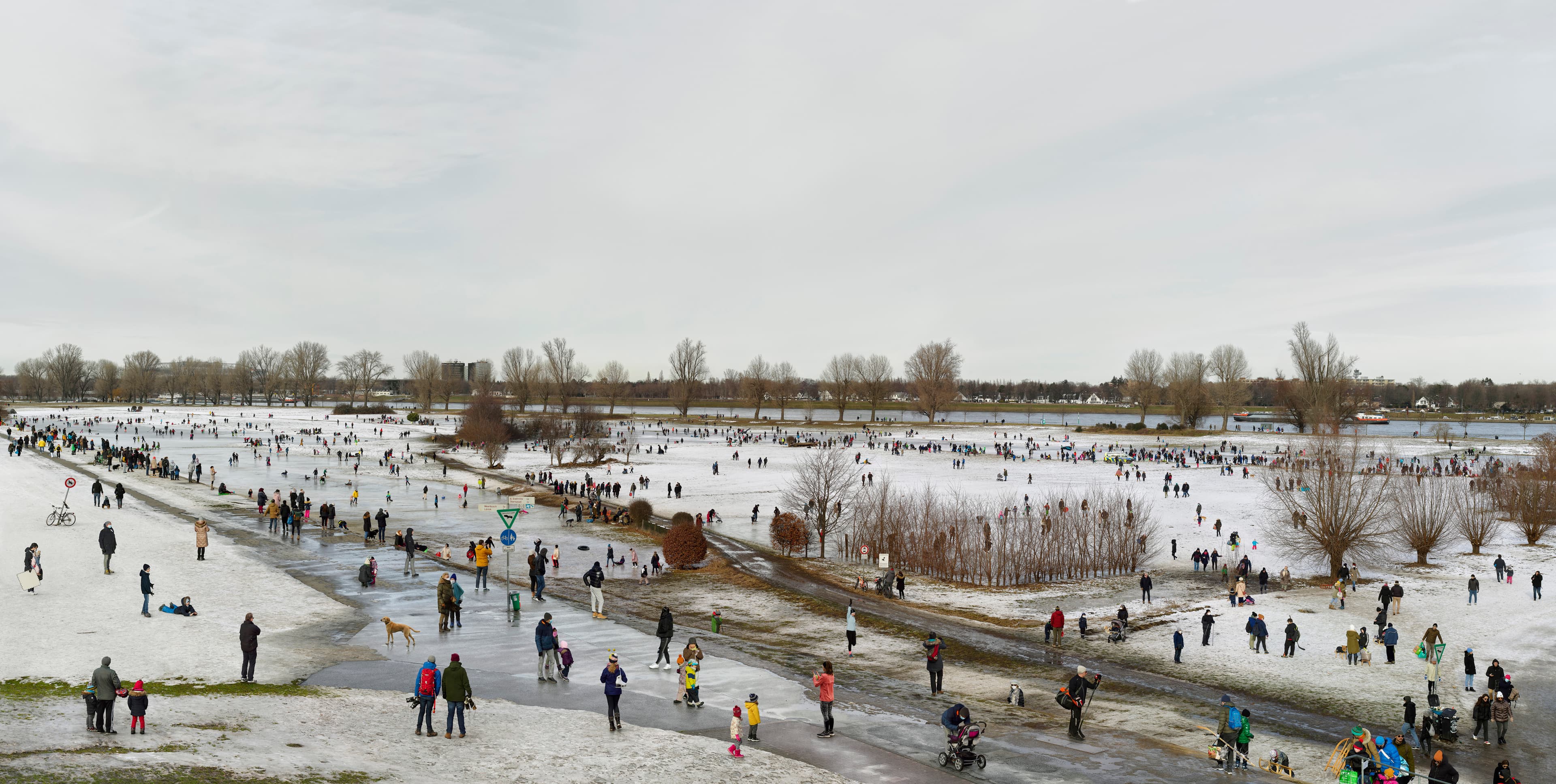
Andreas Gursky, Eisläufer, 2021. © Andreas Gursky / ARS, 2025. Courtesy Sprüth Magers.
Sprüth Magers
March 14–April 19, 2025
New York
Ten years ago in a conversation about the state of photography, Benjamin Buchloh and Isabelle Graw claimed that Andreas Gursky’s pictures naively celebrate the “regime of the spectacle” (Buchloh) and “present a world without critique” (Graw). Whatever it is exactly that the two scholars intended with their verdict, it certainly does not apply to Gursky’s current exhibition at Sprüth Magers. The works in this small show, which keeps the intimate atmosphere of the gallery’s townhouse, deal with the Anthropocene, be it global warming, industrial livestock farming, or the COVID-19 pandemic. In Aletsch Glacier II (2024), Gursky registers the dramatic decrease of the glacier in the Swiss alps since he first photographed it in 1993. Lützerath (2023) displays climate activists camping out in trees to inhibit the digging of an open-pit coal mine. On a lighter note, Schweine I (Pigs I) (2020) depicts a couple of pink swine contentedly immersing themselves in golden hay, an homage to organic pig farming. In Eisläufer (2021), people take a break from the lockdown during the pandemic to go ice-skating on the Rhine meadows thanks to the happy combination of a rare flooding and freezing temperatures.

Installation view: Andreas Gursky: Inherited Images, Sprüth Magers, New York, 2025. Courtesy the artist and Sprüth Magers. Photo: Genevieve Hanson.
To draw historical lines and drive home the point of a planet in peril, Gursky contextualizes each picture with a detail of an old master painting, which he greatly enlarges and directly plasters to the wall like wallpaper. Thus, next to Aletsch Glacier II hangs a detail of The Chamonix Sea of Ice (1825–27) by the romantic painter Carl Gustav Carus, while the happy pigs of Schweine I get a glimpse of their fate in Barent Fabritius’s The slaughtered pig (1656). More interesting, however, are these cross-temporal dialogues when they are less obvious and include a formal dimension. To be sure, Pieter Bruegel the Elder’s The Fall of the Rebel Angels (1562) next to Lützerath elevates environmental protest to the biblical struggle between Good and Evil. But in addition, Bruegel’s painting, in which the angels float in a dense knot in front of a blue sky, resembles the all-over composition of Gursky’s picture, in which the bare trees in winter create a tissue consisting of slim branches which similarly lacks a center. The white sky provides the ground for this Jackson Pollock-like web precisely because this is the last row of trees prior to the gigantic hole of the coal mine. In this respect it is telling that the only readable banner of the protesters states, “The view from here is shit” (Die Aussicht von hier ist scheiße), a play of words because Aussicht in German simultaneously signifies sight and future. The formalism of Lützerath thus is not trite but points to what awaits behind the thin layer of its fragile all-over structure.

Installation view: Andreas Gursky: Inherited Images, Sprüth Magers, New York, 2025. Courtesy the artist and Sprüth Magers. Photo: Genevieve Hanson.
Eisläufer in many ways is a classic Gursky, with its totality of vision, disembodied and all-seeing. The eye constantly zooms in and out, moving between the entire composition and individual figures, thus never coming to rest. This totality distinguishes the viewer’s vision from that of the figures who, instead, remain absorbed in their individual activities in what is effectively a world landscape, combining people in nature, water, and a cityscape in the distance. In a way, this can be read as an allegory for our condition, in which we are so preoccupied with our daily concerns that we lose sight of larger issues. All of this, including the moralizing dimension, are characteristics Eisläufer shares with Bruegel’s Winter Landscape with Skaters and a Bird Trap (1565), a detail of which is included in the exhibition. In fact, while Bruegel depicts an immaculate winter scene, in Gursky the thin layer of snow is about to melt, leading to patches of mud and dirt, a reminder that thanks to global warming there are no more real winters. But not all is (paradise) lost. In fact, Eisläufer, which Gursky calls a snapshot and barely retouched digitally, is deeply humanistic, with people of all ages and genders interacting harmoniously in a public sphere devoid of cell phones and materialism. It seems as if the long months of isolation during the pandemic sensitized people to the basics of civilization. Yet, the spots of dirt tainting the white surface ensure that notwithstanding its hopeful dimension, Gursky’s winter landscape is not a naïve, uncritical spectacle.
Benjamin Paul is an art historian and critic living in New York and Berlin. He teaches Italian Renaissance art at Rutgers and works on early modern and contemporary art.