Teddy Sandoval and The Butch Gardens School of Art
From this catalogue, one quickly gleans just how vast the networks of queer Chicano/as were that both physically attended locales like Butch Gardens and were connected through mail art under the same moniker.
Word count: 1063
Paragraphs: 11
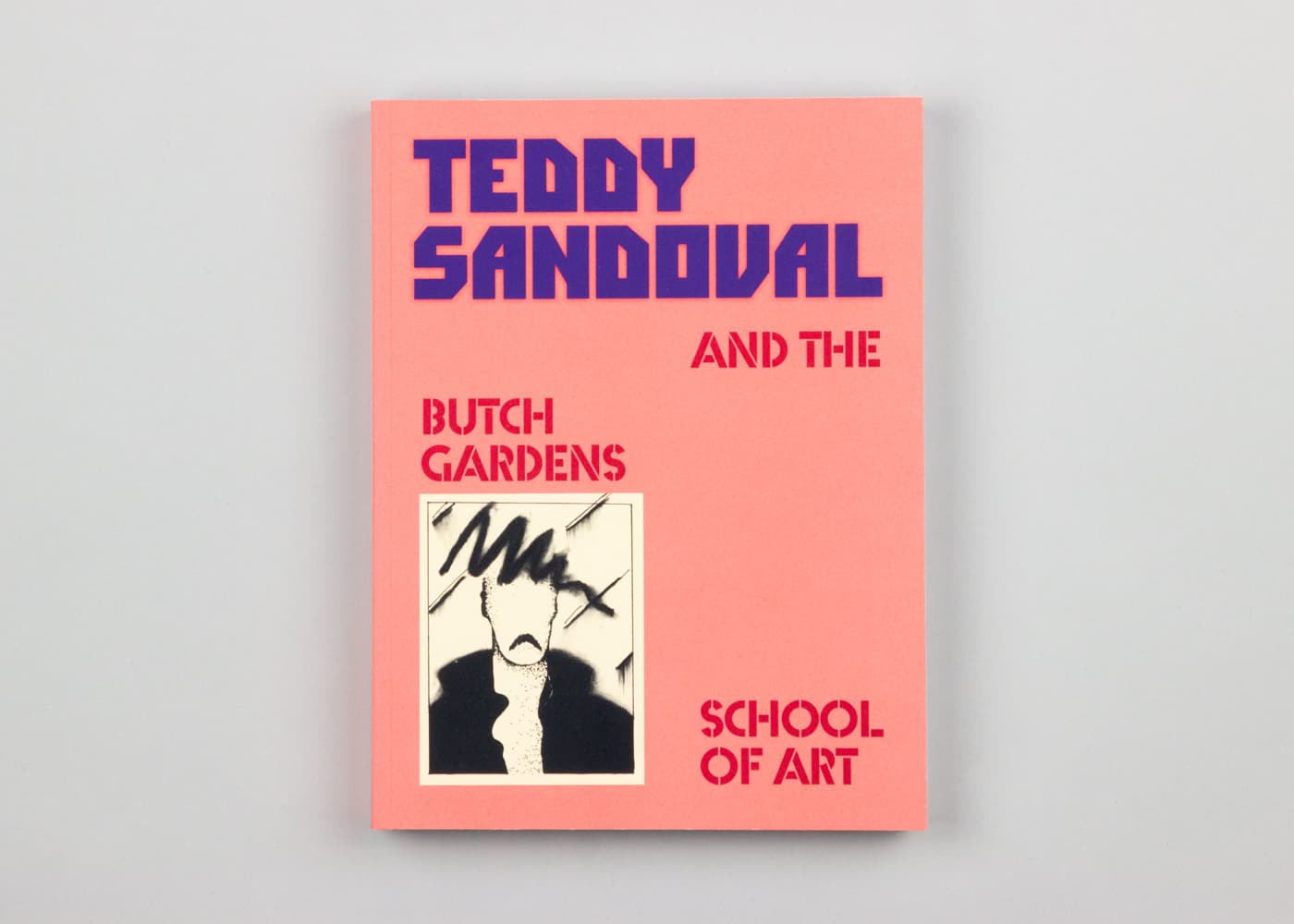
Edited by C. Ondine Chavoya and David Evans Frantz
Inventory Press, the Williams College Museum of Art, Vincent Price Art Museum, and Independent Curators International, 2024
In a 1972 issue of Action Magazine, a full-page ad appears for the Sunset Boulevard gay bar Butch Gardens, which asks the question: “Are you BUTCH enough for BUTCH gardens???” A muscular, shirtless man poses beside the bolded text, with one vascular hand shoved into his tight denim jeans, and the word “BUTCH” tattooed on his left arm. As frequenters of the gay bar and active participants in LA’s queer Chicano/a circuits at-large, artist Teddy Sandoval and his friends regularly rubbed up against these caricatures of gay masculinity that came to inform their artistic practices and daily lives. Sandoval later adopted “the Butch Gardens School of Art” as his personal imprint, circulating mail art and organizing exhibitions under the guise of faux institutional legitimacy.
Teddy Sandoval and The Butch Gardens School of Art accompanies the eponymous retrospective at Williams College School of Art, featuring essays by editors C. Ondine Chavoya and David Evans Frantz, as well as Raquel Gutiérrez and Mari Rodríguez Binnie. Flipping through the catalogue, one quickly gleans just how vast the networks of queer Chicano/as were that both physically attended locales like Butch Gardens and were connected through mail art under the same moniker. Drawings, prints, and paintings by other queer Chicano/a and Latin American artists—among them Félix Ángel, Myrna Báez, Álvaro Barrios, Ester Hernández, Hudinilson, Jr., Antonio Lopez, María Martínez-Cañas, Marisol, and Joey Terrill—appear alongside Sandoval’s. While this exhibition marks the first major consideration of Sandoval, it certainly doesn’t feel that way—the extensively researched essays on his prolific practice paired with selected works by his peers makes for a world so full that reminders of its marginality are repeatedly surprising.

L: Joey Terrill, Page from Homeboy Beautiful, no. 1, 1978, with mail art by Teddy Sandoval. Collage and ink on paper, 11 × 8 1/2 inches. Courtesy Joey Terrill Papers, ONE Archives at the USC Libraries./ R: Teddy Sandoval, Untitled mail art card for the Butch Gardens School of Art, ca. 1978. Ink on paper, 5 × 3 inches.
Covertly tucked into the catalogue are several printed postcards, a material nod to Sandoval’s mail art practice. Most feature compositions of his notorious faceless, mustached silhouettes—icons that came to be most closely associated with the Butch Gardens School of Art. In his essay “Does a Mustache Make a Man?” Frantz details the rise of gay “clone” culture in the mid-seventies, which saw the adoption of conventionally macho social signals (short haircuts, musculature, facial hair, blue collar aesthetics, etc.) to build a hypermasculine aesthetic integrated into cruising and social practices. Naturally, the butch clone became a muse for Sandoval, as he pulled inspiration from magazine illustrations and advertisements to create his own parodies and self-portraits of masculinity.
Although bodies or body parts appear on almost every page (photographed, drawn, painted, or otherwise), few images of Sandoval out of drag are shown, with the most identifiable being a collection of photo booth strips printed on the inside cover and two small red-ink portraits. More often, we see Sandoval enacting various personae: Frida Kahlo in a makeshift strapless dress opposite Gronk; amputated photographs of Sandoval collaged into dramatized ¡Alarma!-style foto-novellas; Sandoval’s drag persona, Rosa de la Montaña, who organized events and printed publications under the Butch Gardens imprint. Editor C. Ondine Chavoya notes that Sandoval’s gender slippages and multiplication of identities constitute a “bold experimentation with—and an ongoing reinvention of—artistic identity” which extends far across his oeuvre, visible from the Butch Gardens School of Art all the way to his coalition of faceless mustachioed clones.
A critical backdrop which I almost hesitate to call attention to—largely because of the editor's de-emphasis of it—is the AIDS epidemic. But as put by B. Ruby Rich in 1987, quoted by Douglas Crimp in his AIDS: Cultural Analysis/Cultural Activism (1987), “to speak of sexuality and the body, and not also speak of AIDS, would be, well, obscene.” The AIDS epidemic could easily be a major character in the telling of this story, as Sandoval and many of the artists included were HIV-positive while making many of the included works. But editors Chavoya and Frantz direct their narrative towards foregrounding just how far-reaching the community surrounding Butch Gardens (both physical and postal) was, and just how brazenly they experimented with queerness and constructs of gender.

Teddy Sandoval, Untitled (Esa maldita mujer), ca. 1977. Mixed-media collage on paper, 11 × 9 1/8 inches.
In Cruising Utopia (2009), Jose Esteban Muñoz uses hope as both critical affect and methodology. He looks to instances of queer collectivity performed in aesthetic works, especially those centering pleasure and desire, arguing for their transformative power to envision better futures and resist dominant societal structures. For Muñoz, queer utopia is “ideality that can be distilled from the past and used to imagine a future.” Teddy Sandoval and The Butch Gardens School of Art follows this tradition closely as it tells a queer history seemingly liberated from oppressive social hierarchies. Love beams out of this catalogue: it radiates from Sandoval’s smirks and sultry glances, from works of mail art so weathered by touch, from dozens of huge cartoonish cocks doodled on collages and printed on postcards. By privileging pleasure and joy, the editors take a page from Cruising Utopia to raise the real possibility of collective fortitude, then and now.
Painted in 1995, the year Sandoval died due to AIDS-related complications, and the last major work realized during his lifetime, Angel Baby (1995) depicts a winged boxer framed by a snake wrapped around a red velvet curtain. The figure’s left arm dons a sacred flaming heart with a band reading “HOPE,” which he shows off alongside gloves branded with “EVERLAST.” In the print’s certificate of authenticity, Sandoval explains that the piece is about his concerns:
…regarding the state of well being. There is plenty to pull from; violence, AIDS, war, and discrimination of all kinds. We as individuals must begin to change our thoughts within our hearts and our souls… Angel Baby is a guardian angel and he is to help you accomplish this.
As we bear witness to yet another wave of persecution on gender nonconforming and trans identities, racist attacks on Chicanx and immigrant communities, and the stripping down of access to HIV/AIDS healthcare, it feels as if we are again engulfed in a certain apocalypse. I think often of the queer communities who came before us, a lineage so tangibly locatable in the patrons of Butch Gardens. With Angel Baby as a guardian, let us again remember, in the words of ACT UP, that “AN ARMY OF LOVERS CANNOT LOSE.”
Zoe Roden is a writer based in Brooklyn.