Another Spell of Light: Unstable Rocks + Sanctuary Station
There is a politics to this filmmaking that embodies the slowness both films purport we must embrace in order to socially and spiritually thrive.
Word count: 1257
Paragraphs: 15

Unstable Rocks (2024). Courtesy First Look Festival, 2025. Museum of the Moving Image.
Directed by Ewelina Rosinska, with Nuno Barroso
Germany, Portugal
25 min.
Directed by Brigid McCaffrey
US
69 min.
“Look at a stone and imagine it having sensations.”
–Ludwig Wittgenstein
Towards the end of Ewelina Rosinska’s short film Unstable Rocks (2024), made in collaboration with Nuno Barroso, there is a brief montage of various gourds, swollen and cracked, in close-up. The amber fruits gleam, warm and fat as an autumnal sun. Rosinska then cuts to a long shot of a painted orange wall limning a water reservoir. Though the juxtaposed images are completely different environments (one agricultural, the other industrial), the color palates echo across the disparate spaces creating a chromatic associative link. The cut from one orange surface to another, as well as the movement from a close-up to an extreme long shot, evokes the Aramaic word Ephphatha from the New Testament, meaning “be thou opened.” Rosinska’s formal move reminds us to open ourselves to the world, to slow down and take in as much splendor from our surroundings as we can possibly bear.

Unstable Rocks (2024). Courtesy First Look Festival, 2025. Museum of the Moving Image.
Unstable Rocks precedes Brigid McCaffrey’s Sanctuary Station (2024) at the Museum of the Moving Image’s 2025 First Look Festival, where both films had their North American premieres on March 14. Unstable Rocks arises from ethnographic and associative impulses: Rosinska and collaborator Nuno Barroso juxtapose a colony of vultures against fossil trails or intuitively bridge nature conservations with bird hospitals. United in political, social, and formal concerns, these are two anti-capitalist cine-poems in the most capacious sense of both terms. Both repeatedly return their viewers to the earth: close-ups of a hawk's carcass ferned with green azolla in a bog; sea anemones blooming amongst barnacles; trees flecked with lichen. And both explore ecoactivists and egalitarian communities who live off the grid, in Portugal and California, respectively.
If utopia is, as Bernadette Mayer writes of Zeno of Elea, “a society without marriage, without religion, without laws, without money, and without property,” then Sanctuary Station and Unstable Rocks adhere to, and surpass, this edict in many ways. And yet, there are profound spiritual undertones within these spaces, especially in Sanctuary Station, which utilizes text from former Catholic nun, environmental activist, and Beat poet Mary Norbert Körte throughout the film. In addition to Körte’s poetry, McCaffrey often employs in-camera editing with her Bolex camera. The rapid cuts feel like a blinking eye, as if almost overwhelmed from a glut of images. There is a kind of ecstasy to the speed as we careen from a stained-glass table lamp to woven rugs to the geometric pattern in an exposed brick wall.

Sanctuary Station (2024). Courtesy First Look Festival, 2025. Museum of the Moving Image.
In Sanctuary Station, McCaffrey specifically explores spiritualism and ecoactivism within communities of women. The gorgeously shot high-contrast black-and-white film opens with a series of tracking shots through a sunstreaked forest and across a wooden train track, before finally landing on a sign that reads, “Save Old Growth.” We have arrived at our destination. Here is the matriarch’s (Körte’s) house, full of knick knacks, photographs, and patched quilts bathed in light. Körte reads aloud a poem while the camera explores her small house and then reflects aloud on the writing of the poem in non-diegetic voice over. “Mother Superior used to say, ‘Feelings don’t count! Feelings don’t count!’” Körte reminisces, “and I understand and side with what she was trying to say which was, ‘No matter how you feel, you do the do.’” Later, a small group of environmentalists walks down a road branding signs that read, “Save the Oaks.” The group is small but mighty, lightly beating drums, laughing, and, finally, holding hands. If their cause doesn’t move you, McCaffrey shows (rather than tells) why their politics matter. After the protest, McCaffrey cuts to a long shot of a forest, utterly silent and still. The frame holds for several beats, luxuriating in the majesty of the impressive trees. A bird trills somewhere in the cloudless ether. This is the “do” of which Mother Superior spoke—participating in the making of, and looking at, the world.
Reflecting on his pairing of these two films, First Look’s Senior Programmer Edo Choi says:
Brigid’s film confronts the question of how we might continue to live in our industrially scarred world in a more authentically and ethically rooted way, and it does this specifically through the lens of the experience of several women living in or working with the California redwoods. Likewise, Ewelina’s film emerges from her and her collaborator Nuno Barroso’s association with artists and eco-activists working at the margins of Portuguese society. I might describe the grammar of both these works as back-to-basics avant-garde filmmaking with an emphasis on the peculiar tonal and rhythmic reveries one can only achieve through the textures of 16 mm film. What’s so thrilling about the way these films speak to each other and to our present is how their intimate, handmade means feel so aptly scaled to the lives of their subjects.
As Choi notes, these films achieve “intimate, handmade means” by choosing 16 mm film as their medium. In Unstable Rocks, evidence of the celluloid’s materiality appears in white scratches that periodically rent the frame of vultures in the sky like heat lightning. In our accelerated attention economy, the physical act of slowing down—whether by working with hand-processed film, farming, or writing poetry—is a radical act of resistance. Each act requires patience over long passages of time. By engaging with such analog material, the director must endure the period between what is shot and when it is subsequently seen. In other words, there is a politics to this filmmaking that embodies the slowness these films purport we must embrace in order to socially and spiritually thrive.
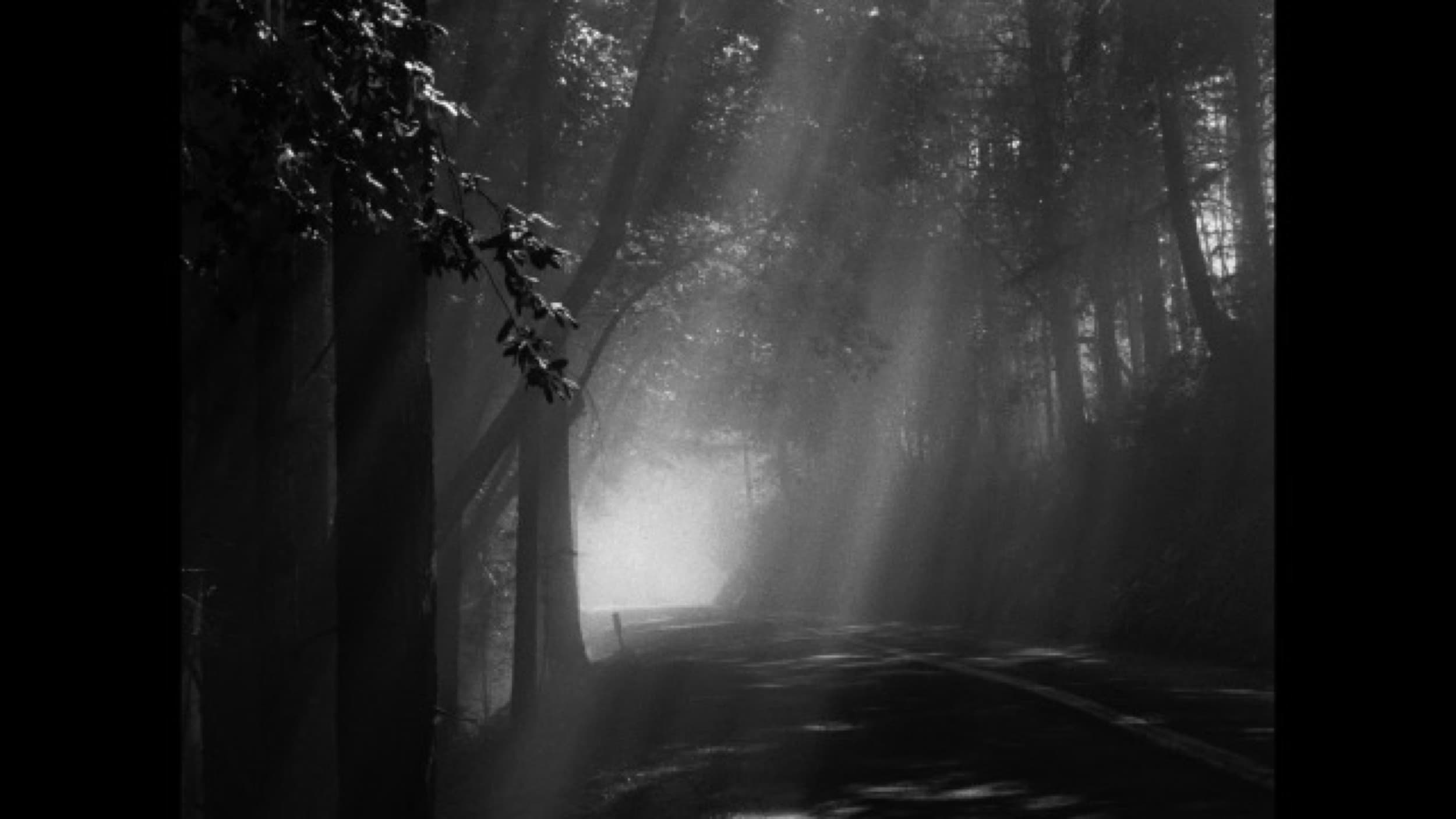
Sanctuary Station (2024). Courtesy First Look Festival, 2025. Museum of the Moving Image.
In Körte’s 1969 text A Generation of Love she writes, “walk with me in / another spelled light / too tentative for / speaking // it is enough / to be / aware to that touch / inside the limitless / confines of your hand.” Körte’s poetry, often marked by a fierce attentiveness to the natural world, also intertwines moments of the quotidian and the sublime. In her penultimate line “inside the limitless,” she offers up a paradox to her reader. There is no inside or outside of the infinite, no “confines” to an immeasurable force that always already surrounds us. And yet.
Körte unifies this impossible idea by cradling the three words (unbroken by enjambment) on a single line. Unstable Rocks and Sanctuary Station similarly offer up seemingly impossible ways of being. Shot in “spelled light,” these environments undulate, glisten, or team with larvae, insects, and faunae; a praying mantis scuttles down the side of a computer; the camera pierces the smallest of spaces, like the inside of poppy, charred black like cinders, or tilts up to revel in the magnificent, furred redwood trunks. In her director’s statement, Rosinska notes that Unstable Rocks “was composed in a very intuitive way.” The pleasure of her film is in the details of where that intuition takes her.
When was the last time you looked up, waded in a tidal pool, or imagined (as Wittgenstein does) the sensations of stones? Though each of these actions offers no material gain or political solution, what they do offer is reverie, attention, and light. Thus, through their medium and subject matter, Unstable Rocks and Sanctuary Station invite new opportunities for how we look, and ethically live, in our increasingly uninhabitable world.
Hannah Bonner’s criticism has appeared in Cleveland Review of Books, Literary Hub, and the Los Angeles Review of Books. Another Woman (EastOver Press 2024) is her first book.