Julius Eastman & Glenn Ligon: Evil Nigger
Word count: 845
Paragraphs: 6

Glenn Ligon, Sparse Shouts (for Julius Eastman), 2024. Neon and paint, 79 1/2 x 140 5/8 x 2 1/8 inches. © Glenn Ligon. Courtesy the artist and 52 Walker, New York.
52 Walker
January 24–March 22, 2025
New York
When American visual artist Glenn Ligon (b. 1960) agreed to participate in an exhibition alongside the late Julius Eastman (1940–90), he crafted Sparse Shouts (for Julius Eastman) (2024), an homage to the musician’s highly structured, repetitive compositions and a way to honor the conductor’s sparse instructions, which often included vague written directions (along the lines of “sparse shouts”), leaving much up for interpretation. Ligon’s installation began with a title and culminated in thirteen variations of the word “speak,” each one rendered in neon lettering and mounted on the wall, blinking in tandem with a score of Eastman’s improvised vocals playing in the background, engaging the viewer in a multisensory experience that begins frenetically and eventually softens. Structurally, the artist’s Sparse Shouts (for Julius Eastman) resembles the multimedia artist’s 2005 work Untitled (negro sunshine), which is also featured in the show; the latter phrase, Ligon notes, has long “stuck in [his] head,” allowing him to explore the fluidity of race, putting the words “negro sunshine” on full display, steeped in neon light. And so, the viewer is forced to reckon with these words.

Julius Eastman, Evil Nigger, 1979/2025. Archival digital print, 41 x 31 inches. Copyright © 2018 by Music Sales Corporation (ASCAP) and Eastman Music Publishing Co. (ASCAP).
Those aren’t the only words called into question. On view at 52 Walker from January 24 through March 22, 2025, Julius Eastman & Glenn Ligon: Evil Nigger celebrates the same improvisation and chance on which Eastman founded his career. Named after his Evil Nigger (1979) composition, which premiered on four pianos at Northwestern University in 1980, the song opens at a rapid, entrancing pace, with a simple downward melody that repeats on a cycle throughout the piece. Playing in a minor key until about halfway through, the melody eventually shifts into all keys, moving from a tonal state into a cacophony of sound, later thinning out into a cloud before dissipating entirely. The composition is equally bold and hypnotic, hinting at certain areas of unification, only to meander in an entirely new direction. The exhibition also includes an archival digital print of Eastman’s score, signed and dated, framed and positioned front and center with the composer’s signature annotations, as well as a five-part print of the “Thruway” series, the composer’s final work to remain unpublished as a playable score.

Julius Eastman, Thruway Player 8, 1970/2025. Pigment print, 19 7/8 x 22 3/4 inches. © The Estate of Julius Eastman. Courtesy the Estate of Julius Eastman and 52 Walker, New York.
Three self-playing Yamaha Disklavier pianos perform Evil Nigger every hour, while an antique Weber piano is positioned in the vicinity; combined, the instruments comprise a work of their own titled Fifty-Two Niggers (1979/2025), along with the Mac mini, audio interface, and MIDI cables and extension cords that make possible the show’s auditory elements. The late Eastman, who gave his pieces controversial names to reflect the scrutiny he felt as a gay Black man, made a career of creating joy in dark times; in a like fashion, Ligon has long integrated Black culture and resilience into his visual works, noting that society remains steeped in white supremacy, and that the likes of Breonna Taylor and George Floyd are not a part of our shared history but occupy center-stage in the present political climate. The artist elaborated that the name would have to spark discussion rather than stifle it, yet that there could be no posters advertising it, and that digital promotions would have to undergo careful testing to avoid being flagged as hate mail or spam. He noted that people in the art world may recognize Evil Nigger as the title of an Eastman composition, but the general public would likely be horrified. Yet there is so much to be horrified by nowadays, and so Ligon considered how he might weave Eastman’s ideas into his own practice and challenge constructions of race, gender, and sexuality in the process.
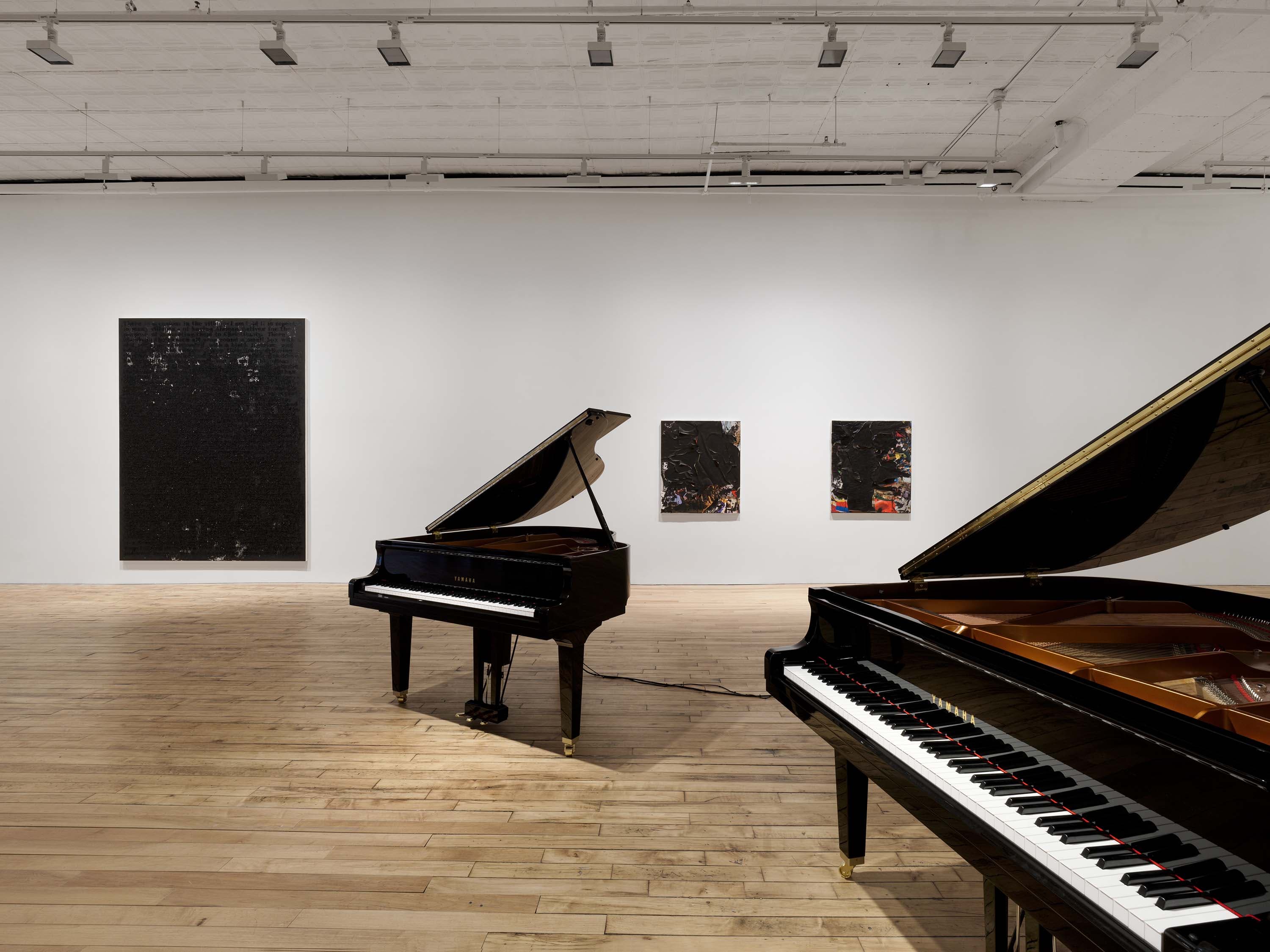
Installation view: Julius Eastman & Glenn Ligon: Evil Nigger, 52 Walker, New York, 2025. Courtesy 52 Walker, New York.
Ligon calls his contributions “ham-fisted,” noting that after launching his career as an abstract expressionist, he found the vocabulary of gestural marks to be inadequate; he instead preferred to find inspiration in the texts he was reading, among them Toni Morrison’s 1992 novel Jazz, which inspired his freestanding neon sculpture Untitled (America)(For Toni Morrison) (2024), a neon-on-metal-support installation representative of the sound of sucking teeth, an expression associated with the Black diaspora. James Baldwin’s 1953 essay “Stranger in the Village,” meanwhile, published in the author’s Notes of a Native Son, provides the same density to which Ligon is drawn. Much of the visual artist’s work revolves around illegibility and erasure, themes central to pieces like Stranger #98 (2023) and Redacted #11 (2023). Both are marred with oil and coal dust, a waste product Ligon now uses as a material, the deep black eclipsing the canvases. Untitled (2012) showcases the word “AMERICA” in black ink, backwards and upside down on burnt paper, offering a similar sense of masking. Compelling and consistent, the artist offers the same insistence that’s long been imbued in Eastman’s work, and the pronounced contrast of the black tones and piercing neon light honors the visibility—and come-and-go relevance—of Black authors like Baldwin. Just as Eastman’s music resists easy categorization, Ligon’s works challenge the viewer to confront the fluidity of language and identity.
Charles Moore is an art historian and writer based in New York and author of the book The Black Market: A Guide to Art Collecting. He currently is a first-year doctoral student at Columbia University Teachers College, researching the life and career of abstract painter Ed Clark.