Anastasia Samoylova & Walker Evans: Floridas
Word count: 1281
Paragraphs: 10
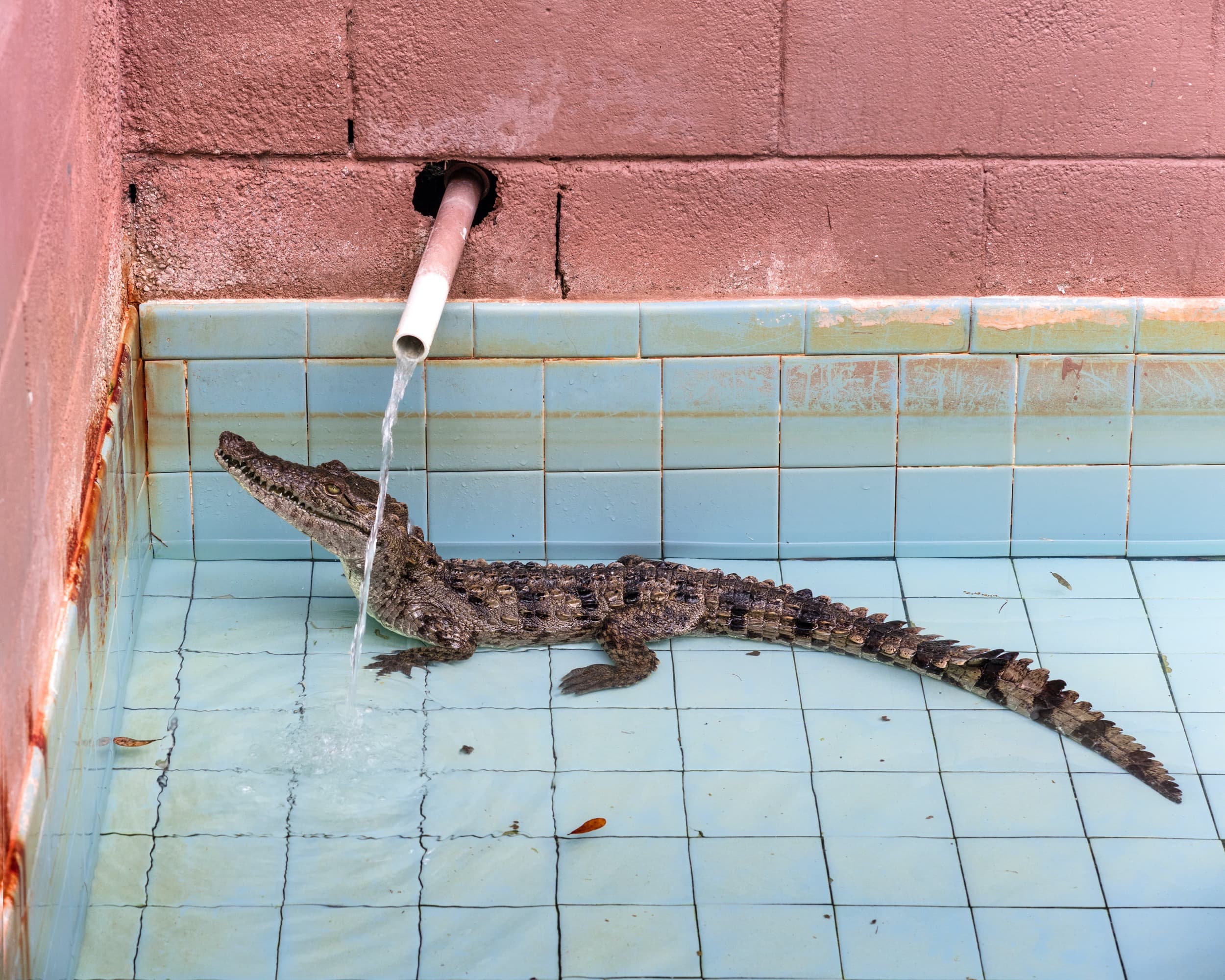
Anastasia Samoylova, Gatorama, 2020. Inkjet print, 40 x 50 inches. © Anastasia Samoylova. Courtesy the Metropolitan Museum of Art, New York.
The Metropolitan Museum of Art
October 14, 2024–May 11, 2025
New York
In a 2022 essay about Florida’s ongoing environmental destruction, author Jeff VanderMeer described its condition as “a state quickly dissolving around all of its edges.” Floridas—a joint exhibition of photographs and paintings by Anastasia Samoylova and Walker Evans—invites viewers to consider these peculiar margins of paradise through a collection of images spanning nearly fifty years of combined travel throughout the Sunshine State. An array of early twentieth-century penny picture postcards from Evans’s personal archive welcomes you into the gallery with an exoticized iconography that continues to live on in the American imaginary: arching palm trees, opulent beachside resorts, poised flamingos, thickets of lush foliage framing neat rows of boats, and crates overflowing with vibrant oranges. Samoylova, in turn, greets us with a contemporary intervention of her own: Gatorama (2020), which presents the eponymous reptile confined to the shallow, mildew-streaked pool of a tourist roadside attraction. Its vast wetland habitat shrunk down to a claustrophobic corner of sky blue tile and coral pink brick, the alligator hatchling’s commodified displacement at the outskirts of Floridian fantasy is rendered here with an arresting rawness.

Walker Evans, Resort Photographer at Work, 1941, printed later. Gelatin silver print, 7 5/8 x 10 inches. © Walker Evans Archive, The Metropolitan Museum of Art. Courtesy the Metropolitan Museum of Art, New York.
Under each photographer’s observational gaze, the friction between Florida’s carefully constructed economic and cultural image and its ecological reality gradually reveal themselves through a series of facades and artifices. Evans’s compact cameras document billboard painters, a Sarasota trailer home labeled with the laidback slogan “KUM / ANGO,” and fragmented details from the weathered hand-painted vernacular of beachside signage and discarded ads hocking wares ranging from fresh melons to rental boats. In Resort Photographer at Work (1941), Evans captures the elaborate staging of a patron’s portrait along a coastal boardwalk amid prop alligators, palm trees, and a trompe l'oeil wooden cut-out of a boat over rolling waves. A pair of pelicans preen near the sitter, threatening to disrupt the vacationer’s idealized composition.
Like Evans, Samoylova takes up scenes of manufactured paradise as her subject matter, flattening stylized graphics into collage-like tableaux of surreal contradiction. Chain Link Fence, Miami Beach (2018) portrays the city’s aspiration to future opulence constricted by unfinished construction while Pointe Mall, Orlando (2020) presents the decaying neo-tropical pastiche of an outdoor mall’s billboards and storefronts. A solar-powered roadside gun shop in Port Orange advertises itself through a cheery seafoam-green facade and automatic rifles crudely spray-painted along its walls. Samoylova also documents artists fashioning their own images of the Sunshine State, such as a Miami muralist deeply engrossed in a 2020 commemorative portrait of Muhammad Ali. Across from this image, Overpainted Poster, Miami (2020) sees a sunbleached wheatpaste of the 45th president obscured by a graceful flurry of peeling graffiti. Perhaps most striking is Venus Mirror (2020), taken through the windows of an empty furniture store in the Miami Design District during the COVID-19 pandemic. Set against the material residues of political turmoil and economic decline, Samoylova’s disorienting reflections and refractions remind us that there’s always more to Florida than what meets the eye.

Anastasia Samoylova, Venus Mirror, Miami, 2020. Inkjet print, 40 x 32 inches. © Anastasia Samoylova. Courtesy the Metropolitan Museum of Art, New York.
Neither artist settles on photography as the only medium suitable for mediating their ecopolitical realities. A quartet of Evans’s rarely shown en-plein-air paintings of local houses on Anna Maria Island appear alongside Samoylova’s ongoing experiments in assemblage, which operate through acrylic reworkings, exaggerations, and extensions of her own images’ visual fields. Neither Evans nor Samoylova want to transform their subjects into something else. Instead, they enhance poignant details others may overlook, such as the rippling reflection of overgrown vegetation, a mural painted on the side of a public restroom, or a contrast stripe of salmon pink on a boxy beachside shack. The character of these places is amplified through glossy photographic print and textured brush stroke alike.
Evans paid repeated visits to Florida, primarily the west coast, from the 1930s to the 1970s, accumulating a significant, but understudied, archive of thousands of negatives and prints now housed in the Met’s collection. Miami-based Samoylova accumulated her body of work over dozens of road trips from 2017 to 2020, crisscrossing the state between tiny rural enclaves, beachfront towns, sprawling suburbs, and rapidly developing cities. Seeing their oeuvres together in the gallery, one can trace the chilling trajectory of Florida’s extreme environmental transformation.
Evans envisioned Florida as one of the last American frontiers, a climate haven for wealthy travelers and social outcasts on the verge of a burgeoning tourism industry. Samoylova presents not only the aftermath of this man-made expansion, but also shows Florida as a new, more sinister, kind of frontier on the frontlines of the climate crisis. Once a haven, the state now risks becoming home to the nation’s earliest climate refugees displaced by sea-level rise and hurricanes—an anxiety foregrounded in scenes like Blue Courtyard, Hollywood (2019), where a flooded home entrance might be mistaken at first glance for a swimming pool. In the back corner of the exhibition, two of Samoylova’s images present a haunting juxtaposition: one of the last remaining homes on the Panhandle’s Mexico Beach and an aerial view of condominium towers in Bonita Springs. Both are situated in landscapes of precarity. One is an elevated, hurricane-resistant fortress of reinforced concrete among empty, rewilded lots left vacant by those who decided not to rebuild after another “Big One.” The other shows a set of gleaming new high-rises soaring over the lush fragility of vulnerable coastal wetlands. Through a telephoto lens that collapses these tremendous spatial and temporal distances into a singular and sublime visual plane, Samoylova documents the ebb and flow of real estate booms and natural heritage protections that has shaped the land for generations.

Installation view: Floridas: Anastasia Samoylova and Walker Evans, The Metropolitan Museum of Art, New York, 2024–25. Courtesy the Metropolitan Museum of Art.
On one of my visits to Floridas, I overhear a conversation between a visitor and a security guard reflecting on their trips to the state. The usual upbeat recollections of picturesque beaches, theme parks, and Art Deco buildings all gradually give way to an awkward silence when one of them brings up the previous year’s record-breaking, especially brutal hurricane season. As I listen to them, I find myself standing in front of Lost Wig (2017), an accidental self-portrait of Samoylova’s shadow hovering over an eco-synthetic entanglement of hair, sand, gravel, litter, and grass. Growing up in Florida, I was always haunted by the pervasive sense of impermanence embedded in its landscapes, a feeling later reinforced by watching the edges of my hometown literally dissolve in computer models that forecast the effects of climate change. It is a place mired in fantasies, stigmas, and stereotypes, repeatedly made and unmade by the encroachments of developers and the re-intrusion of water and wildlife into their previous habitats. It is an uncanny place, vulnerable and hostile, weird and wondrous, jarring and precious. Powerfully moved by its misunderstood terrain, Walker Evans once described Florida as “ghastly and very pleasant.” It is a manufactured dream of paradise perpetually contaminated by the unruly nature its human inhabitants try so hard to pave over, but can never truly keep out.
Both Evans and Samoylova refuse to present Florida as a photographic puzzle for us to solve and conquer. Rather, they depict the Sunshine State in its contradictory and pluralistic totality, stark economic disparities and elusive quests for pristine authenticity side by side. Across porous ecotones of water-stained pastel walls, encrusted concrete, rusted cars, and dead native sea grape leaves ensnared in chain link fencing, Samoylova in particular documents Florida’s aesthetic emergence into the Anthropocene with an unflinching, nuanced hyperrealism. Standing in Floridas, I am reminded of when the eye of a hurricane passes over, that photographic moment of suspended stillness when the sun emerges and illuminates the destruction. Then the walls of the storm close back around you.
Eleonor Botoman is a Brooklyn-based writer and museum worker exploring histories of environmental art, climate resilient design, and multispecies world-making. Their criticism and poetry has appeared in the The Long Now Foundation, BlackFlash Magazine, C Magazine, Artforum, and Kernel Magazine among others, and they publish their newsletter Screenshot Reliquary monthly.