Sohrab Hura: Mother
Word count: 990
Paragraphs: 9
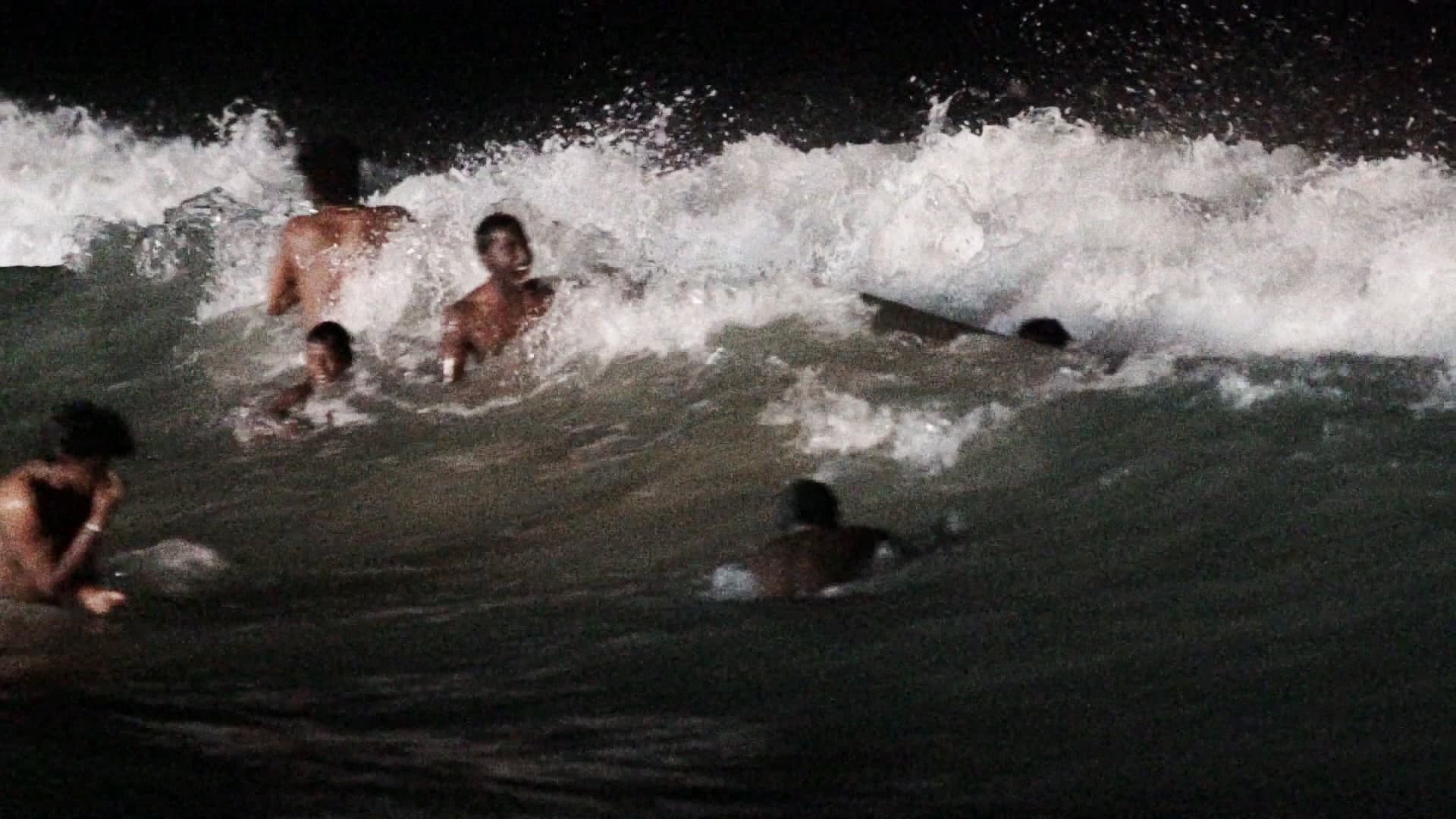
Sohrab Hura, The Coast, 2020. Video: color, 17 minutes, 27 seconds. Courtesy the artist and Experimenter, Kolkata and Mumbai.
MoMA PS1
October 10, 2024–February 17, 2025
Queens
Sohrab Hura’s transfixing film The Coast (2020), on view at MoMA PS1 as part of his first survey in the US, takes place during the annual religious festival of Dasara in Tamil Nadu. It’s filmed on a beach at night, and the celebrants, who have embodied various characters with masks and costumes, enter the sea at the end of the day to return to themselves, cleansed. The mood of the film shifts and morphs, as turbulent as the breaking waves. Shot against an ink-black sky, the film begins with a grating, mechanical soundtrack that creates a sense of tension and anxiety. In slowed-down footage, people, many of whom are fully clothed, appear to struggle toward the shore, like castaways. Eventually the soundtrack fades and is replaced by the soft, rhythmic sounds of the waves moving over the sand. We see mothers laughing with children, couples helping each other out of the water, play and joy replacing fear. The coastline, in Hura’s works, is not only a changeable border between land and sea, but also a stand-in for other porous and contested borders and for the fluctuating nature of fact and fiction.
A Magnum photographer who has published numerous photography books through his own imprint, Ugly Dog, Hura has come to mistrust the medium of photography, or at least the way documentary photography has been produced and consumed. “I knew exactly what photograph to make, to make someone feel what way, you know? So it started to feel performative,” he told Aperture. This wariness is evident not only in the room full of paintings in the exhibition—a medium that he’s turned to recently—but also in the photo-based installations and films on view, which steadfastly resist a straightforward narrative and intentionally undercut attempts to make meaning.

Sohrab Hura, The Coast, 2013–19. Archival pigment prints. Installation view: Sohrab Hura: Mother, MoMA PS1, Queens, 2024–25. Photo: Mason Blake.
The Coast is also the title of a book Hura published in 2019 and of an installation of photographs (2013–19) at MoMA PS1, which brings some fifty unframed photographs together in a grid that spreads out from the corner of a room. As in the film version, the mood fluctuates. Some of the images are playful—a photograph of someone feeding goldfish, his eye magnified in the goldfish bowl, next to an image of a young man sitting on the sand, his eye enlarged by a magnifying glass. Others carry a threat of violence: in one, a boy seems about to hit another boy in the head with a rock; in another, a masked figure grins demonically. Some of the images appear as well in the film—Hura often borrows from one body of work for another so that his photographs reappear in different contexts, playing other roles and incurring new meanings.
The Coast is part of a larger project called “The Lost Head and the Bird,” which is also the title of a projection in the exhibition comprised of still images by Hura and found footage from WhatsApp videos that refer, if elliptically, to the undercurrents of violence in India arising from border disputes but also from conflicts around class and caste. There are twelve versions of the projection, which all include a short story about a woman whose lover has stolen her head. The photographic diptychs flash by at a speed that can be frenzied to the point of incoherence, a flood of imagery meant to reflect the cacophony of pictures we confront every day—and perhaps to question our ability to parse them.

Sohrab Hura, Untitled, from “Snow,” 2015–ongoing. Inkjet print. Courtesy the artist and Experimenter, Kolkata and Mumbai.
Earlier projects by Hura, while less frenetic, are often equally indirect. He made the photographs in “Snow,” for instance, over multiple winter seasons in Kashmir, a region claimed by both India and Pakistan. The snow in Kashmir is a tourist attraction for Indians, who are also told by their government that Kashmir belongs to them. The photographs—bare feet in flip-flops on the snow, a bus stuck in a snowbank, someone weeding the young grass after the snow has melted—capture small moments, none of which directly refer to the ongoing conflict. It’s as if Hura holds himself at arm’s length, aware of his complicity as an outsider in the region.
Hura’s unease around making pictures of marginalized people eventually led him to turn the camera on his own family, and in 2005, he began making pictures of his mother, who had been diagnosed with schizophrenia when he was a teenager. The photographs, often of his mother and her dog Elsa, are intentionally composed and lit imperfectly. Photographs of wrinkled sheets, or of his mother sleeping next to Elsa, who wears a veterinarian’s cone and gazes balefully into the camera, portray not only the off-kilterness of mental illness, but also convey a sense of intimacy between mother and son.

Installation view: Sohrab Hura: Mother, MoMA PS1, Queens, 2024–25. Photo: Steven Paneccasio.
Recently, Hura has turned to painting as a reprieve from the encumbrances of photography, and these works occupy an entire room of this show. Ten cardboard boxes—some open, some closed—are arrayed in the center of the room and painted with scenes both personal and political: a school choir, Rosa Parks on the bus, Yasser Arafat. On the walls are brightly colored paintings depicting more intimate subjects—a mournful portrayal of his father in bed, wearing a knit cap, for instance. The text written directly on the wall in Hura’s handwriting accompanies the photo: “Father on the last day of radiation.” Others have a bittersweet undercurrent: Summer trip with A (2023) shows a young woman in a yellow T-shirt, her blond hair blowing in the open window of a car. It’s as if a weight has been lifted in the paintings, which aren’t saddled with the burden of documentary truth. Or they tell a different sort of truth, delivered lightly but also more directly: one of the smaller paintings from 2022 depicts a stream of urine coming from inside a covered litter box; a cat’s tail sticks out of the opening. It’s titled simply, Asshole.
Jean Dykstra is a photography critic and the former editor of photograph magazine.