Maria Lai: A Journey to America
Word count: 979
Paragraphs: 7

Installation view: Maria Lai: A Journey to America, Magazzino Italian Art, Cold Spring, NY, 2025. Courtesy Magazzino Italian Art. © Archivio Maria Lai, by SIAE 2024/Artists Rights Society (ARS). Photo: Marco Anelli/Tommaso Sacconi.
Magazzino Italian Art
November 15, 2024–July 28, 2025
Cold Spring, NY
In 1968, the Italian artist Maria Lai visited the United States, which Magazzino Italian Art is referencing in the title of what is effectively her first retrospective in this country. But much more than that trip, it was the local traditions of Sardinia, where Lai was born in 1919, that had an impact on her artistic production. The discovery of Lai, who died in 2013, gained momentum in 2017 when works were shown at both Documenta and the Venice Biennale. In Kassel and Venice, Lai was somewhat relegated to the arts and crafts corner with her carpets, collages of layered fabrics, and ensembles of painted popsicle sticks, wooden spoons, and feathers, in line with the conceptual orientations of the two mega-exhibitions, in which seemingly anachronistic outsider art played an important role. What’s more, as a female artist who had only recently become known to a wider public, Lai was well suited to the feminism associated with the nascent #MeToo movement. Both approaches are somehow accurate, but so reductionist that they did Lai a disservice. For the significance of Lai’s art lies not least in her contemporaneity and her engagement with Italian Arte Povera, to which she lent a feminine, and above all, Sardinian touch.
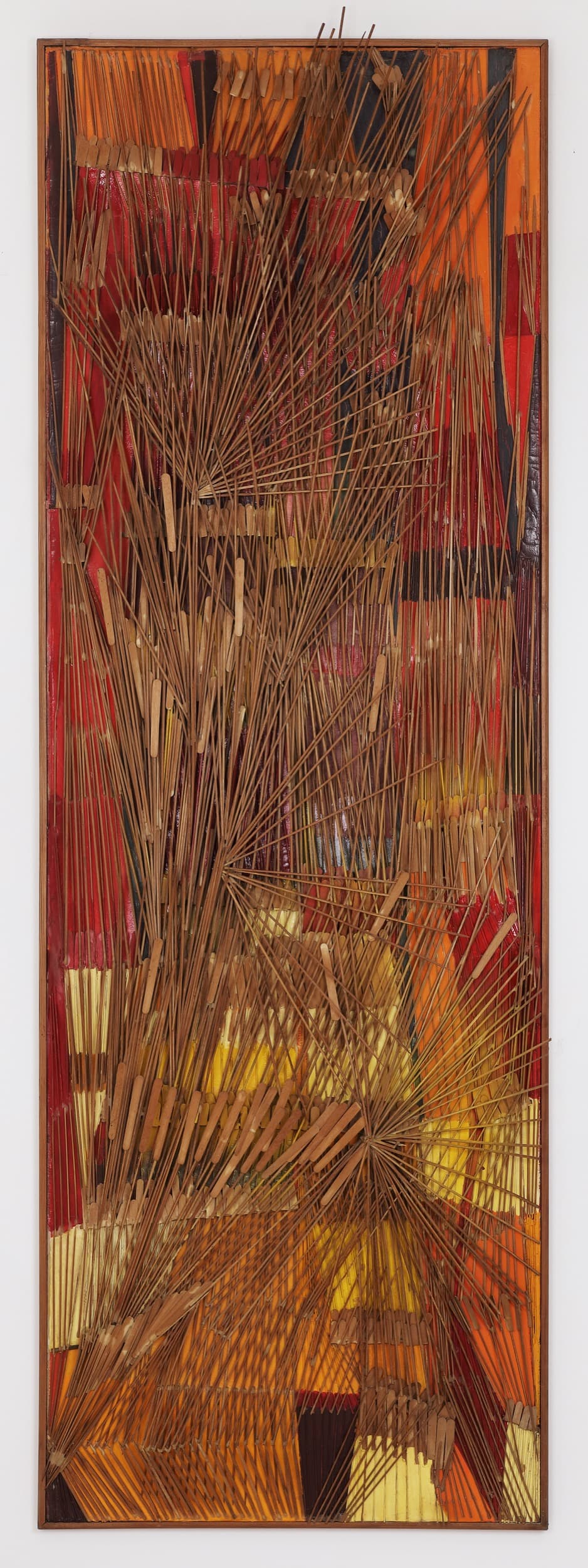
Maria Lai, Senza titolo, Telaio, 1972. © Archivio Maria Lai, by SIAE 2024/Artists Rights Society (ARS). Photo: Marco Anelli/Tommaso Sacconi.
Although Lai studied under the abstract sculptor Arturo Martini at the Accademia di Belle Arti in Venice in the 1940s (as the only woman, mind you), her early work consists of representational drawings, examples of which are included at Magazzino. It was not until the 1960s and ’70s—undoubtedly Lai’s most productive phase—that she created objects, inspired by the Sardinian weaving tradition, which defy categorization. She began with the so-called “Telaio,” structures reminiscent of looms, in which cords are stretched in different arrangements over irregularly painted surfaces and repeatedly crossed by horizontal wooden beams reminiscent of weaving ships. In the “Sewn Canvases,” she pieced together scraps of fabric and sewed abstract compositions into the resulting irregular patchwork from which loose threads hang down. Combining these two processes, Lai then developed the “Telaio-libro” in the 1970s, woven and sewn books that can be turned over and display both abstract fabric configurations like the “Sewn Canvases” and (albeit illegible) typography.
From a structural point of view, these are all methods that Lai shares with Arte Povera, which emerged at exactly the same time. But she chose a completely different, more radical aesthetic that does more justice to the name of this movement than the works of its more famous protagonists. The term Arte Povera, coined by the Italian curator Germano Celant, is misleading in many respects, as artists such as Michelangelo Pistoletto, Jannis Kounellis, and Mario Merz were by no means concerned with “poor art,” but rather with the new technological possibilities of a highly industrialized, globalized society, to which they responded with a renewed awareness of history, the use of traditional media, and a return to nature. They countered the machine aesthetics of American Minimalism and the cynical consumerism of Pop art with an explicitly anti-technological stance, but without sacrificing elegance, craftsmanship, and sophisticated materials. Pistoletto’s foundational work of Arte Povera, Venere degli stracci from 1967, for example, programmatically confronts capitalist society with the (timeless) beauty of art by placing an antique Venus Callipyge statue in front of a mountain of discarded rags.
Compared to Pistoletto’s elaborate and elegant multimedia sculpture, Lai’s woven art actually appears “poor” and almost archaic. Her dingy, paint-stained “Telaio,” in which the coarse cords seem to be sloppily fastened without precision or aesthetic intent, are not only made of simple materials, but emphasize the artisanal dimension far more than most Arte Povera works, including Pistoletto’s immaculate Venere, which was symptomatically cast in concrete. But Lai’s emphasis on history and local traditions is also far more specific than Pistoletto’s, whose Venus only generically refers to a distant Roman (and Greek) antiquity. Textile art has a centuries-old tradition in Sardinia, and even in the twentieth century, most households still possessed a loom. Lai’s works thus establish a close connection to this pre-industrial, rural, economic sector in Sardinia, which was, however, already largely obsolete during her lifetime and whose practice had since become a ritual and mythologized. Lai’s refusal to participate in the practices of advanced consumer society is expressed precisely in the fact that she drew attention to traditions that are outdated but still active in memory and lent them social and aesthetic relevance.

Installation view: Maria Lai: A Journey to America, Magazzino Italian Art, Cold Spring, NY, 2025. Courtesy Magazzino Italian Art. © Archivio Maria Lai, by SIAE 2024/Artists Rights Society (ARS). Photo: Marco Anelli/Tommaso Sacconi.
However, weaving is not only a symbol of a (certainly partly nostalgic) anti-modern attitude but has also been considered women’s labor—not least since Penelope and Ariadne—especially in Sardinia, where only women were allowed to operate the looms. Lai thus referred to the roles of women in the lore and practices of archaic societies. In fact, the poetic and sensual power of her works results from aspects that have traditionally feminine connotations, such as the softness of the tactile material, the delicacy of the (sewn) lines, and the fragility of the pieced-together constructions. With the fairy tales that Lai illustrated in her “Telaio-libri” from the 1980s onwards, she also drew on the long tradition of storytelling with which women accompanied their handiwork, like the fairy creatures who, according to Sardinian legends, wove myths and stories. Lai was therefore less concerned with lamenting the discrimination against Sardinian women than with emphasizing their achievements and thus the potential that lies in the old rituals. Nor was she concerned with fetishizing the rites of a pre-industrial, archaic age. Instead, her forms of historical memory reveal a radical critique of the present, ranging from globalized high-tech capitalism to patriarchy. Precisely because Lai emphasized craftsmanship and rejected commodity aesthetics, engaged with history and local traditions, while also considering the role of women, her art is more topical than ever.
Benjamin Paul is an art historian and critic living in New York and Berlin. He teaches Italian Renaissance art at Rutgers and works on early modern and contemporary art.