José Parlá: Homecoming
Word count: 836
Paragraphs: 10
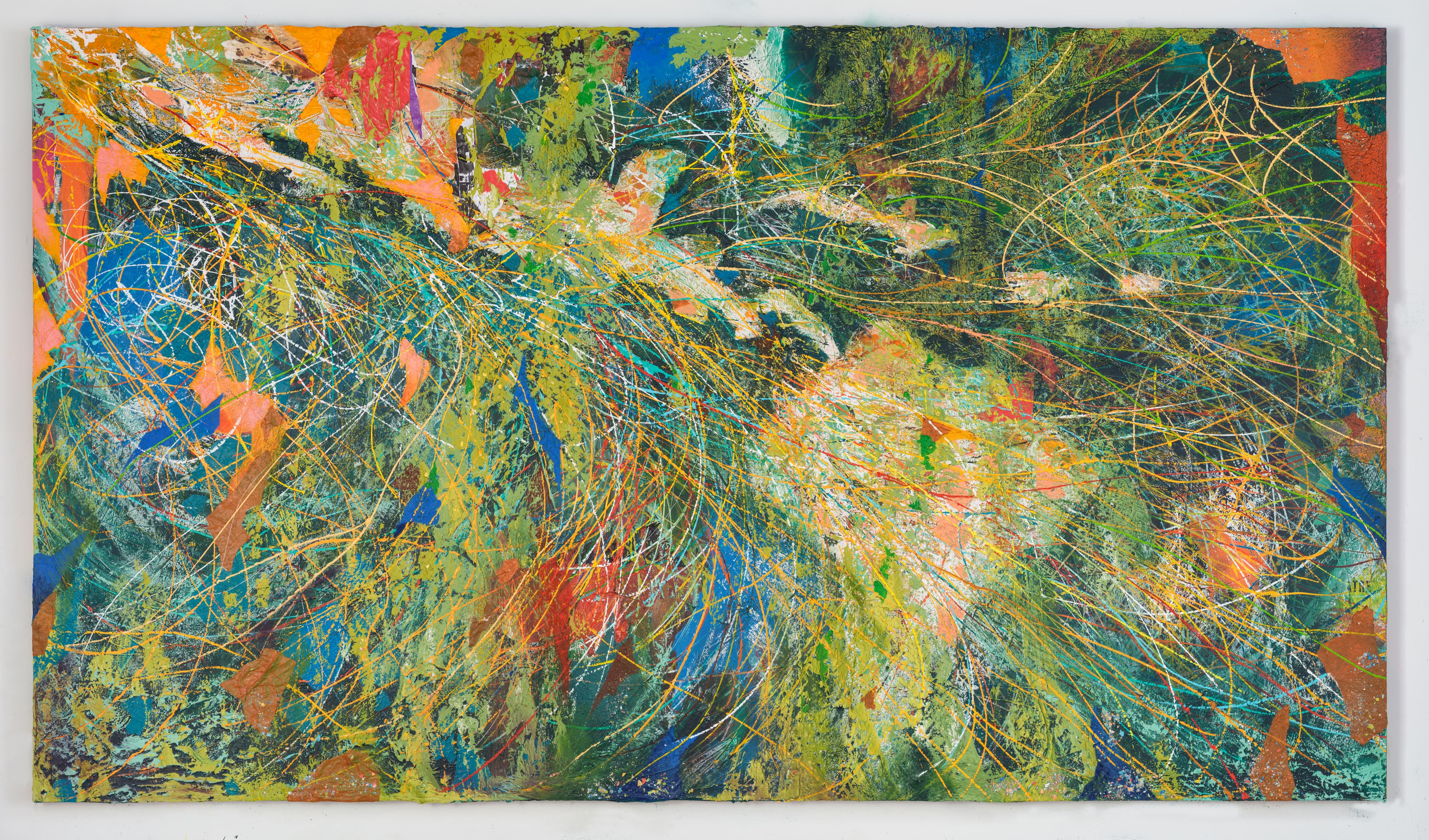
José Parlá. Heritage Trails, Journeys of Hope and Renewal, 2024. Acrylic, oil, enamel, collage, and plaster on canvas, 96 x 168 x 3 inches. Courtesy the artist and Parlá Studios.
Pérez Art Museum Miami
November 4, 2024–July 6, 2025
Miami
José Parlá downright cavorts while he works, tangling sharp, elegant calligraphy across massive mixed-media canvases—which provoke movement themselves. Fortunately, Homecoming, his new show at the Pérez Art Museum Miami (PAMM), features speakers playing Cuban music and hip-hop.
Parlá was a b-boy before he became a painter. Today, he fuses fine art and real life through a new kind of history painting contemplating the accretion of urban decay on city streets. Oil paint and plaster join collaged ads and tessellated acrylic chips atop his sculptural surfaces. Parlá’s first-ever museum show in his birthplace, however, uniquely envelops viewers in the Magic City. These works bloom with a fierceness unprecedented for even his practice, a testament to this distinctly lush metropolis—and Parlá’s florescence following a COVID-related near-death experience in 2021.
Homecoming unfolds over one-and-a-half rooms tucked into PAMM’s cavernous facilities. An antechamber establishes Parlá’s back story, and his authority—as a Miamian, and as a graffiti writer (although Parlá himself told me he opposes “the G word”). Black books, news clippings, and photos of his early illegal endeavors populate a vitrine, alongside a letter of recommendation that his art teacher at Miami Coral Park Senior High School composed in 1989.
Parlá spent his childhood in Puerto Rico, then moved back to Miami amidst hip-hop’s rise. He began tagging and retains the medium’s athleticism in his work today. Parlá’s canvases come pre-stretched and remain on the wall as he weaves serpentine script until it’s better off called “linework.” Parlá’s scrawl often evokes Cy Twombly, but its ethos also draws from Rammellzee, the late rogue world builder who believed that indecipherable Wild Style could wrest the power of language back from the powers that be.

José Parlá. Aguanile, The Spiritual Cleansing of Home, 2024. Acrylic, oil, enamel, collage, and plaster on canvas, 96 x 72 x 3 inches. Courtesy the artist and Parlá Studios.
Five small paintings from 2006 spotlight Parlá’s signature asemic writing and his formerly gritty color palettes. These selections from his “Storied Arteries of the City” series offer a visual key as viewers enter the main gallery. That same script sprawls more ambitiously across the ensuing seven looming new artworks. While Parlá told me there are sentences in each of the pieces on view, they mostly read like gestural webs. But the artist believes transcending any one language like this might help him communicate universally, beyond words. The symmetry of Aguanilé, the Spiritual Cleansing of Home (2024), for instance, purportedly contains the Seal of the City of Miami and the Cuban coat of arms. Unfocused eyes may even detect text etched into American Mindscape (2024), which Parlá started in 2021, amidst protests in his ancestral homeland, before finishing this year. Those suggestions contrast declarations from the printed matter that Parlá sourced from Miami Beach and Little Havana. Eyes peek out from pages and paint alike.
American Mindscape is vegetal and rich yet moodier than Heritage Trails, Journeys of Hope and Renewal (2024), on the other side of the entryway, which offers an assortment of equally tropical hues. Parlá is still capturing the essence of the city here, but Miami is a special kind of town, defined by its natural splendor as much as its iconic structures—like the pastel architecture of A Life of Memories Racing Through Art Deco Miami Beach Avenues (2024). Overall, Homecoming reminds visitors that Ponce de León named Florida for its flowers. The comparatively artificial phosphorescence of Breath of Life, Inhale and Exhale (2024) more closely resembles Parlá’s recent paintings, though it throws a more nuanced glow. The diptych’s two panels suggest lungs, honoring Parlá’s 2021 recovery from a life-threatening case of COVID, which has evidently imbued his work with enhanced conceptual substance and an expanded interest in movement.
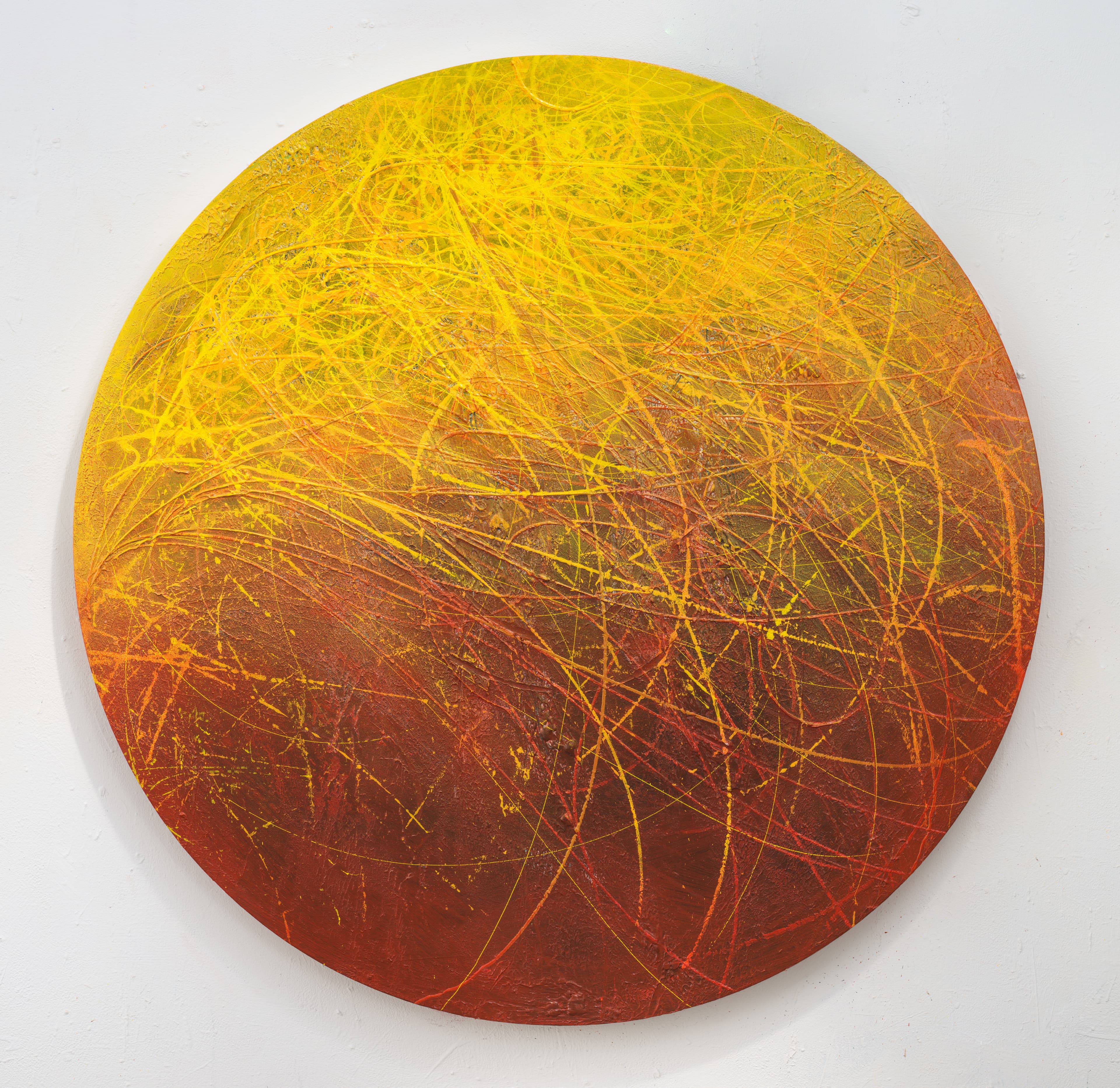
José Parlá. Return to Miami's Ancestral Circle, 2024. Acrylic, oil, enamel, collage, and plaster on canvas: 60 x 60 x 2 1/4 inches. Courtesy the artist and Parlá Studios.
Return to Miami’s Ancestral Circle (2024) honors one of the city’s oft-overlooked treasures—the Miami Circle. Discovered in Brickell back in 1998, remnants of this round cut-rock site are hailed as a trace of the Tequesta tribe, who were forcibly displaced from Miami for Cuba in the eighteenth century. Meanwhile, Miami has become “Latin America’s northernmost city.” With its organic hues marked by bright flight paths, Heritage Trails documents a more profound kind of cultural accretion than any Parlá has played with before—the layering of human society atop Earth’s history, like wheatpastes on a wall.
Such machinations animate the show’s sprawling titular artwork HOMECOMING (Before Time, the First Migrations) (2024), which tracks Pangaea’s shift to our present map while demonstrating cartography’s subjective nature, another way humanity augments the planet. Archipelagos and weather patterns readily appear, as do the series’s most pronounced chunks of Parlá’s script. The shapes of Florida and Cuba are, miraculously, hidden in plain view. Parlá painted this piece on site, and invited the public to watch him dance and jump from a ladder, rendering his linework. The table, cart, and paint he brought from Gowanus all remain in the heart of the room, with the records and soundsystem serenading guests. It’s a far cry from recreating the artist’s two-tiered Snøhetta-designed studio, but as this show proves, sometimes a hint holds more power.