Art and Graphic Design of the European Avant-Gardes
Word count: 977
Paragraphs: 13
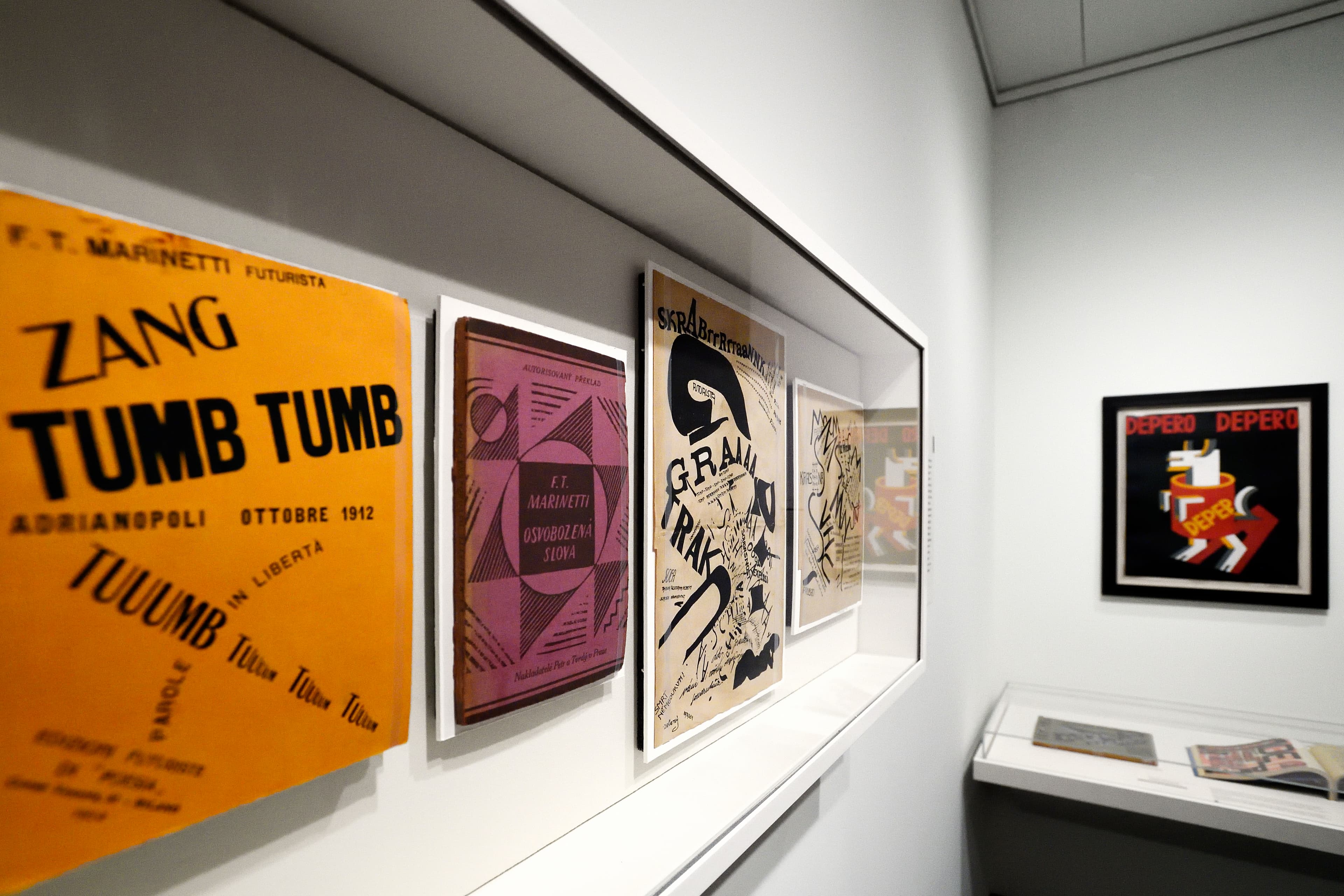
Installation view, Art and Graphic Design of the European Avant-Gardes at The Irene and Richard Frary Gallery, 2024–25. Courtesy the Irene and Richard Frary Gallery. Photo: Will Kirk for Johns Hopkins University.
The Irene and Richard Frary Gallery
October 23, 2024–February 21, 2025
Washington, DC
The very grand, new exhibition in the Irene and Richard Frary Gallery at the Bloomberg Center of the Johns Hopkins University: Art and Graphic Design of the European Avant-Gardes sets the mind alight.
I set off right away with the Hungarian Lajos Kassák’s multicolored Bildarchitektur (Picture Architecture) (1925), and it put me right in the mood for the rest of my time in this grand exhibition, which I will generally label as a visitor “we.” For we were looking at the central white arrow of Bildarchitektur hurtling down the middle, pointing to the bottom of the frame, and then on the right, a kind of curved yellow basin, and then, on the other side of that white slash pointing down, a little moon at the top, yellow, exactly the yellow of the shape we were just looking at, and then a red, and then a blue, and the whole thing feels at once joyously colorful.
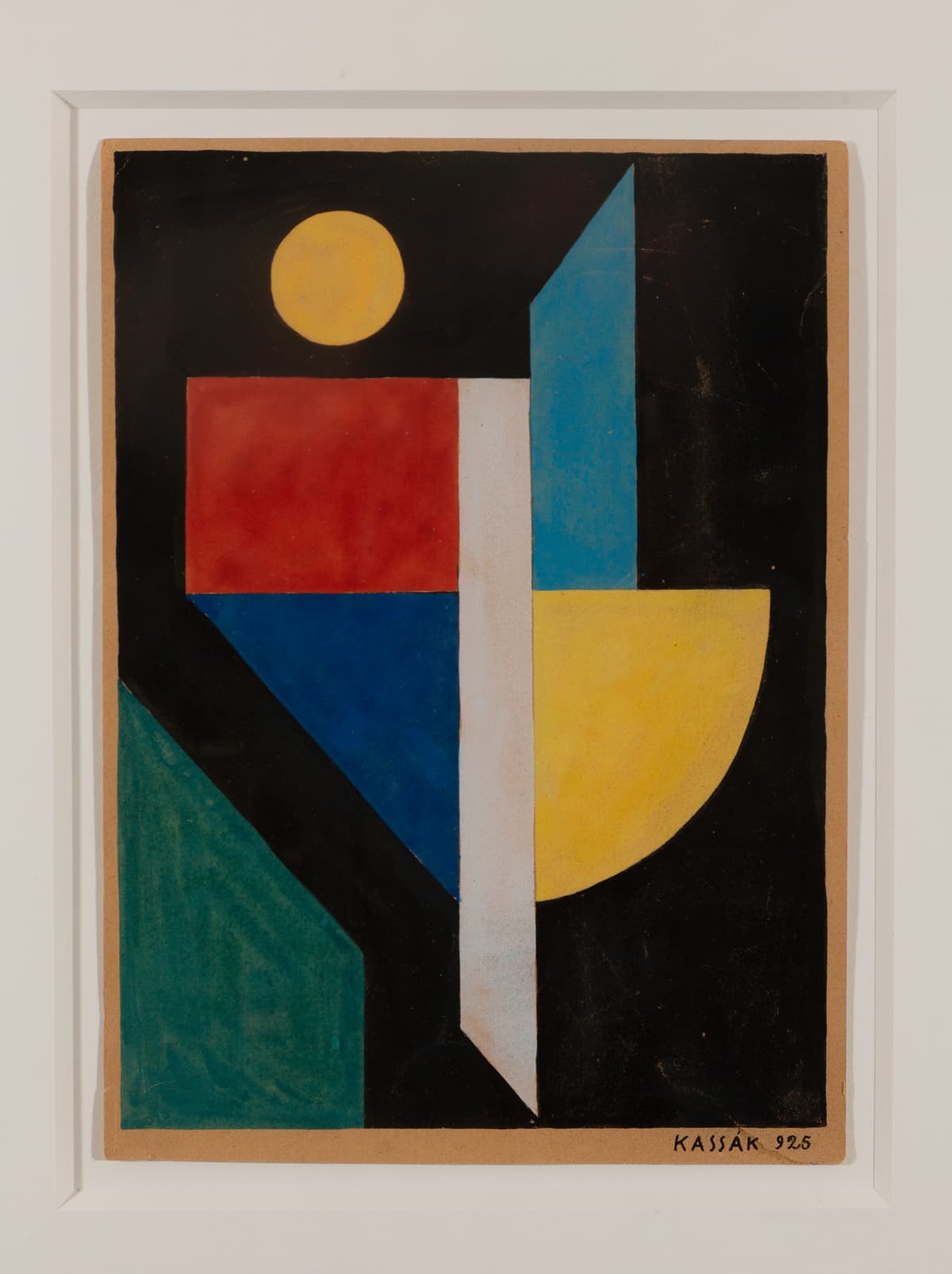
Lajos Kassák, Bildarchitektur (Picture Architecture),1925. Multi-color gouache on paper, 173/8 x 143/4 inches. Courtesy the Irene and Richard Frary Gallery. Photo: Bruce Schwarz.
As an initial wall text shouts: Heroes of destruction, fanatics of construction! and as it points out (let me—as myself alone—say straight off that everything pointed out in the captions is absolutely valuable), this exhibition deals with the turmoil of the early twentieth century with its violence, its economic crises, and its technological transformations. So as we see repeatedly on these walls—some of them red since much of the art is revolutionary—everything was different in these years about ideas, the traditional ones abandoned in the search for radically new forms of expression from 1910–35. Experiments with new styles arose throughout the continent, from urban centers to the provinces. These avant-gardes manifested the transformation of everyday life, and the frequent debates became urgent, so this is the opposite of “art for art.” Indeed, this collection, arranged chronologically (and brilliantly!), develops from Futurism, Dada, Suprematism, Constructivism, Surrealism, and of course Impressionism—and more and more from the many countries involved. Many of these works had never been seen, and the excitement felt tangible. Actually, there were other movements which I had never heard of, such as Compressionism. Wow. I loved the whole enormous thing.
No one could possibly overlook all the Filippo Tommaso Marinetti texts and displays, and the “ZANG TUMB TUMB” and so on—but a delicious amount of “and so on.” I know we all know the ways in which Marinetti’s Futurism spread, and I love reading about “Poetism” and all that, and those names that were specific to Czech culture because it was all about Prague and Marinetti’s experiments with the sound of the radical movement of words to evoke military conflict. It’s the dynamism of a liberated word, and no less of those types of graphic experiments in Prague.

Installation view, Art and Graphic Design of the European Avant-Gardes at The Irene and Richard Frary Gallery, 2024–25. Courtesy the Irene and Richard Frary Gallery. Photo: Will Kirk for Johns Hopkins University.
Fortunato Depero, who moved to Rome in 1914 and was a part of the Futurist circles, co-authored with Giacomo Balla, the 1915 manifesto of the future’s reconstruction of the universe. Just so, the urban environment was totally reinvented in every part of life, urban and rural, remodeling nurseries, kitchens, and indeed everything.
Power, power, and the art of power. These works work together here, and by the time we get to Tristan Tzara, and Surrealism after Dada, I am blissed out. One text quote proceeds: all about “a time of analysis and systems,” and I can’t imagine any visitor to this exhibition starved for an analysis of enthusiasm. Surely, there abounds, as an initial poster text announced, a kind of constructivism that all the artists across the western, central, and eastern Europe were related to. In no way was the artwork lacking in ongoing thought, action, and change.
Details got us, like the one describing the book that was really exhibiting metal bolts in industrial aluminum: just perfect, a bolted book. Ah, says the wall text, the work is dangerous and can be used in the projector. Oof!
How not to appreciate the red, black, white, and all these colors associated with Constructivism? The Suprematists and the “sword of joy” being right out there. All very simple and yet very complicated as a kind of simplicity that we love. Not to forget Liubov Popova, creator of that wonderful object with the writing in the text going every which way, in that woven paper portfolio with six leaves of prints. This, and the crucial title of the “obesity of roses,” and all the violence of that “slap in the face of public taste….” The violence implicit in the reams of verbiage is shown in the lettering, itself fascinating. All of it. I love thinking of details like that “obesity” of the roses.
And then we see that rose all blown up on her black stem. The kind of illustration that Mikhail Larionov (one of my all-time favorites) does with her is just funny, and we can laugh out loud when we’re going through this entire constructive kind of outlay of the avant-garde in all its sizes and shapes and wordings: simply superb. I think that must’ve been true of everybody who saw the exhibit and its original shape.
I love recalling Vladimir Mayakovsky! About whom I now know more about than, alas, when I went to Russia one lonely time. There’s an amazing cover by him, with the vertical lines going this way, and the diagonal going that way, and the lettering screwy but totally clear. That seems to be the most exciting thing, the combination of clear and screwy, and yet that’s the way Mayakovsky is: screwy and yet totally understandable.
A kind of freedom of typography is obviously one of the most important things in this exhibit and comes up all the time, with all the different colors, all the different vertical and horizontal shapes. We loved it all!
Mary Ann Caws is Distinguished Professor of Comparative Literature, English, and French at the Graduate School of the City University of New York. Her many areas of interest in 20th-century avant-garde literature and art include Surrealism, poets René Char and André Breton, Virginia Woolf and the Bloomsbury group, and artists Robert Motherwell, Joseph Cornell, and Pablo Picasso. Conceptually, one of her primary themes has been the relationship between image and text.