LEE MARY MANNING with Jean Dykstra

Portrait of Lee Mary Manning, pencil on paper by Phong H. Bui.
Word count: 4522
Paragraphs: 53
CANADA
November 22, 2024–January 11, 2025
New York
Lee Mary Manning practices a lost art: looking closely and paying attention. Their photographic compositions are comprised of snapshot-sized prints of closely observed details—a braid, a sunflower, the zipper of a sweatshirt—often combined with carefully chosen bits of ephemera (decorative paper bags, a tangle of yarn). The resulting works—far more than the sum of their parts—are deceptively simple and deeply evocative. Fluid and playful, they allow for meaning to emerge through the connections across images. On the occasion of Manning’s exhibition at CANADA gallery, Kiss of the Sun, they were joined in conversation with photography critic, Jean Dykstra, on the New Social Environment (Episode #1118). The following conversation touches upon their practice; the influence of poetry, dance, and music; and collecting and looking.

Lee Mary Manning, Arcobaleni, 2023. Chromogenic print, mat board, tissue paper, artist’s frame, 20 ¼ × 15 ½ × 1 ½ inches (framed). Courtesy the artist and CANADA. Photo: Joe DeNardo.
Jean Dykstra (Rail): Lee, congratulations on your show. Last year, CANADA published your book called Grace Is Like New Music. I love the title, and it points to the relationship in your work between photography and music, poetry, and dance. It also nods to something else about your work, which is its elliptical character—meaning is created indirectly and through the connections between photographs of ordinary things. How do things like music, dance, and poetry find their way into your work?
Lee Mary Manning: In 2021, I knew I was going to be in preparation for making a show. I thought I would make a publication and a show at the same time, and I quickly realized that the book was going to be far more vast: the book had no deadline, and the show did. So I quickly pivoted and fortunately, just after the show in 2022 at CANADA, called Ambient Music, I was invited to do a residency, which was an absolutely perfect opportunity to sequence the book. So it was my first residency, and I spent the five weeks there sequencing the book. Around ten years before that, in 2012, I had picked up my analog cameras again and started making analog work, and then I started showing that work in 2014. So I had this decade of images. And that was the only parameter for the book, to sort of let loose all of these photographs in one volume. I set about to do it more as an art book, as opposed to showcasing specific images. When I think of my preoccupations, like music and poetry and choreography and dance, I decided to set those photographs, page to page to page, in this dance of shapes and volume and moving through the pages with no sense of narrative. There are actually a few segments of the book that do have themes, but I just set about making the book based purely on my own intuitive rhythm of what the images meant. And I wanted no sense of time… the only argument I got into with the designer was that I wanted no page numbers, because I wanted you to be able to just open the book at any point and go in any direction, almost like a choose-your-own-adventure feeling.
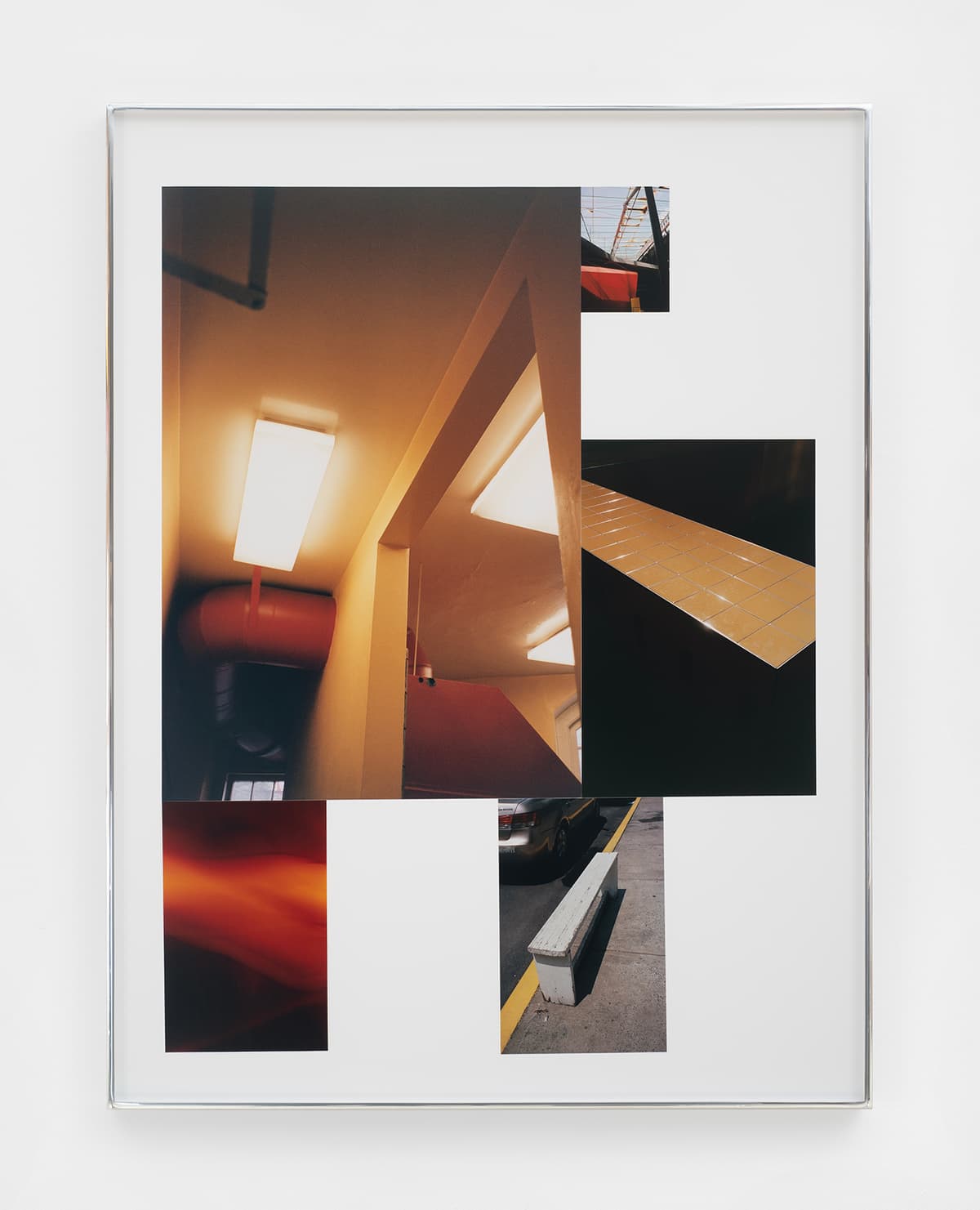
Lee Mary Manning, Chroma, 2024. Chromogenic prints, mat board, artist’s frame, 39 1/4 × 29 3/4 × 1 1/2 inches (framed). Courtesy the artist and CANADA. Photo: Joe DeNardo.
Rail: One of the things that really intrigues me is that in some of your images, the references to dance or music or poetry are a little bit more direct. In Arcobaleni (2023), for example (“rainbow” in Italian), there’s a photograph of three dancers performing on a stage, taken in a way that their movements are blurred, paired with an image of a wispy conifer branch, with thin, needle-like leaves that echo the blur of the dancers’ limbs, and then there’s an unevenly cut strip of rainbow-colored paper along the top. In other works, though, those references are less direct, more folded into the piece. There’s a rhythm and a poetry that seems inherent in the way you put the works together.
Manning: Arcobaleni was made at the invitation of the Festival of Two Worlds in Spoleto, Italy, which occurs every summer for the last, I think, sixty years. My residency was in this small town outside of Rome, at the estates of Anna Mahler and Sol LeWitt, who both spent significant time in Spoleto. That was where I made the book. But I spent five weeks there, and had my camera with me throughout, and I was very fortunate to get invited the following summer to make a show for the festival using all of the work I made when I was in Spoleto. So Arcobaleni is from one of the performances at the festival in 2022; it’s the Trisha Brown Company. And the paper—I was really transfixed with this beautiful art supply store in Spoleto that had all this really rad dead stock—art, ephemera, papers, and old notebooks and organizers—so a lot of that stuff came home with me, and I played with a lot of it. As I was assembling the book, I would take breaks and play around with that material, and that’s how that little scrap ended up in Arcobaleni.

Lee Mary Manning, High Hopes Redux, 2023. Chromogenic prints, mat board, artist's frame, 27 × 23 × 1.5 inches (framed). Courtesy the artist and CANADA. Photo: Joe DeNardo.
Rail: Your work feels very observational to me. At its heart, it’s about paying attention, and that sounds like a simple thing—paying attention—but it really isn’t, particularly in this moment. And I think it’s only getting more and more difficult, when there are so many distractions, and a generally heightened level of anxiety and vigilance. It can be difficult to be in the moment. Along those lines, I love your image High Hopes Redux (2023): it’s a box of pears sort of nestled beautifully together, and then there’s an image of three white plastic containers suspended over some other wares that might be for sale, and a photograph of several straw hats hanging on hooks on the wall of a restaurant. Most people would just walk by any of these objects without stopping to notice them. So I’m wondering, when you go out into the world, what makes you pick up your camera to take a picture of something? Do you feel like you have to be in the right frame of mind to go out and photograph? Do you feel like you need to empty your mind to be able to observe these small, everyday scenes of harmony or beauty?
Manning: I think there was a time before you had cell phones, when if you were traveling, or if you went out to a party or something, you would have your camera in your pocket. So I think I was maybe generationally more alert to wanting to record and have proof of going somewhere or seeing something. But it’s hard to answer what drives me to take out my camera and make an image. The impulse is simply that, you know, it’s something I regard as pretty, like the pears—that was at Broadway Market in London in 2017, I think. I actually made that print many years back, and then it lived by itself for a while. And then the “redux” in the title is when I added the two additional photographs, which were each from different trips to London. “High hopes” is a reference to one of my favorite Mike Leigh films.
Rail: Don’t you have a photograph that’s titled simply Mike Leigh (2020)? It looks like it’s taken at night, of an architectural detail on a building.

Lee Mary Manning, Mike Leigh, 2020. Chromogenic print, 30 × 22 inches. Courtesy the artist and CANADA. Photo: Joe DeNardo.
Manning: I probably have twenty-five different Mike Leigh references in my titles.
Rail: I’m such a fan of his films.
Manning: He’s really a masterful humanist. But, yeah, I think sometimes the flow is just there, like maybe the light will affect me—a really crispy winter light, maybe. It’s very ephemeral, what puts me in the flow and not in the flow.
Rail: Once you are back in your studio with all these pictures, how does that process work for you, in terms of making compositions, putting things together? It seems like it must be sort of intuitive and free flowing.
Manning: Both of those words totally apply. When I had one of my first studios, it was with a group of other artists, and a couple of them were also photographers. They had each taken sheet metal and drilled it to their walls and just used magnets. And I took that as a way to go about seeing all these images at once. So for a time, I had this studio where I could just magnetize all these 3 1/2 by 5-inch images. There’s a sort of intuitive pull—maybe there’s a really overt relationship that makes sense, like color or shape, or maybe it’s way weirder and only makes sense to me, and then later somebody will say it makes sense to them in a totally different way. And then I’ll be like, “Oh that too!” Lately, I’ve moved into having my studio in my apartment, and now I’ve been working flat, on tables, for the last probably two and a half years. And I like that as well. I play cards by myself a lot, I play solitaire with actual cards, and it feels like setting out the cards, you know, I’m just kind of pulling from them and shuffling through them. I also work kind of quickly; I don’t like to linger too long on a decision.
Rail: There’s one photograph in particular, Mulberry (for Moyra D) (2020), that I really love, and I’m not even sure I can articulate why. Part of it is that it’s beautiful, certainly, but it also has to do with the yellow-green mulberry leaves that have fallen onto the windshield of a car, the combination of the natural with the mechanical, and the fact that you might not know what you’re looking at immediately. It also has to do, for me, with the palpable sense of fall conveyed by this small detail, and a bittersweet sense of seasons changing, time moving forward, all from this tightly cropped detail of a windshield wiper half-covered in leaves. I wondered about this picture, as well, because it’s also fairly rare that you have a single image take up the entire frame.

Lee Mary Manning, Mulberry (for Moyra D), 2020. Chromogenic print, 17 1/4 × 12 1/4 × 1 1/2 inches (framed). Courtesy the artist and CANADA. Photo: Joe DeNardo.
Manning: This piece is really special to me. It was made during a tremendously heavy period of time. I think I was meant to do something for one of the art fairs that got, you know, suddenly put online. There’s not really a set of rules for what makes something okay to live by itself. And I like that, even as I assemble arrangements of things, I like this idea that over time, I can pull out an image from within that work and have that stand alone as a single image. It just feels like every once in a while, for me it’s like taking a breath and just having one image. The images themselves sort of dictate that to me at various times.
Rail: It sounds like you kind of use your own work as an archive, in that you draw from it and play with it.
Manning: Yeah, that’s true, actually.
Rail: What led you to use snapshot-sized images in your work, and where do you get them printed?
Manning: I have this beloved mom and pop place that I work with, and they’re one of the only labs I’ve found that’ll do the 3 1/2 by 5-inch prints, which for me, anyway, is really the right size to be handheld.
Rail: Why did you decide to make your compositions with snapshot-size photographs? There’s something about that size that makes the work feel accessible, even though the compositions themselves are actually very sophisticated and, as we were saying earlier, poetic and elliptical. The viewer can sort of create their own narratives, draw their own conclusions, and make their own connections between the images.
Manning: In the era of photo blogs and Tumblr accounts, in the mid-2000s, I was really inspired to keep one of those photo blogs. And the format that I copied and adjusted to my own aesthetic was just: image, image, image, image, image, and then I would update the post. I would do a post every day, usually in the mornings. And so you’re doing this sort of scroll, this edit of images, and you’re sort of telling a story with this sequence of images. That photo blog set in motion the invitation to start making publications, and the invitation to make work inside of fine-art spaces, with framed work, and as I was moving into that territory, I had also picked up my analog cameras again and had started amassing these stacks of 3 1/2 by 5-inch images. The first time I made an assemblage like this was for my first show with CANADA in 2018 called Love. And it felt like this really subtle jump, because it was the closest I could get to creating that sequence, almost like an experimental film of just: image, image, image. And to have it be more elegant, or more formal, to set it into a frame and work with a printer and a framer.
Rail: Do you still maintain the blog? It was called Unchanging Window, right?
Manning: It still lives online. I don’t ever update it anymore, but I’m always really relieved that it’s still there when I go to check it.
Rail: Do you use Instagram now in the way that you used to use the blog, or is it an entirely different kind of thing?
Manning: No, it feels like very much the same thing, especially once Instagram started to allow you to create carousels of images. I was like: here we go. I’d already been doing that for eight or nine years. So, the only reason Unchanging Window went dormant is that it felt like the world of image blogs and Tumblrs had just sort of evaporated, like no one was left in the building.
Rail: In terms of the photographs you use in your compositions, you’ve talked about not being precious about them, not minding if there are fingerprints on them or if the prints showed the dust on the lens, that kind of thing. I was wondering if any part of that was a reaction against digital photography and Photoshop and even AI, and towards something that shows the marks of your hand in its creation—or that includes so-called mistakes in the equipment you used.
Manning: Yeah, totally. I mean, I haven’t even really wrapped my head around the AI piece yet, but definitely, the objectness of going back to analog had everything to do with a sort of reaction to the fact that the digital space always felt so fraught, like you had to get the next program, have the newest model of the next camera. You know, all the cameras that I’m working with now are mostly twenty to thirty years old, and they’re working just fine. I definitely owe a lot to the digital cameras I used for so many of those blog years. But moving to analog just meant I have one shot, like if there’s something happening right in front of me, maybe I’ll get two chances to take a picture of it, and probably just one. And if I’m zooming in on something, I physically have to get close to that thing, as in Both (Ode to Will S) (2023), when I was standing right next to my friend Will. So all of that did feel like a little bit of a reaction, because I’m a bit willful. Maybe I’ll become interested in digital again, but I still love that I don’t color-correct, this is the miracle of the science of this camera, this is the picture I got.

Lee Mary Manning, Both (Ode to Will S), 2023. Chromogenic prints, mat board, watercolor, paper, artist’s frame, 35 × 29 1/2 × 1 1/2 inches (framed). Courtesy the artist and CANADA. Photo: Joe DeNardo.
Rail: I love Both (Ode to Will S), too. You can see the echoes of the colors throughout the picture—the pink and green kind of flow throughout the picture, which is really lovely. Sometimes the formal relationships are less obvious, but in this one the pink and green show up like little staccato notes in relation to the image that is the main focus, which is a close up of a faded pink sweatshirt half-unzipped over a faded green T-shirt.
Manning: I really love it too. I’m laughing because that’s a picture of my friend Will, and he claims that he doesn’t have a green T-shirt, that it had to have been white. So I’m not sure what kind of alchemy went on, but somehow this T-shirt is green.
Rail: Another example, I guess, of the serendipity that happens when you don’t color-correct or touch things up digitally.
I also wanted to ask you a bit about the ephemera you incorporate into your work, which is something I really appreciate about the pictures, too. You’ll include a paper bag and some pictures, or scraps of paper, or bits of yarn, or you’ll place a small paper bag on the back of a work. There’s something playful about the use of these materials.
Manning: I just like collecting and looking. I don’t always get concerned with it through photography. I also used to just pick things up at my former job, like scraps of fabric, or bits of nature. I’d keep a leaf inside a book for a long time, or a flattened flower. Or, like many people I know, I’ve got an extensive, beautiful bag collection. I would use those for special things, often gifts or things, and for me, it was like figuring out a way to give them space alongside these other images. And initially they kind of felt like pauses, like: image, image, image, and then you can just kind of pause and ponder this moth wing, or maybe the colors in the moth wing are the same as the colors inside the photograph. And then in my last show with CANADA in 2022, I took it to a whole other kind of idea, and each of those works had a little bit of something, another kind of material inside. So it’s like a jack in the box: if you took it home and opened it up, you might find something on the verso, applied to the back of the frame as a sort of echo.
Rail: I also read it as a kind of a rejection of the preciousness of the fine art world.
Manning: I’m sure having a leaf that’s going to biodegrade inside of a frame is probably a little questionable from an archival standpoint, but when I see artworks that have preserved or made important these other bits of ephemera, I’m always so curious why that was important to this person, or what meaning is attached to it. So I think the survival of those works is cool. No matter what state those leaves or flowers will be in in time, I think it’ll still be interesting.
Rail: It’s another aspect of paying attention to small things, to things that we don’t normally think are worthy of being noticed.
I read an interview that you did with Ben Estes, in which he said, “When I try to imagine a Lee Mary Manning photograph I sometimes have a hard time actually picturing anything at all. Instead I imagine a kind of weather, or a deep breath.” I thought that was such a beautiful impression of your work, and I was wondering how you, yourself would describe the subject matter of your pictures.
Manning: It’s really funny, because people are often like, “Oh, well, what kind of photographs do you take?” and I usually just say, “Everything, you know. Everyday life.” It’s always really hard to formalize it because it can kind of be anything.
Rail: Maybe you should go with Ben’s lovely description. How did you first get into photography? When did you first pick up a camera, and then when did you decide to embrace the idea of being a photographer?

Lee Mary Manning, Running into Nan at the Barberini, 2024. Chromogenic prints, mat board, artist’s frame, 35 3/8 × 21 × 1 1/2 inches (framed). Courtesy the artist and CANADA. Photo: Joe DeNardo.
Manning: My dad was an artist, so looking and image-making and paying attention was really a big part of spending time with him. I didn’t live with him, but I saw him every other weekend and he had this interest in nature photography when I was pretty young. As early as age ten, I had my own camera, and funny enough, I found a roll of that film from around age eleven, from a fifth grade field trip. And the pictures were so funny, mostly because many of them looked exactly like images I would take now. I had bent down so close to a geranium in my grandma’s yard that it was a blur, so I haven’t changed that much.
I wasn’t really encouraged that much to pursue the arts. My family was really interested in politics. I studied politics and went into that field really briefly, and then moved to San Francisco and sort of centered my life around other artists and musicians and a really beautiful queer community, and cameras were always around. Artists were always a little intimidating to me. I thought in order to become an artist, one would have had to follow this formal path to studying art. Most of the people I knew in that arena had gone that way, and so I felt very much like that was their world, and I was just a fan, and I’m really comfortable being a fan. I got into my thirties and felt really shy to be seen and put myself out there to make things and self-identify as an artist, even though by that time I knew that there was such a thing as a self-taught artist. I hid in the anonymity of this blog for many years. People were so generous—Jackie Klempay gave me my first show in an apartment in Brooklyn in 2014, and I had a series of shows after that, which led me to my hopefully forever home at CANADA. And I guess I’m leaving out the part where I had this job for a long time that felt like golden handcuffs.
Rail: Was this at the Gap?
Manning: Yeah. I was going to make a joke that I worked at this small start-up called the Gap. I worked with so many amazing fashion photographers and creative people and art directors, and I traveled a ton for that job, and that was really the impetus for even starting the blog. So I was just traveling all the time and being in new places, and I moved to New York with that job. Making work and making shows and making publications started at the tail end of having that job, which was really beautiful, because it upset this idea that making work was going to put clothes on my back or give me sustenance. It was very freeing, because I was making the medium bucks at Gap, and I could buy film, and I could pay to rent a studio, and then that crazy kind of benevolent thing happened, where I got laid off from that job and was kicked into—you’re gonna try this now. And it’s been this beautiful trust exercise.
Rail: You weren’t a photographer for the Gap, but you do some fashion work now, right?
Manning: Yeah, I would really add fashion as something that influences my work, in terms of an alertness to clothes in general, and my connection to a lot of people in that world. Saying yes when it comes up has been really fun.
Rail: Were there other artists or photographers who you were looking at and thinking about? Or particular dancers or poets who were influencing you?

Lee Mary Manning, Existence, Incorporated, 2024. Chromogenic prints, corrugated paper, mat board, artist’s frame, 21 1/8 × 15 3/4 × 1 3/4 inches (framed). Courtesy the artist and CANADA. Photo: Joe DeNardo.
Manning: There are so many that are racing through my mind right now. Moyra Davey and Wolfgang Tillmans, and juicier, heavier influences would be experimental filmmakers like Nathaniel Dorsky, Jonas Mekas, or Stan Brakhage. But getting to move to New York at the time I did, I’d always had a relationship to dance and specifically to postmodern dance, and getting to go and see Yvonne Rainer dance and do talks, and Merce Cunningham was still alive when I moved to New York and seeing his company and seeing him… poets like Alice Notley and Eileen Myles and Tim Dlugos. I could go on and on.
Rail: All of those influences come through so much in your work. There’s a lot of gesture, there’s a lot of beautiful little shorthand; your work visually reads very much like a poem to me. I also wanted to ask you about some of your titles, because they’re so evocative, like Music for Shattering Supermarkets (2022), for example.
Manning: Titling is really the funnest part to me and it was a big part of the blog as well. Each post would have either a line from a song or a line from a poem. I remember thinking, “Oh, one of the funnest parts of making an artwork is going to be making the title.” And it’s true, it’s such a joy, because maybe there’s a wink to something specific in the piece, or maybe it’s a wink to the mood of that time, or a song of that period that’s important to me. It feels like a really joyful exercise where I can make overt meaning, because the imagery, especially in the assemblages, can be a little oblique, and people can choose their own meaning. When I attach a title to something, then I’m giving it a little more juice to sort of pick apart what’s happening in the piece.
Music for Shattering Supermarkets is a really funny one. It was kind of standalone, and very occasionally I’ll take multiple pictures of something from a couple of different tries, or maybe I’ll move back farther or something. And I’d had these lawn-mower pictures sort of stuck in this stack of images for a long time, and always dreamed of putting them in this pattern that exactly follows the row of the clipper. Music for Shattering Supermarkets is actually by this British jazz composer Michael Garrick, whose album contains this song. It’s one of my favorites; it evokes this really beautiful feeling and it’s got this kind of crescendo, and it sort of felt like a perfect title for this. I love being able to try things out, and then I’ll kind of forget I tried something out, and I can come back to it.

Lee Mary Manning, Music for Shattering Supermarkets, 2022. Chromogenic prints, mat board, artist's frame, 18 1/4 × 15 1/4 × 1 1/2 inches (framed). Courtesy the artist and CANADA. Photo: Joe DeNardo.
Rail: You can see the experimentation happening and the creative process. Is there a narrative underlying any of your pieces, even if it might only be known to you?
Manning: Really rarely. Mostly it’s so intuitive, and it’s so quick. I don’t want to dictate too much of what’s going on, even to myself. It was interesting, for two summers in a row, to make these shows that were specific to a place. And then it was really refreshing to work on the current show that had no more rules—there’s no time period, there’s no place, there’s no format. I did away with any kind of uniformity around framing. And I’m really excited to just sort of keep fucking with my own rules—pardon my French.
Jean Dykstra is a photography critic and the former editor of photograph magazine.