The Discipline Reveals its Dirty Laundry
Word count: 965
Paragraphs: 10

Installation view: Architecture as an Instruction-Based Art, Harvard Graduate School of Design, Druker Design Gallery, Cambridge, MA, 2024. Courtesy Harvard Graduate School of Design. Photo: Justin Knight.
Harvard Graduate School of Design, Druker Design Gallery
August 25–October 15, 2024
Cambridge, MA
Curated by Farshid Moussavi, Architecture as an Instruction-Based Art is a new show. This in itself is a feat. An act of exposition featuring ninety international architecture firms, the show pulls back the curtain on the instruments of practice by displaying a collection of polychromatic screenshots of building information models (BIM) and computer-aided design (CAD) files, plotted and pinned to the wall. The architects here, it seems, often are togglers of layers and arbiters of model visibility. This formatting renders the respective design of each project less significant, with the exhibition's power instead residing in how the works serve as specific kind of ready-made artifacts, captured from the software we use in practice. Moussavi likens the work of an architect to that of a conceptual artist, drawing a parallel to Sol LeWitt, who translated his experience as a graphic designer at the office of I. M. Pei into large wall drawings, executed by teams following LeWitt’s detailed instructions.1
Moussavi’s own contribution, a BIM screenshot of the Ismaili Center Houston, is a deliberate exercise in transparency—layers piled on, making no effort to hide the complexities of contemporary practice. It is an artifact of digital labor and real-time coordination that shows how all architectural elements might be orchestrated to support a conceptual idea for the building. Yet Angela Pang’s remark during the exhibition’s lecture—that architects treat such work like “dirty laundry”—reveals a deeper discomfort with exposing the unrefined processes that underpin our profession. These artifacts, typically relegated to the background, are revealed here as intimate artifacts of architectural production. Pang is correct; it is not common practice to display such information, despite the files being legally essential to professional life outside of the academy. For group shows in academic institutions of this kind, architects have historically produced, or reproduced, polished representations of finished architecture, but in this exhibition that is not the case. As such, the show marks a shift from representation to presentation.
The theory of representation versus presentation was introduced into architectural discourse by John May, who, alongside Zeina Koreitem with their firm MILLIØNS, presented work in the exhibition. In his book Signal. Image. Architecture. (2019), May explains that imaging—what we see in the exhibition—“does not want to be a representation of the world, it wants to be a presentation of the world: an automatic and perceptually up-to-date, real-time model of the world.” May further notes that real-time models contain:
a running analysis of all possible future object-scenarios: formal-geometric possibilities, tectonic parameters, construction and maintenance costs, energy consumption metrics, geodemographic considerations, insurance liabilities, material characteristics, and local and global stock supply availabilities.
Amelyn Ng’s essay “7D Vision” (“Software as Infrastructure”, e-flux, 2020) further interrogates BIM models, suggesting that with the introduction of sophisticated modeling software, “something has fundamentally changed in the ambitions of architectural visualization, and with it, relationships between representation and reality.” If architectural images are no longer concerned with depicting reality but are instead tasked with predicting it, what then does Architecture as Instruction-Based Art tell us about the future of these future object-scenarios?
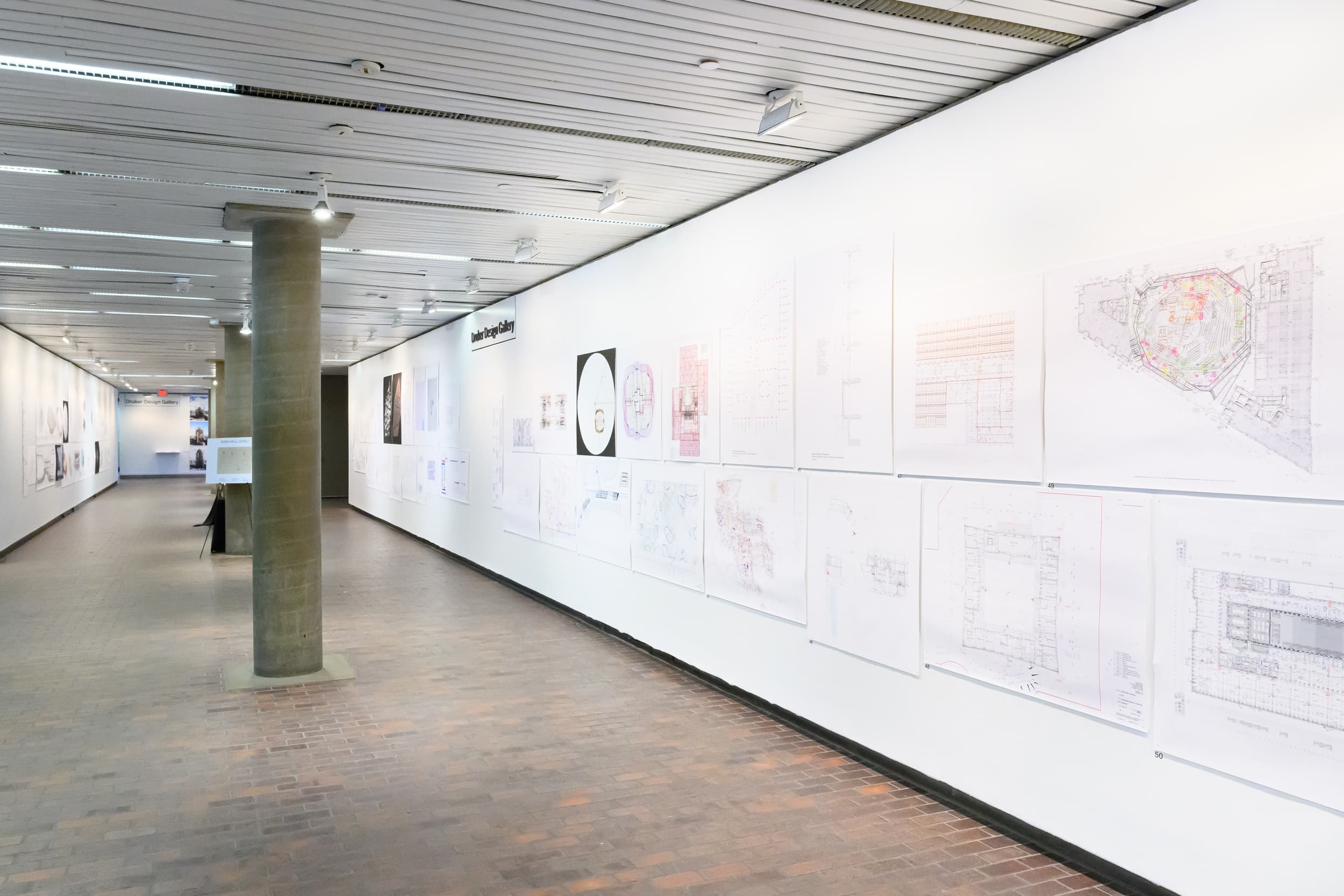
Installation view: Architecture as an Instruction-Based Art, Harvard Graduate School of Design, Druker Design Gallery, Cambridge, MA, 2024. Courtesy Harvard Graduate School of Design. Photo: Justin Knight.
Christian Kerez’s Parkings in Bahrain provides an example. A sea of double-curved concrete surfaces oscillate between concave and convex forms. It’s a project that could have never been conceived or constructed without the generative forms of modeling. Kerez’s team produced (scripted) a dizzying seventy-five thousand 1:20 sections to will the form into existence, certainly an example of what May calls “formal-geometric possibilities.”
Meanwhile, an image of the Elbphilharmonie Hamburg by Herzog & de Meuron offers a glimpse into another kind of architectural entanglement, this time with the infrastructure of systems—mechanical, electrical, plumbing (MEP). A rule of thumb in the building industry is to reserve 25–35 percent of a project’s cost for MEP alone, raising the question of whether this is something to conceal, reveal, or otherwise architecturally problematize. Herzog & de Meuron’s image zooms in on this often-neglected aspect of architecture, offering a disembodied jellyfish-like model of the Elbphilharmonie’s MEP network, floating eerily, weightless and untethered to the building itself. Philip Schmerbeck, associate and studio director at Herzog & de Meuron, noted that the image offers clues to the instructions and technical requirements handed down by engineers, acousticians, and contractors—a constellation of technical data that ultimately shapes and tempers the building. Eric Höweler observed that the MEP model mimics the volume of the concert hall itself, a “pantomime, miming its extents.”2 In this image, architecture’s secrets aren’t just exposed, they are made into its own spectacle through increasingly efficient arrangements that were not possible before the advent of BIM software.
Ultimately, Architecture as an Instruction-Based Art captures an urgent set of realities for both academia and practice with its survey format allowing for multiple interpretations of how the discipline should respond to these conditions. Moussavi asserts that there is much room for “micropolitics,” declaring that architects exert influence by deciding “what is moveable and not moveable, traversable or not traversable, transparent or opaque, touchable or untouchable, closed or open, and the colors, geometries, and structures that are present as people go about their everyday activities.” However, a looming question remains: how does this shift, from representation to presentation, or orthography to imaging, fundamentally change the discipline across pedagogy and practice? In her closing remarks, Grace La, Chair of the Department of Architecture at Harvard GSD, noted that the images in the show “represent how monstrous our systems have become to the extent that they are a third of our capital,” offering a path forward in imagining what the discipline might look like formally, politically, and culturally without those systems. Perhaps we need to look back in order to clarify the new.
- Farshid Moussavi, “Architecture As an Instruction-Based Art.” Harvard GSD, 2024, YouTube.
- Höweler, Eric. “‘Herzog de Meuron’s Astounding Drawing of the Ductwork for the Concert Hall of the Elbphilharmonie in Hamburg.’” Instagram, September 3, 2024. https://www.instagram.com/p/C_enNiBOY-7/.
Michael Abel Deng is a painter, founding partner at Abel Nile New York and Chief Design Officer at Homer.
Ian Erickson is a contributor to the Brooklyn Rail.