Jimi Kabela: Amalgamation

Jimi Kabela, gumbo, 2024. Oil, fabric material on canvas, 70 3⁄4 x 47 inches. Courtesy the artist and Nancy Hoffman Gallery.
Word count: 658
Paragraphs: 7
Nancy Hoffman Gallery
October 24–December 7, 2024
New York
For his New York solo debut, Jimi Kabela presents more than forty dense and intense recent abstract oil paintings loaded with colorful gestural markings. Appropriately titled Amalgamation, the exhibition features works that appear as composites of forms and gestures, neither random nor programmatic. Lyrical and expressive, but not doggedly expressionistic, each painting imparts a distinct energy and a unique feeling. And each contributes to the cohesive whole in this remarkably assured exhibition by an artist who just recently received an MFA from Pratt Institute. Born in the Democratic Republic of the Congo in 1990, Kabela emigrated to the US with his family when he was ten. He earned a BFA at the University of Texas at Arlington, in 2021, before relocating to New York City.
Many works feature irregular patterns of small and medium-sized circular forms that seem to pulsate in rhythmic clusters within the thick impasto surfaces of the allover compositions. Kabela uses flourishes of oil pigment and sometimes collage elements—like bits of clothing, feathers, and small circular metal or plastic objects—to enhance the relief-like quality of the encrusted surfaces. One of the most striking works, gumbo (2024), a large canvas (over 70 by 47 inches) whose title was inspired by a visit to New Orleans, has a relatively sparse background. Splashes of dark pigment in the upper portion of the composition play counterpoint to seven plastic discs painted dark gray near the lower edge. Identical in size, the discs are arranged in two rows, with three of them connected by a length of string to suggest movement, a mechanized motion by an analog machine of some kind—perhaps like the whirling reels of an old recording machine. A painting-sculpture hybrid, the work recalls the “Combines” of Robert Rauschenberg, an artist who has had a sizable impact on Kabela’s practice. Several paintings with large gray numbers in boldface, including misplacement (2023), seem to allude to Jasper Johns’s paintings, although Kabela has stated that these compositions stem directly from his interest in typography.
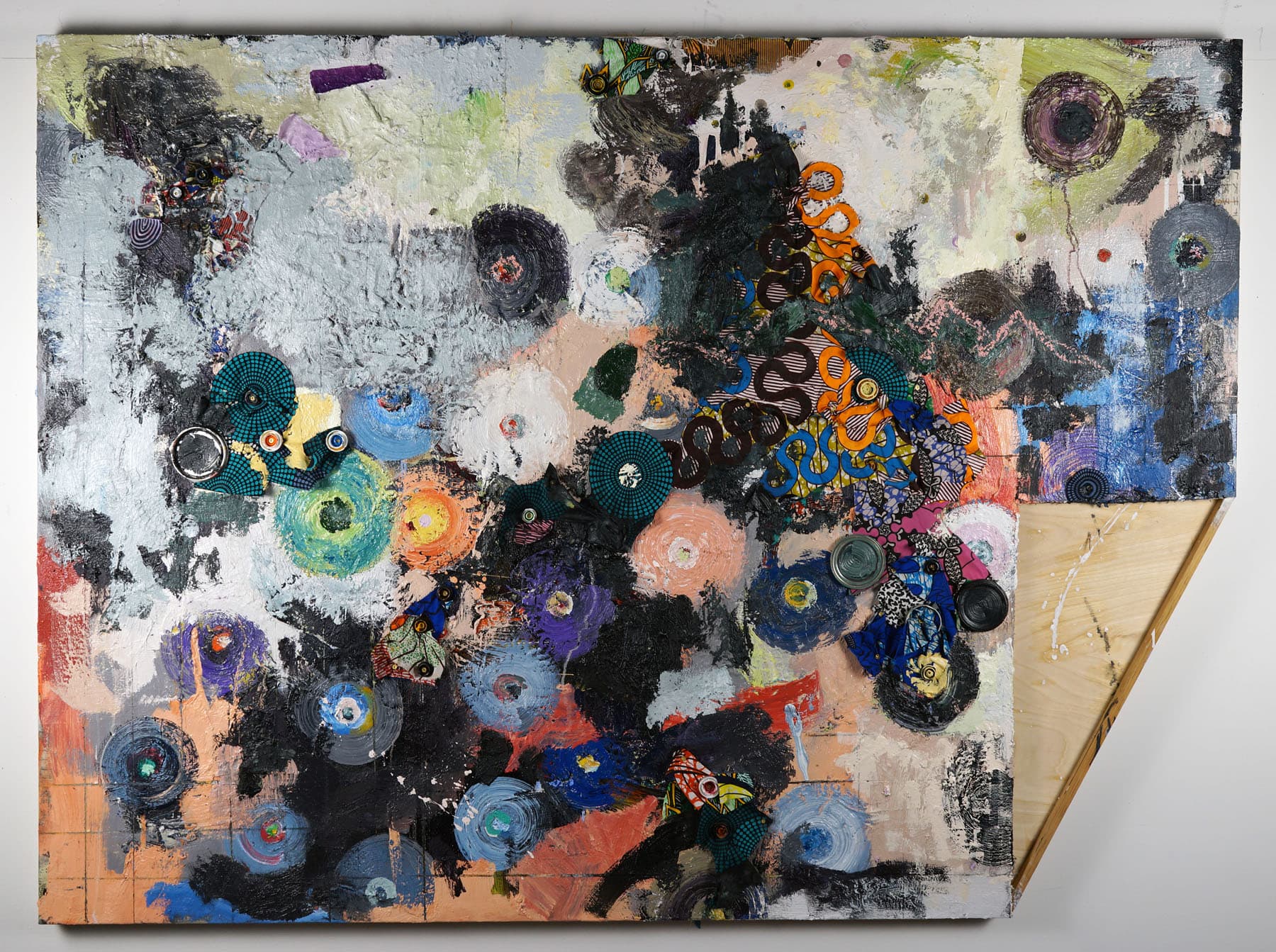
Jimi Kablea, bamba (they said), 2023. Oil, fabric material on panel, 48 x 66 inches. Courtesy the artist and Nancy Hoffman Gallery.
Further reflecting a relationship to the “Combines,” Kabela’s bamba (they said), (2023)—a large, bold canvas—shows clusters of orblike discs of pink, green, and blue that punctuate and dominate the lively, horizontal panel. The expansive composition is disrupted, however, by a rectangular section on the lower right that has been cut out and replaced with a diagonal wooden bar. This incongruous void adds to the painting an unexpected sculptural dimension, as well as a welcome breathing space within the otherwise sumptuously congested composition.
Romare Bearden’s collages have also had a lasting influence on Kabela, evident in the angular pieces of cloth cut up and fixed to the surfaces. These scraps of women’s clothing include fragments of garments that the young artist purchased on recent visits to Africa. Kabela explores his African identity and heritage by means of a fundamentally abstract visual language that encompasses these poignant bits of cloth. In works such as un petit voyage (2024), the floral patterns of the Congolese fabric are barely discernible at first, as they subtly merge with hovering circular forms and touches of bravado brushstroke that enliven the surface.

Jimi Kabela, un petit voyage, 2024. Oil, fabric material on canvas, 48 x 76 inches. Courtesy the artist and Nancy Hoffman Gallery.
At times, the cloth lends Kabela’s works an unabashedly decorative quality, as in a kora song (2023), in which a narrow strip of torn fabric with a rigid diamond pattern, on the right, balances painterly brushwork of black and yellow to the left. An elongated patch of cloth in the center of the composition suggests a stylized figure floating diagonally in space. Perhaps the most opulent and sensuous works are in the series of octagonal canvases, including balunda (friendship) and balunda II (friendship) (both 2024). In these paintings, repeating leaf shapes and floral elements along the edges contain central palimpsests of small circles and dots that appear among writhing serpentine shapes or plant stems that only furtively rise to the surface.
David Ebony is a contributing editor of Art in America. He is also the author of monthly columns for Yale University Press online, and Artnet News.