Crossing Over: Art and Science at Caltech, 1920–2020
Word count: 1018
Paragraphs: 15
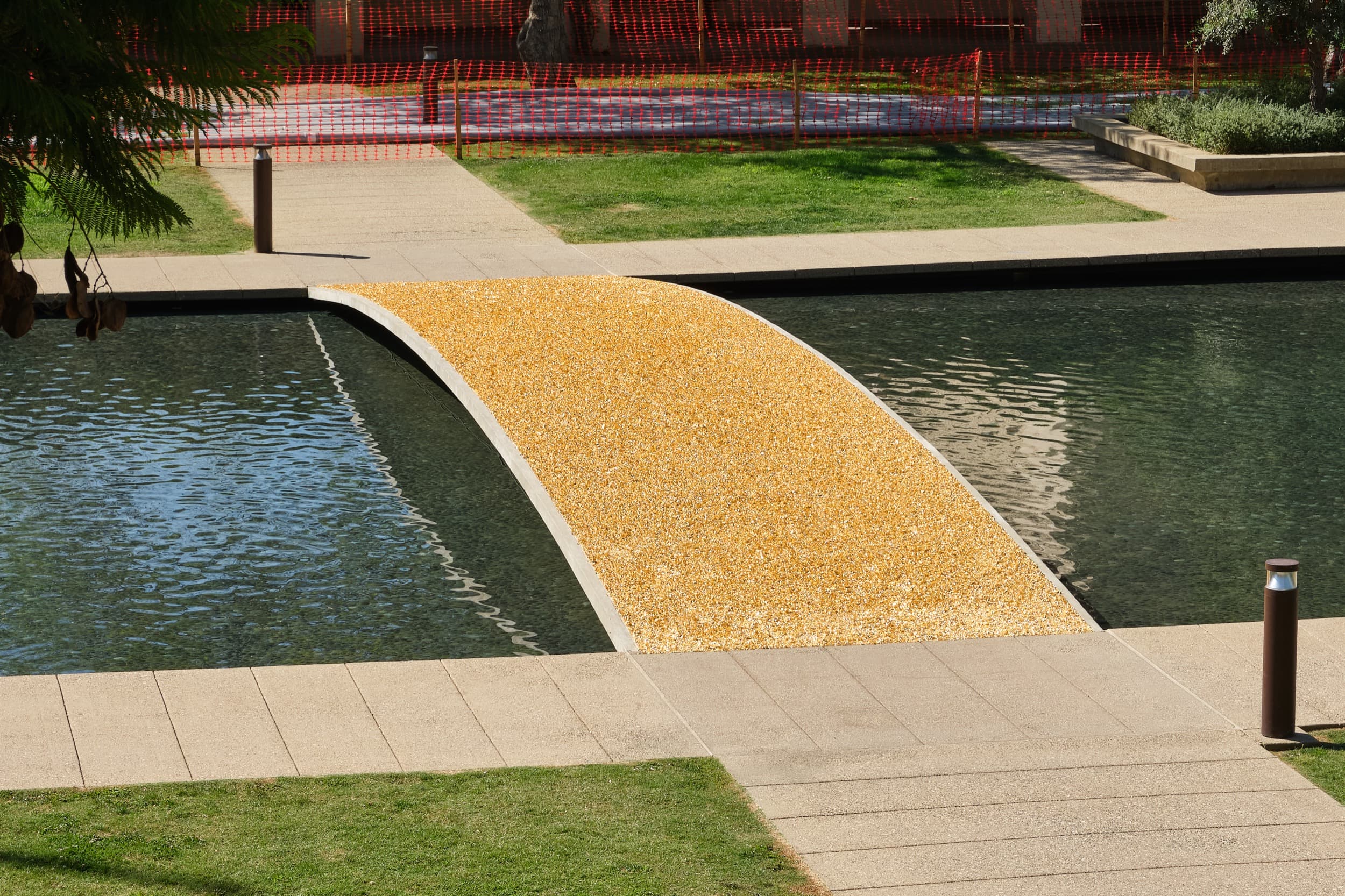
Lita Albuquerque, This Moment in Time, 2024. Artificial gold leaf on vinyl. Photo: Chris Hanke.
Caltech Archives & Special Collections
September 27–December 15, 2024
Pasadena, CA
Crossing Over: Art and Science at Caltech, 1920–2020, curated by Claudia Bohn-Spector and directed by Peter Collopy, presents an exhibition by way of a scavenger hunt. Funded in part via the Getty Foundation’s current PST ART: Art and Science Collide initiative, the exhibition unfolds across six sites at the hermetic institution. In it, materials from Caltech’s archives are presented alongside work by artists such as Helen Pashgian, Lita Albuquerque, and Lia Halloran in spaces that are usually reserved for scientific research and instruction. In wielding scientific materials as and alongside aesthetic ones, the exhibition makes all of Caltech into a playground for various forms of observation.
Entering Caltech via its entrance off Wilson Ave. in Pasadena, visitors are greeted by a teetering, scaffold-like structure. Built of matchstick-thin wooden planks, with a container of pamphlets attached at its side and a curved gray panel bearing the exhibition’s name, spare in its austere geometricity. The orange and white guides suggest a route through Caltech in its school colors, with Crossing Over’s galleries and installations numbered as stops along the way.
Behind the exhibition sign, Shana Mabari’s Spectrum Petals (2024) reflect visible light from handpicked points along the electromagnetic spectrum. These discs function as monochrome mirrors, distorting the viewer’s reflection into a warbled funhouse image. Set against an idyllic lawn bordered by Spanish-style architecture, Mabari’s petals make the campus into an experiment in spectroscopy.
Shana Mabari, Spectrum Petals, 2024. Acrylic and mirror. Photo: Eric Minh Swenson.

When in search of Crossing Over’s indoor galleries, one gets the sense that the exhibition extends beyond what is being literally placed on display. Traipsing through laboratory and administrative buildings, one slows down to appreciate serpentine light fixtures, or peers through cracked open doors to catch a glimpse of a mottled bronze sculpture sitting atop a professor’s desk. The galleries themselves are treasure troves: architectural mockups for observatories, topographical models of molecular structure, anatomical drawings of Drosophila—fruit fly—phenotypes. Globally, there is a concern with the question of scientific observation: who may see, what they see, and how they represent it. In Crossing Over, scientists poke and prod their own representational systems, constantly creating new aestheticized chemical models, designing mold research slides with all the clarity and cool of Lissitzky. Of particular interest are historical materials on gendered divisions of scientific labor, where women complete computations or sketch organisms, but rarely enter the telescope or handle living materials themselves. The issues that govern the objects in Crossing Over are much like those that govern modern art history, as many scientists seek universal visual language via abstraction. There is also an intimacy to these objects that is key to psychological modernism, especially in the personal sketches and notes of Nobel Prize-winning physicist Richard Feynman (1985), where nude drawings sit atop calculus equations, cartesian curves commingling with the female form.
For conservation reasons, Caltech’s historic buildings and their walls could not be touched, so most of these materials come in custom built, charmingly haphazard structures of plywood and plastic that balance uneasily on rubber-capped legs. The resulting symbiosis is neither mutualistic nor parasitic; the exhibition works both with and against its host.
Crossing Over’s complex interaction with its site continues outdoors. A new work by California artist Lita Albuquerque, This Moment in Time (2024), comprises gold leaf papered over a concrete pathway that cuts through Caltech Pond. The metal shudders, lifting away from its surface at any breeze. Such an installation is subject to all kinds of intervention and disturbance, despite the metal stanchions sitting on either side of the bridge. On one of my visits, a stray half of a ping pong table sat perpendicular to the bridge, as if frustrated that it could not cross. On other days, shimmering footprints of flattened gold leaf refracted across the bridge’s otherwise shaggy surface, likely belonging to a student who was rushing between classes—traces of a turf war between art and science.
Crossing Over’s final stop is an installation by the artist Helen Pashgian, presented in an emptied-out storage room on the ground floor of the Chen Neuroscience Research Building. In one sense, this is a victory in the turf war. Pipettes have been displaced to make room for a meditative glass disc. The lighting cycles, beginning dark and eventually illuminating a circle that burns orange and solar, dissolves by clockwork into afterimage. In another sense, art here has been relegated to the closet.
The visual environment of Crossing Over is co-produced by the exhibition, Caltech’s institutional history, and the daily presence of students and faculty. Installed in the Ronald and Maxine Linde Laboratory for Global Environmental Science are materials on astronomy, assembled around a built-in coelostat solar telescope. To the building’s side sits a small courtyard, where students work on laptops alongside a hexahedral sculpture of aluminum rods. Entitled Perception (2010–11) and designed by material scientist and Caltech trustee Ronald Linde, it predates and will outlive Crossing Over, but for this moment exists alongside it. Beside the sculpture is a whiteboard that on one of my visits featured doodles, equations, and a block of text reading:
CALTECH SECRET #72
BENEATH THE FOUNTAINS LIE AN UNDERGROUND SEWER COMPLEX. INSIDE, A RAT, TRAINED IN MARTIAL ARTS, HAS RAISED FOUR TURTLES TO FIGHT CRIME+EAT PIZZA.
In triangulating between Linde’s dilettante sculpting and campus humor lifted straight from comic books, Caltech’s institutional project comes into focus. Caltech is a playground, and the toys within it derive from and often reinforce expansionist visions. One of Crossing Over’s galleries focuses on the atom and its splitting, recounting Caltech’s association with the Manhattan Project. In BOMBHEAD, (2002/1989) a print of a collage by Bruce Conner, a mushroom cloud has replaced a soldier’s head. The institutional, or at least its representation, subsumes the individual. To most publics, all this remains opaque.
When applied within scientific institutions, the arts may be meant as a salve, as a weapon, as a cover. Crossing Over helps us understand the mores by which these various functions come to lay atop each other.
Adam Ludwig is a writer based in Los Angeles.