Anne Wilson: The MAD Drawing Room and Errant Behaviors
Word count: 871
Paragraphs: 9

Installation view: Anne Wilson: Errant Behaviors, Museum of Arts and Design, New York. Photo: Jenna Bascom.
Museum of Arts and Design
April 20, 2024 - May 11, 2025
New York
The occasion of Anne Wilson’s one-day workshop, “Close Looking,” brought me to the second floor of the Museum of Arts and Design (MAD) on Tuesday, November 5th. For my part, thinking about Election Day and its consequences threatened to overwhelm the centered-on-self attentiveness the artist asked of ten participants. Wilson acknowledged this coincidence during her opening remarks in the MAD Drawing Room, the installation of materials, wall didactics, and books paired with MAD’s recent acquisition of Wilson’s two-screen video and sound installation, Errant Behaviors (2004).
Visitors to Wilson’s installation encounter Errant Behaviors, sited across from MAD’s second floor elevators. In previous iterations of this work, the concurrent projects were mounted facing each other across a room. The MAD installation, of side-by-side projections, can be construed as a new work. Wilson has noted how the stop-motion animation used in Errant Behaviors parallels the structural development in lacemaking, with the actions of hand allowing “aspects of foible, imperfection, curiosity, and irregularity.” The videos are in color, so every now and again moments of red dust or yellow pinheads become visible within the setting of black thread in white environment. The motions of the separate clusters of threads and pins rarely coincide, compositionally, but the identical pacing of the stop motion functions like poetic meter, adding like-speed to the changing images. Shawn Decker’s percussive, chirping, electronic sound adds to the associative potential of the jittering visual elements. At one point, the horizontal lengths of trembling thread on the right seem to encourage crumpled bits of fiber on the left to cross the divide and become notes on a musical score.
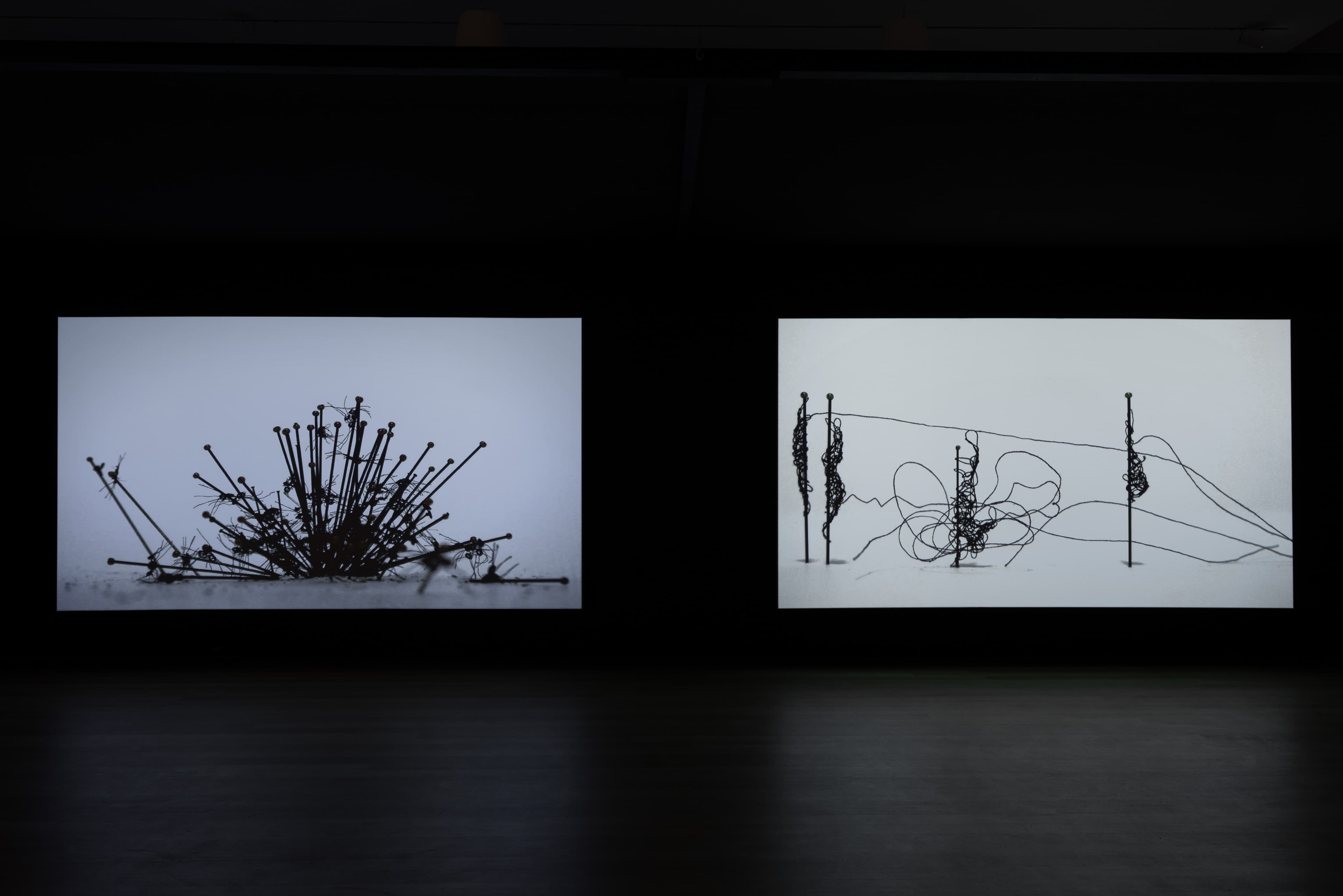
Installation view: Anne Wilson: Errant Behaviors, Museum of Arts and Design, New York. Photo: Jenna Bascom.
The MAD Drawing Room is modeled after Wilson’s Davis Street Drawing Room (2022-23), a room in the artist’s home, in Evanston, Illinois, that she converted into a public space. The Davis Street Drawing Room included portions of Wilson’s personal collection of lace fragments, rolled house linens, worn cloth, handmade glass bobbins, and early hair and cloth studies from her art practice. These were mounted on walls or placed on tables so as to be accessible to visitors. During public hours, people made use of the space by drawing, photographing, and writing, or else choosing books to read from portions of Wilson’s substantial personal library of books and journals devoted to textile history, chemistry, and fashioning techniques.
Wilson’s house was originally built in 1887, and renovated in what the artist described as Prairie style, in 1909. The converted home and studio was a comfortable setting for visitors to scrutinize the remainders, fragments, and souvenirs among the materials on view. In MAD’s institutional setting, designed by Brad Cloepfil’s Allied Works Architecture in 2008, the domestic intimacy of the Davis Street Drawing Room was replaced by large-scale laminated photomurals and text, wall-mounted video monitors, and lecterns, acrylic covered display tables, and other furnishings appropriate to the display conditions of a museum.
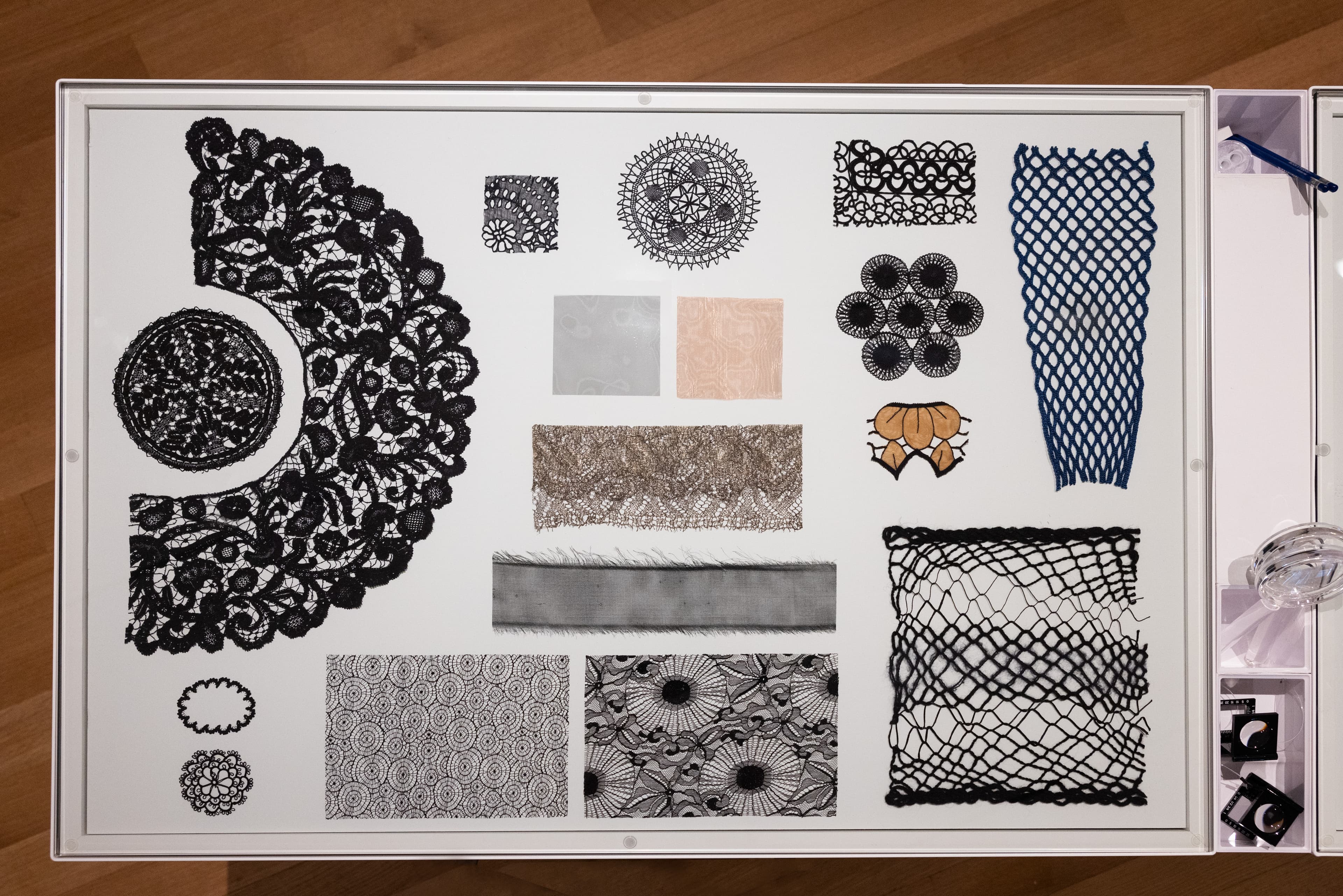
Installation view: Anne Wilson: Errant Behaviors, Museum of Arts and Design, New York. Photo: Jenna Bascom.
On my first visit to Wilson’s exhibition in April 2024, I was struck by the ways in which the MAD Drawing Room evoked a research or teaching center. (Wilson taught for more than 40 years in the Fiber and Material Studies Program at the School of the Art Institute of Chicago.) The site’s wall didactics and furnishings, especially the display tables covered by sheets of clear acrylic, affirmed the institution’s look-but-do-not-touch sensibility. Almost all the materials Wilson loaned to the exhibit were from the Davis Street Drawing Room, so the shift in kind of attentiveness wasn’t connected to the visual delights brought from Wilson’s personal archive. Rather, the protective distancing of the installation functioned to turn the whole room into a situational artifact.
For the “Close Looking” workshop, Wilson provided a temporary additional table covered with pieces of traditional and machine-made laces. These were available for handling and for artistic engagement by way of various types of paper, drawing implements, cutting tools, hand magnifiers, and erasers also provided. Wilson introduced the workshop with a brief meditation on “slow close looking and listening; about invention and critical thinking; [and] about finding complexity and meaning in textiles and sound.” She invited the day’s participants—for the most part artists already working with fiber or textiles—to select whatever fascinated them from the accessible examples, then write or draw their responses to the material. The participants could choose to take what they made home, or else donate it to MAD’s folders devoted to the project. (I donated my two graphite drawings to the museum.)
The two-hour allotment meant that Wilson had to hurry through her welcome and instructions, apologizing at one point for how the event’s time limit impinged on how much information she could provide. Once the invitation was tendered to select items for that closer scrutiny, though, the collective awareness of passing time almost immediately abated. We were a roomful of artists making art, and eyes, ears, touch, even the aroma of old lace and the sounds of pencils scratching on textured paper filled our minds. It was disconcerting when MAD curator Elissa Auther gave the alert that the workshop would end in fifteen minutes.
Buzz Spector is an artist and writer living in the Hudson Valley.