ArchitectureNovember 2024In Conversation
ALGERNON MILLER with Dan Roche
Word count: 1681
Paragraphs: 19

Aerial View. Courtesy Algernon Miller.
Algernon Miller (b. 1945) is an artist from Harlem who is today considered one of several pioneers of Afrofuturism. Since the 1970s, Miller has created powerful public art installations all over New York, including Tree of Hope (1972). This interview with Miller explores his design for Frederick Douglass Plaza (2010), a memorial many call a “Gateway to Harlem,” on the northwest corner of Central Park.
Dan Roche: On my walk from the C train to your studio, I saw a rally for Palestine happening in Frederick Douglass Plaza. It was so cool to see right before getting to speak with you.
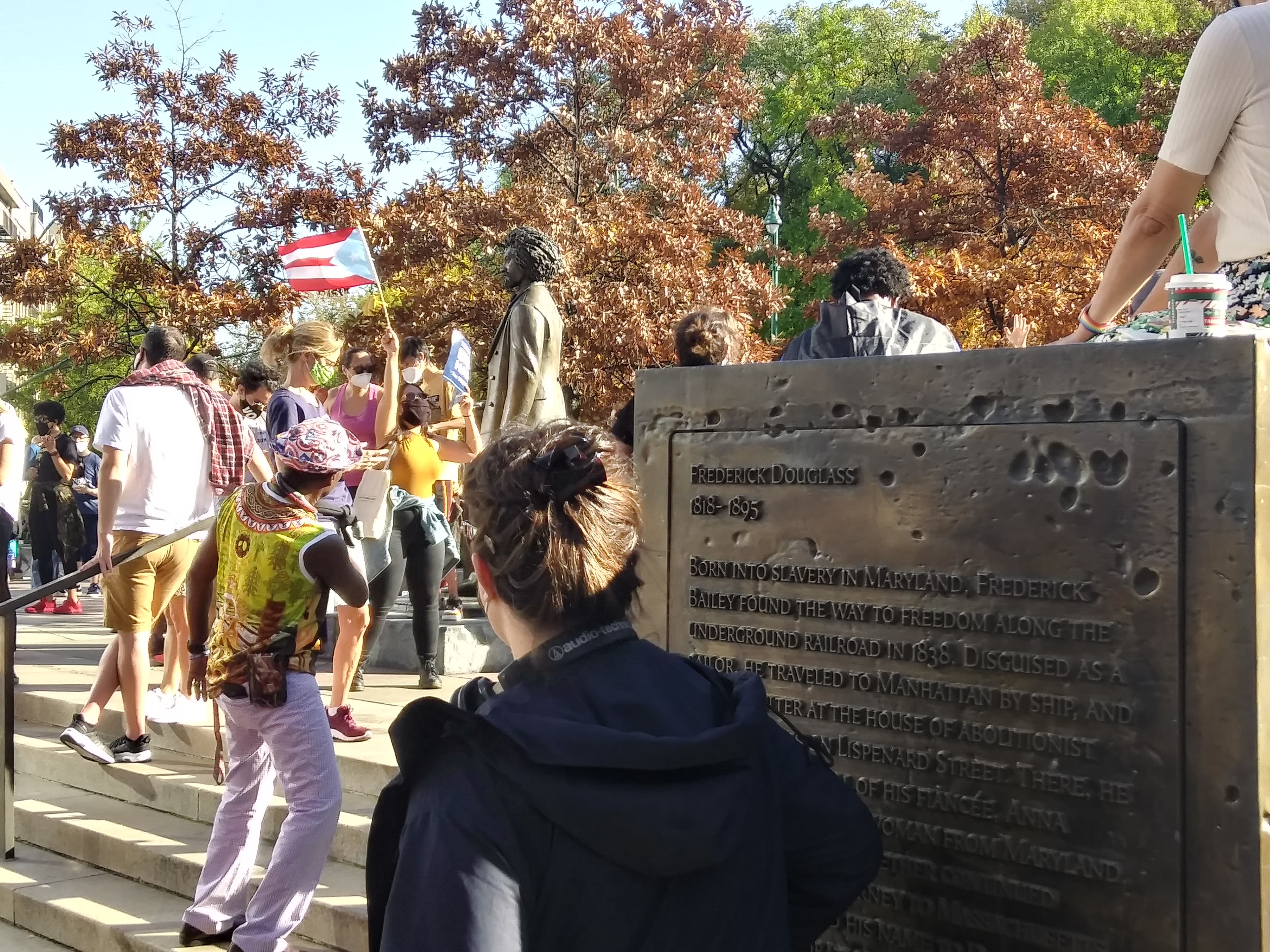
Algernon Miller: Really? Well, that’s how it was supposed to be used. There have been a lot of other rallies there too, like for Black Lives Matter and the Justice League’s silent march for justice against police brutality. There have also been many educational and cultural events in the plaza. To see people using it like that is one of the greatest rewards for having done this project. That just made my day.
Rail: When did you first become involved in the design for Frederick Douglass Circle? How did it start?
Miller: In the mid to late nineties, a series of community-based design workshops organized by Central Park Conservancy and the Cityscape Institute led to a design competition for the circle in 2003. That year, I submitted our design proposal. My mother’s Harlem Gateway Committee led a community movement to rename 110th Street “Central Park North.” “There’s a Central Park South, so why isn’t there a Central Park North?” she used to say. So she accomplished that around 1965. She was very active as a community leader, and she formed a beautification program to improve the entry to Harlem.
One day, while on a visit with my mom on Central Park North, she mentioned that she had gotten wind of something happening around the corner at the public school on 111th Street, and that perhaps I should go check it out. It paid to listen to Mom. I went to the school’s auditorium, where I saw Lowery Stokes Sims on the stage presenting a request for proposal (RFP) for Frederick Douglass Circle. There, at the first information meeting about the RFP, I ran into Gabriel Koren, a sculptor. Gabriel had previously made some iconic figurative statues of Malcolm X and Marcus Garvey, and was interested in doing one for Douglass. I asked Lowery if it was possible to partner with another artist and she said of course, so that’s when I teamed up with Gabriel. She was classically trained in her native country, Hungary, so her understanding of anatomy as a figurative sculptor was really solid. As a multidisciplinary artist with prior experience with public art and similar proposals, such as the African Burial Ground, I felt confident that I could handle the landscape part of the project, so our proposal ended up combining our backgrounds.
Rail: Can you walk me through the design?
Miller: It started with a lot of research. I went to the Midtown library one day in 2002 and took home fifteen books. There was one book, Hidden in Plain View, about Ozella Williams family’s story about quilts and the role that they played in the Underground Railroad. The book and this quilt story became the big idea, and I knew I wanted it to be central to my design scheme.
Later, I would learn that the abolitionist movement as well as the women’s suffrage movement had come together from sewing circles. Frederick Douglass himself hosted many of these sewing circles in his own home. Douglass was both an abolitionist and a women’s suffragist, of course. The women knitted and made quilts to sell and raise funds for the abolitionist movement. These women had a popular slogan that stated, “may the points of our needles prick the slave owner’s conscience.”
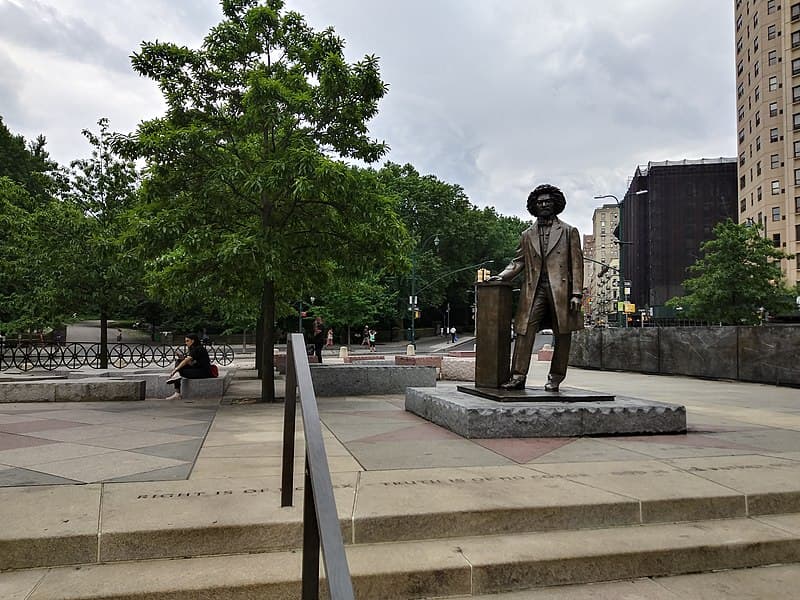
Frederick Douglass Statue, 110th St and Central Park West. Photo: Jay Dobkin.
Rail: My understanding of the quilts is that they were used to explain which areas were safe on the Underground Railroad, and there was secret information embedded in the quilts. Like a cloth attached to a signpost outside someone’s house with a certain code on it would communicate to people that it was safe to stay there.
Miller: Yeah, that’s correct. It was customary for people to publicly air out their quilts. You could say that the encoded ones functioned as signposts on the Underground Railroad. Hidden in Plain View talks about people such as the Antebellum Blacksmith, who was considered a Captain of the Underground Railroad on the plantation and had several functions. For example, it was said that striking a rhythmic code on his anvil might signal that it was time to prepare for an escape. He also might make hidden compartments in wagons, and since a good blacksmith might be sent to other plantations to work, he may have had a sense of the distances and escape routes. His character was associated with the Monkey Wrench quilt pattern as an indication of his importance. I decided to utilize the Monkey Wrench symbol on the hub of the 30 foot wagon wheel fence that delineates the inner circle of the plaza. Additionally, a bow tie patterned quilt might suggest going to the church as a safe house. One of my favorite patterns was called the Drunkards Path, which resembles a puzzle piece. That reminds me of this African proverb that suggests that straight lines are inherently evil. It also represented the path one should take when escaping the plantation, avoiding the abominable slave catchers—it was best to not travel in a straight line. Some of these patterns were designed as raised elements and set in rhythmic interplay throughout the circle at heights adjusted to accommodate seating among the in-set stones. The three-dimensional granite quilt patterns were inscribed with historical details of Douglass’s life and quotations that offered an ample opportunity for teaching moments and invited exploration of his life and his profound, enduring impact.
Then there’s a water feature to the west side of the circle. Incorporated into the bisecting wall are water elements which reflect the tides of the ocean as a transporting metaphor for the traverse of Africans to America. Douglass’s escape to New York was by way of water, and his travels to Europe too, in order to advance the abolitionist cause and raise funds for the purchase of his own official freedom. The cascading waters at the walls also convey his associations with the rivers of his youth on the eastern shores of Maryland and their subsequent role in facilitating the escape of slaves. This bronze linear fountain studded with illuminated stars—fiber optic lights—also suggests the celestial constellations that guided slaves escaping by night. This project, perhaps for the first time, was when the arts commission Percent for Art program allowed an artist to design everything. So that meant I had to sign off on all of the features, because it was all designated as art.
My early models were made of embossed metal. Then, one day while working on the project, I visited the American Folk Art Museum [by Tod Williams and Billie Tsien]. I noticed that the museum had this beautiful material on the outside, copper-bronze alloy. That day, I realized that was the material I wanted to use for the fountain, the copper-bronze, because it had a great fractal-like gaseous texture.
The fountain was a huge part of this project, and by far the most expensive single element. I have a wonderful photo of some Haitian kids playing in the fountain, which is significant because Douglass was appointed Minister to Haiti by Benjamin Harrison. I wanted the memorial to be a kind of learning space as well as a cultural destination.
Douglass Circle Election Result Celebration. Photo: Jay Dobkin.
Rail: How was your concept received?
Miller: The project and design concepts had an overwhelmingly positive response from the majority of the public. However, in the beginning, the contiguous community boards had a lot of meetings. A few people at Harlem's Community Board 10 had objections about the sculptor of Douglass [Gabriel], being white. So I had to go to bat for her by informing them that Gabriel’s friends were some of the most well-known Afrocentric activists. And she had worked on important projects like this before. This wasn’t a one-off for her. I had to go to bat for her, and defend the choice to have her as a sculptor, which if I had to do it all over again, I would, because of her consciousness. I think if Gabriel was around during the time of the abolitionists, she would have been one.
I presented the project and talked about the quilts and their importance to the design. So we got in touch with the authors of Hidden in Plain View to make sure that everything was authentic. Everything had to be vetted for authenticity. I got in touch with a member of the Williams family who told the story of the quilts. Everything had to be, and was, approved by the Arts Commission.
Well after the approval process was completed, some felt that the story about the quilts may not have actually happened. Someone from the New-York Historical Society said that the Underground Railroad quilt story was not part of the “slave narratives.” People in the blog world were like, “Frederick Douglass never saw a quilt in his life!” So we had to prove the legitimacy of Frederick Douglass’s connection with quilts. We eventually found a woman who owned a quilt block that Frederick Douglass had personally signed. She sent a photo of it to me. The particular pattern he signed was an actual north star quilt patch—coincidentally, the same granite block pattern that the Douglass statue stands on. Most likely it was sent to him to sign because the name of his newspaper was also The North Star. This clearly demonstrated Frederick Douglass’s connection with quilts. And as I mentioned earlier, the women's suffragist and abolitionist movements came together around sewing circles, where they produced quilts to raise funds for Frederick Douglass’s movement.
Dan Roche is a contributor to the Brooklyn Rail.